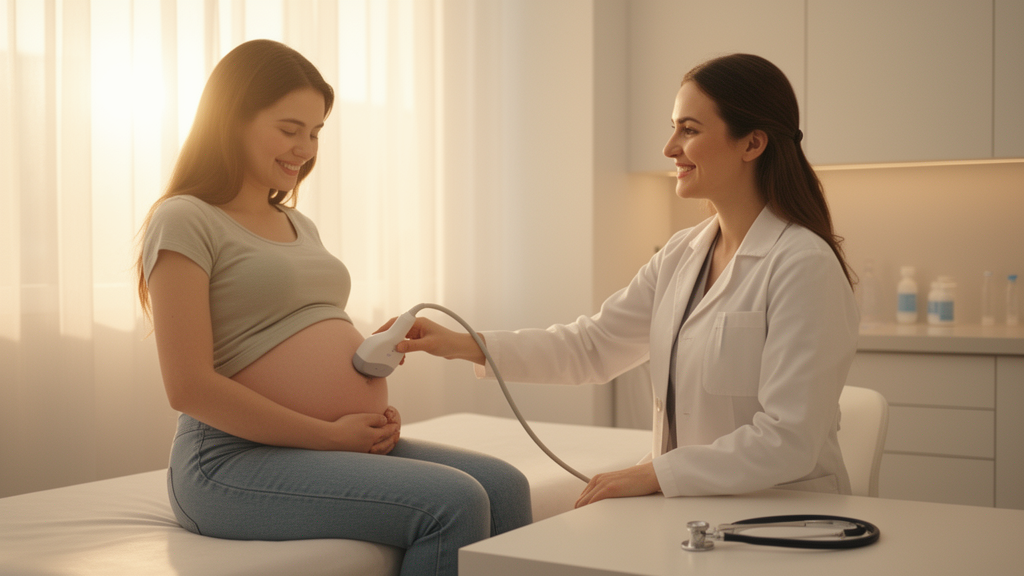
For more than a century, antenatal care has been built on a simple premise: schedule more visits as pregnancy advances, because most complications arise late. That model, introduced when the UK government rolled out universal antenatal care in 1929, helped drive maternal mortality from around 400–500 deaths per 100,000 births down to fewer than 10 per 100,000 live births by the late twentieth century. But a new Policy Forum published in PLOS Medicine argues that the architecture of pregnancy care is overdue for a structural inversion—one that shifts the centre of gravity from the third trimester to the first.
The concept, known as the ‘inverted pyramid of care’, was first articulated in 2011 by fetal medicine pioneer Kypros Nicolaides. Rather than concentrating attention on diagnosing and treating complications after they emerge, the model proposes structured risk assessment in early pregnancy, so that prevention and intensified surveillance can be targeted at women and babies at elevated risk of maternal conditions such as pre-eclampsia, intrinsic fetal problems such as chromosomal abnormalities, and uteroplacental disorders such as placenta accreta spectrum. Writing fifteen years on, Laura Magee, Peter von Dadelszen and Kypros Nicolaides of King’s College London update the concept with a detailed map of what can now be screened, when, and how accurately.
A central refinement since 2011 is the recognition that early screening may be contingent. Not every risk can be resolved at twelve weeks; instead, a first-trimester assessment can identify a sub-population who should be re-screened in mid- or late pregnancy. The authors lay out an updated schedule of optimal screening timepoints—around 12, 20 and 36 weeks—matched to the most accurate available methods for each condition, and they distinguish advances that are ready for implementation from promising technologies that are not yet policy-ready.
The logic of screening rests on well-established principles: a programme is justified only when early detection of a serious condition, using an acceptable and accurate test, produces better outcomes than usual care at acceptable cost and harm. The flagship example remains antenatal syphilis screening, associated with reductions of 97 percent in congenital syphilis, 82 percent in stillbirth, 64 percent in preterm birth and 80 percent in neonatal death. For any new test, the balance hinges on the screen-positive rate, the detection rate, and the clinical, psychological and health-system harms of false positives—a trade-off that shifts as confirmatory strategies become safer, as has happened with cell-free DNA testing.
Nowhere is that shift clearer than in the detection of fetal chromosomal abnormalities, which affect 5 to 7 in every 1,000 pregnancies. Traditional combined screening—nuchal translucency, fetal heart rate, and the blood markers PAPP-A and free beta-hCG—detects roughly 90 percent of trisomy 21 cases at a 5 percent screen-positive rate. Cell-free DNA analysis, which exploits the 10 to 15 percent of placenta-derived DNA fragments circulating in maternal plasma, pushes detection above 99 percent at a screen-positive rate below 0.1 percent. Belgium and the Netherlands now offer it universally; where cost, exceeding £200 per patient in the UK, is prohibitive, contingent screening—offering cfDNA only to those who first screen positive—still achieves 96 percent detection.
Placental dysfunction is the other great target of the inverted pyramid. Preterm pre-eclampsia is rare but carries the highest individual risks, and the widely validated Fetal Medicine Foundation competing-risks model—combining maternal characteristics with mean arterial pressure, uterine artery Doppler and placental growth factor—predicts it far more accurately and cost-effectively than clinical risk factors alone, particularly for women of Black ethnicity. Crucially, prevention follows prediction: among women identified as high risk, low-dose aspirin started before 16 weeks reduces preterm pre-eclampsia before 32 weeks by roughly 90 percent. Being screen-positive also flags half of preterm small-for-gestational-age infants and two-thirds of placental dysfunction-related stillbirths before 32 weeks, because the underlying pathophysiology is shared.
Re-screening at 20 and 36 weeks extends the strategy. At 20 weeks, combining maternal history, blood pressure, uterine artery pulsatility and estimated fetal weight detects 90 percent of pre-eclampsia and 80 percent of preterm small-for-gestational-age babies. At 36 weeks—when about 75 percent of pre-eclampsia occurs at term—maternal history, mean arterial pressure, placental growth factor and sFlt-1 detect roughly 75 percent of term pre-eclampsia, compared with just one-third using clinical risk factors. The PREVENT-PE randomised trial of 8,136 women showed that personalised, risk-stratified timed birth based on 35-to-36-week risk reduced pre-eclampsia incidence by 30 percent, with no increase in emergency Caesarean or neonatal unit admissions, and saved around £500 per case averted.
Artificial intelligence emerges as a recurring theme in the authors’ forward look. Measurement error in fetal biometry currently undermines the detection of both small- and large-for-gestational-age fetuses, and the humble symphysis-fundal height measurement—still widely recommended for its simplicity—detects poor fetal growth poorly and has not improved outcomes over clinical palpation. If the spread of measurement error were halved, almost 90 percent of fetuses at risk of being small could be detected at a screen-positive rate of just 2 percent, an improvement the authors argue AI-assisted ultrasound could deliver through automated plane recognition, standardised measurements and real-time analysis of cine loops. The International Society for Ultrasound in Obstetrics and Gynaecology frames AI as an adjunct to improve quality and access, not a replacement for expert diagnosis.
The review also identifies conditions where screening is ready now: ultrasound diagnosis of placenta accreta spectrum at the 20-week scan using at least three of five markers, contingent transvaginal ultrasound for vasa praevia—a condition whose associated stillbirths are largely preventable by elective preterm Caesarean—and mid-pregnancy cervical length screening for preterm birth risk, which matters because 85 percent of preterm births occur among women without the strongest clinical risk factors. Gestational diabetes, complicating 10 to 30 percent of pregnancies, can be predicted in the first trimester with multivariable models detecting nearly 90 percent of women who will need insulin, though the authors caution that no model yet reliably identifies who will remain disease-free.
The authors close with a broader vision: pregnancy as a window onto lifelong health. Pre-eclampsia and gestational diabetes mark elevated cardio-renal-metabolic risk, but that risk is likely driven by shared underlying factors—such as chronic hypertension—identifiable in early pregnancy. As prediction improves and the gestational ‘signal of risk’ fades, they argue, antenatal care should become a launch point for long-term maternal disease prevention. Some advances, they conclude, are ready for implementation today; others, from AI-assisted biometry to metabolomic diabetes screening, will require validation. Either way, the pyramid has been turned—and momentum, they write, continues to build for prediction, prevention, personalisation and participation in maternal and fetal care.
Subject of Research: Risk-stratified antenatal care and early pregnancy screening for maternal and fetal complications
Article Title: The inverted pyramid of care in modern-day obstetrics
Article References: Magee, L. A., von Dadelszen, P., & Nicolaides, K. H. (2026). The inverted pyramid of care in modern-day obstetrics. PLOS Medicine, 23(9), e1005255. https://doi.org/10.1371/journal.pmed.1005255
Image Credits: AI Generated
DOI: 10.1371/journal.pmed.1005255
Keywords: antenatal care, pre-eclampsia, inverted pyramid of care, cell-free DNA screening, placental dysfunction, fetal growth restriction, preterm birth, gestational diabetes, placenta accreta spectrum, artificial intelligence, ultrasound screening, maternal health
News Source: Harold Sullivan. (October 9, 2026). Flipping the Pyramid: Why Pregnancy Care Should Start in the First Trimester. Scienmag.