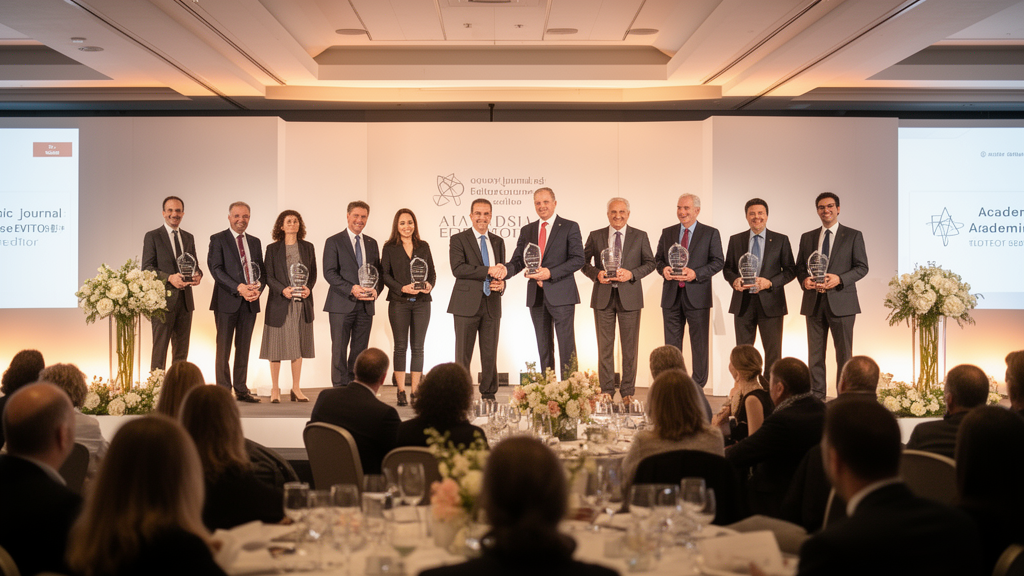
Springer Nature has announced the recipients of its 2026 Editor of Distinction Awards, and the list is dominated by a single editorial community: the team behind the Journal of Pharmaceutical Investigation. Ten editors affiliated with the journal have been recognized with the Springer Nature Editorial Contribution Award, and nine of them have also received the Springer Nature Author Service Award, a rare double recognition that underscores the depth of commitment within this particular corner of the pharmaceutical sciences publishing world.
The Editorial Contribution Award is given for what Springer Nature describes as meticulous assessment of submissions and rigorous management of the peer review process, work that safeguards the scientific accuracy of the published record. The 2026 recipients from the Journal of Pharmaceutical Investigation are Chulhun Park, Gayong Shim, Han-Joo Maeng, Hyun-Jong Cho, Jee-Heon Jeong, Jong Oh Kim, Kwangmeyung Kim, Wooram Park, Yoo Kyung Kang, and Yoon-Jee Chae. Each of these editors has been singled out for the careful, technically demanding labor that determines whether a manuscript meets the standards required before it can enter the scientific literature.
The Author Service Award, by contrast, recognizes exceptional service in improving the author experience and ensuring that peer review is efficient, constructive, and fair. Nine of the ten Editorial Contribution recipients also appear on this list: Chulhun Park, Gayong Shim, Han-Joo Maeng, Jee-Heon Jeong, Jong Oh Kim, Kwangmeyung Kim, Wooram Park, Yoo Kyung Kang, and Yoon-Jee Chae. Hyun-Jong Cho, honored for editorial contribution, does not appear among the Author Service awardees, making the overlap between the two lists nearly complete but not absolute.
In its announcement, Springer Nature framed the awards as a celebration of editors who go beyond the minimum requirements of the role. The publisher highlighted three dimensions of editorial work: developing networks for authors and peer reviewers, helping authors improve their papers, and advocating for journal communities. Editorial teams, the company noted, work tirelessly to help advance discovery, and the annual Editor of Distinction Awards exist to make that often invisible contribution visible.
To understand why such recognition matters, it helps to consider what pharmaceutical investigation research actually demands of its gatekeepers. Manuscripts in this field routinely span drug delivery systems, nanocarrier design, pharmacokinetics, formulation science, and translational therapeutics. A single submission may combine synthetic chemistry, cell-based assays, animal pharmacology, and statistical modeling. An editor responsible for such a paper must identify reviewers with genuinely relevant expertise, weigh conflicting technical assessments, and judge whether the claimed therapeutic advance is supported by the experimental design. Errors that slip through this filter can propagate into the literature and, in the worst cases, inform downstream research decisions.
Peer review in the pharmaceutical sciences also carries a distinctive burden of reproducibility. Formulation studies, for example, depend on precise details of excipient ratios, preparation methods, and characterization techniques such as dynamic light scattering, differential scanning calorimetry, and in vitro release testing. Editors who insist on complete methodological disclosure perform a service that extends far beyond the individual paper: they make it possible for other laboratories to replicate, extend, or challenge the published findings. The phrase used by Springer Nature, safeguarding the scientific accuracy of the published record, is not ceremonial in this context. It describes a concrete technical function on which the reliability of an entire subfield depends.
The second half of the recognition, the Author Service Award, addresses a different but equally consequential dimension of editorial work. Surveys across scholarly publishing consistently show that authors judge journals not only by impact metrics but by the quality and speed of the review experience. A review process that is efficient, constructive, and fair, in the language of the award citation, reduces time to publication, lowers frustration, and produces better papers. Constructive criticism from a knowledgeable editor can transform a technically sound but poorly organized manuscript into a clear, reproducible contribution, while an opaque or adversarial process can drive early-career researchers away from a journal entirely.
The concentration of awards within one journal is notable. The Journal of Pharmaceutical Investigation, published by Springer, serves a research community centered on pharmaceutical technology, drug delivery, and pharmacokinetic analysis, with a particularly strong base in South Korea, where several of the recognized editors are based at Korean universities and research institutions. That a single editorial board swept both award categories suggests an unusually cohesive team culture, in which the same individuals invest effort both in the technical scrutiny of submissions and in the mentoring and support of the authors behind them. In many journals these functions are distributed across larger boards or handled by separate editorial and production staff; here, a compact group appears to carry both burdens.
Springer Nature’s broader Editor of Distinction program spans its portfolio of thousands of journals, and the awards are presented annually to editors whose service stands out across the publisher’s editorial communities. The program’s stated rationale is that editors are the custodians of scientific quality: they select reviewers, adjudicate disagreements, enforce ethics standards, and shape the tone of scholarly discourse within their fields. Most of this work is unpaid or modestly compensated, performed by active researchers who fit editorial duties around their own laboratories, teaching, and grant obligations. Recognitions such as these are one of the few formal mechanisms by which publishers acknowledge that labor.
For the pharmaceutical research community, the message of the 2026 awards is twofold. First, the integrity of the published record in drug delivery and pharmaceutical technology is being actively defended by editors whose scrutiny of submissions and management of peer review meet the highest internal standards Springer Nature applies. Second, the author experience at the Journal of Pharmaceutical Investigation is being shaped by people who treat manuscript development as a collaborative enterprise rather than a gatekeeping exercise. As the volume of global pharmaceutical research continues to grow, and as new modalities such as mRNA therapeutics, lipid nanoparticles, and antibody-drug conjugates multiply the technical demands on reviewers, the model of editorial service represented by this year’s recipients, combining rigorous scientific assessment with genuine support for authors, offers a template for what sustainable, high-quality peer review can look like.
Subject of Research: Springer Nature's 2026 Editor of Distinction Awards recognizing editors of the Journal of Pharmaceutical Investigation for peer review and author service
Article Title: Springer Nature Editor of Distinction Awards 2026
Article References: Springer Nature Editor of Distinction Awards 2026. (n.d.). Original publication
Image Credits: AI Generated
DOI: Not provided
Keywords: Springer Nature, Editor of Distinction Awards, Journal of Pharmaceutical Investigation, peer review, editorial service, pharmaceutical sciences, scholarly publishing, author experience, scientific integrity, drug delivery research, academic awards, research publishing
News Source: Ophelia Keating. (October 9, 2026). Springer Nature Honors Standout Editors of Pharmaceutical Research Journal for 2026. Scienmag.