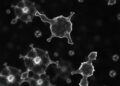
Credit: Credit: Goshtasp Cheraghian /Azad University/Iran.
A new class of materials which are suitable agents for oil displacing in enhanced oil recovery have been developed by scientists in the Energy Safety Research Institute (ESRI) at Swansea University and scientists at Islamic Azad University in Iran.
The new nanoparticle-surfactant complexes, composed of sodium dodecyl sulfate (SDS) surfactant and fumed silica nanoparticles (Si-NPs) have important applications in enhanced oil recovery (EOR). The materials are shown to improve the oil recovery by 58% compared to 45% recovery in the presence of surfactant alone.
The researchers led by Goshtasp Cheraghian and Professor Andrew R. Barron reported their find in the American Chemical Society journal Industrial & Engineering Chemistry Research.
Fabrication and testing of these materials were carried out by Goshtasp Cheraghian (Member of Young Researchers at Azad University) and Sajad Kiani, (a PhD student at the Energy Safety Research Institute at the Swansea University Bay Campus).
There, they used a 5-spot glass micromodel to evaluate the suitable agents for oil displacing in EOR. Such micromodel experiments have been used to investigate the mechanism of the fluid flow on porous mediums via flow visualization, pore space geometry, topology and heterogeneity effects, which are not possible to assess using traditional core-flood experiments.
"It is a surprise that the addition of silica nanoparticles, essentially nano-sand, to the surfactant solution leads to such a large ?ow modi?cation," said Barron, "the changes are due to an alteration of the viscosity as well as effective wettability alteration, which effects the sweeping of the oil towards the recovery point."
The results of this work support an improved insight into the role of NPs and surfactants in enhanced oil recovery and future use in EOR formulations. Barron described the multinational team as "a great example of international collaboration across boarders aimed at developing new materials for minimizing the impact of oil production through maximizing recovery."
###
Co-authors of the papers are Dr Shirin Alexander a Sêr Cymru Research Fellow at Swansea University and Dr Nashaat Nassar an Associate Professor in the Department of Chemical and Petroleum Engineering, University of Calgary, Canada. Barron is the Charles W. Duncan Jr.-Welch Professor of Chemistry and a professor of materials science and nanoengineering at Rice University (Houston USA), and the Sêr Cymru Chair of Low Carbon Energy and Environment at Swansea.
This research was carried out with support from the Robert A. Welch Foundation, the Welsh Government Sêr Cymru II Fellowship Program, and FLEXIS, which is part-funded by the European Regional Development Fund (ERDF) through the Welsh Government. Read the article at http://pubs.acs.org/doi/abs/10.1021/acs.iecr.7b01675
Images for download:
Differences of the movement of oil through the micro channels of the addition of surfactant in the presence of silica nanoparticles as compared to the surfactant alone showing how the nano-sand alters the extraction of the oil. An effective formula for EOR applications, according to the scientists at Swansea University. (Credit: Goshtasp Cheraghian /Azad University/Iran).
Notes
* For more information on ESRI go to: http://www.swansea.ac.uk/engineering/bay-campus/engineering-quarter/energy-safety-research-institute/
* Swansea University is a world-class, research-led, dual campus university. The University was established in 1920 and was the first campus university in the UK. It currently offers around 350 undergraduate courses and 350 postgraduate courses to circa 20,000 undergraduate and postgraduate students.
The University's 46-acre Singleton Park Campus is located in beautiful parkland with views across Swansea Bay. The University's 65-acre science and innovation Bay Campus, which opened in September 2015, is located a few miles away on the eastern approach to the city. It has the distinction of having direct access to a beach and its own seafront promenade. Both campuses are close to the Gower Peninsula, the UK's first Area of Outstanding Natural Beauty.
Swansea is ranked the top university in Wales and is currently The Times and The Sunday Times 'Welsh University of the Year'. It is also ranked within the top 350 best universities in the world in the Times Higher Education World University rankings.
The results of the Research Excellence Framework (REF) 2014 showed the University has achieved its ambition to be a top 30 research University, soaring up the league table to 26th in the UK, with the 'biggest leap among research-intensive institutions' (Times Higher Education, December 2014) in the UK.
The University has ambitious expansion plans as it moves towards its centenary in 2020, as it continues to extend its global reach and realising its domestic and international ambitions.
Swansea University is a registered charity. No.1138342. Visit http://www.swansea.ac.uk
Media Contact
Janis Pickwick
[email protected]
01-792-295-050
@swanseauni
http://www.swansea.ac.uk/
Original Source
http://www.swansea.ac.uk/media-centre/latest-research/newmaterialsdiscoveredbyswanseauniversityandislamicazaduniversityscientistshaveimportantapplicationsinenhancedoilrecovery.php http://dx.doi.org/10.1021/acs.iecr.7b01675