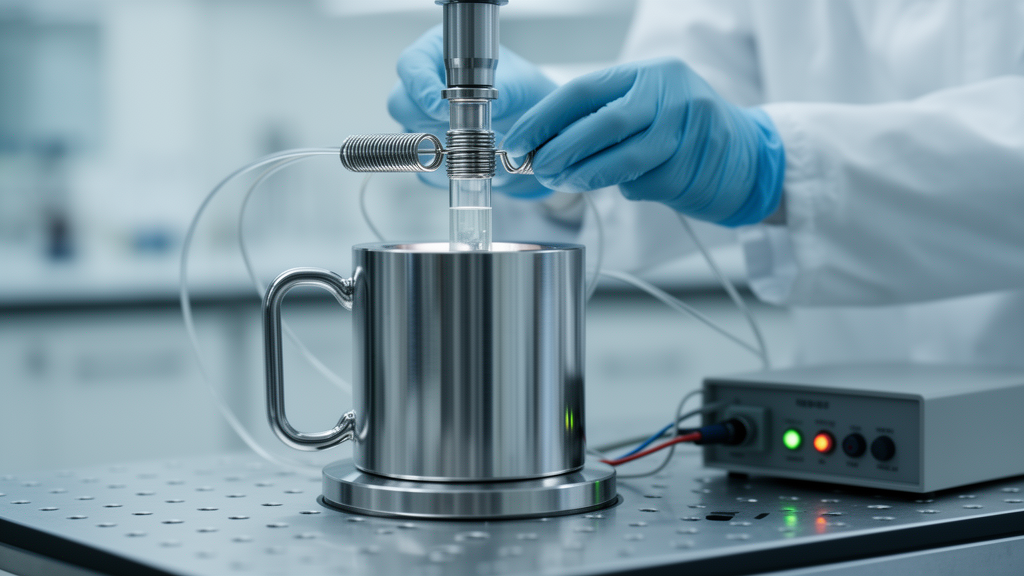
Nuclear magnetic resonance has long been a science of giants: superconducting magnets cooled by liquid helium, filling entire rooms and costing millions of dollars. But a new study from researchers at the École Normale Supérieure in Paris suggests that some of the most delicate quantum tricks in NMR do not require such behemoths at all. Writing in the journal Magnetic Resonance, Sebastiaan Van Dyck, Coline Wiame, Kirill F. Sheberstov and Geoffrey Bodenhausen report that long-lived nuclear spin states, exotic configurations of protons that can persist far longer than ordinary magnetization, can be excited and observed on a compact benchtop spectrometer operating at just 1.4 tesla, roughly the field strength of a large refrigerator magnet. The finding could bring a powerful class of experiments out of specialized laboratories and onto the lab bench.
Long-lived states, or LLSs, were first described more than two decades ago as nuclear spin arrangements whose lifetimes exceed the longitudinal relaxation time T1, the timescale on which ordinary magnetization fades. In the simplest case of two protons, the state takes the form of a population imbalance between the symmetric triplet states and the antisymmetric singlet state. Because this imbalance is immune to the dominant relaxation mechanism, the dipole-dipole coupling between the two protons, it decays far more slowly than conventional signals. That extended memory makes LLSs attractive for tracking slow molecular motions, measuring tiny diffusion coefficients, and, in combination with hyperpolarization techniques, sustaining magnetization in biomedical imaging applications.
The Paris team focused on a particularly subtle variant: delocalized long-lived states spread across four protons in short aliphatic chains, the two adjacent methylene groups found in molecules such as ethanolamine, lysine, vitamin B1, metronidazole and phenoxyethylamine. In these achiral molecules, the two protons within each methylene group are chemically equivalent, but the pairs can be magnetically inequivalent because the vicinal couplings linking neighboring groups differ slightly. That inequivalence, which arises from unequal populations of rotamers produced by rotation about the carbon-carbon bond, is the key that unlocks excitation of a state delocalized across both proton pairs.
To create these states, the researchers used spin-lock-induced crossing, or SLIC, a technique in which a selective radiofrequency field is applied at a precisely chosen amplitude to drive the spin system through a level anti-crossing. At high magnetic fields, such as the 11.7 tesla of a conventional 500 MHz spectrometer, the recipe is well established: the radiofrequency amplitude must match twice the averaged intrapair coupling, and the pulse duration must be tuned to the difference between vicinal couplings. A T00 filter then strips away everything except the singlet order, and a second SLIC pulse converts the stored imbalance back into observable magnetization.
At low fields, however, the physics changes dramatically. Chemical shift differences shrink in proportion to the magnetic field, so at 1.4 tesla the two methylene groups of an aliphatic chain become strongly coupled, forming what spectroscopists call an AA’BB’ system rather than the weakly coupled AA’XX’ system seen at high field. The full, untruncated J-coupling Hamiltonian must be considered, and the selective radiofrequency pulse applied to one pair inevitably perturbs its neighbor through second-order effects. Simulations performed with the Spin Dynamica package revealed a troubling consequence: a blind spot where excitation fails almost completely when the chemical shift difference between the pairs approaches three times the SLIC amplitude.
The simulations also pointed the way out. For a typical four-spin system with a chemical shift difference of 52 hertz, simply importing the high-field parameters dropped the LLS yield to about 35 percent of its maximum. Re-optimizing the pulse amplitude and, crucially, the duration, which had to be stretched by more than 80 percent, restored the yield to roughly 80 percent, an enhancement factor of about 2.3. Experimentally, the team found that re-optimization at low field improved yields by up to a factor of 3.6 for molecules whose methylene signals sit close together, while for lysine and phenoxyethylamine, where the shift differences remain above 60 hertz even at low field, the high-field conditions worked unchanged.
Five molecules were studied in total, dissolved in deuterated water at concentrations between 50 and 250 millimolar, with phenoxyethylamine in deuterated methanol. For metronidazole and phenoxyethylamine, the long-lived states are reported for the first time. The measurements were carried out on a 60 MHz Magritek benchtop instrument and a 500 MHz Bruker NEO spectrometer, using the same samples, solvents, concentrations and temperatures at both fields, allowing a direct comparison of relaxation behavior across a nearly ninefold difference in field strength.
The comparison yielded a striking result: the advantage of long-lived states survives the drop to benchtop conditions. At high field, the ratio of the LLS lifetime to T1 ranged from 3.0 to 4.2 for all molecules except vitamin B1, which showed an exceptional gain of 7.6. At low field, the ratios spanned 3.0 to 6.8, with only lysine showing a modest gain of 1.6. For ethanolamine, the enhancement was actually 17 percent better at low field than at high field. In other words, the extended spin memory that makes LLSs valuable is not a privilege of giant superconducting magnets.
The authors caution that the two-way conversion efficiency of SLIC remains on the order of only 10 percent, and the low intrinsic sensitivity of a 1.4 tesla magnet forced them to use relatively concentrated solutions. They note that combining low-field SLIC with dynamic nuclear polarization, a hyperpolarization technique that can boost signals by orders of magnitude, is a natural next step, and one that several of the same laboratories have already pursued with bullet-DNP transfer of hyperpolarized samples. Such a combination could make long-lived-state experiments practical on truly compact hardware.
The broader significance lies in democratization. Benchtop spectrometers are already common in industrial quality control, teaching laboratories and flow chemistry setups, precisely because they need no cryogens and minimal maintenance. If long-lived spin order can be reliably excited, stored and read out on such instruments, applications ranging from monitoring slow molecular dynamics to hyperpolarized assays could migrate from a handful of specialist labs to a much wider community. The Paris group’s demonstration that strong coupling, once seen as an obstacle at low field, can be tamed by simply retuning a pulse, turns a limitation into a design rule, and brings the quantum memory of nuclear spins one step closer to the everyday laboratory bench.
Subject of Research: Excitation of delocalized long-lived proton spin states in aliphatic molecules at low and high magnetic fields
Article Title: Excitation of delocalized long-lived states of aliphatic protons at low and high magnetic fields
Article References: Van Dyck, S., Wiame, C., Sheberstov, K. F., & Bodenhausen, G. (2026). Excitation of delocalized long-lived states of aliphatic protons at low and high magnetic fields. Magnetic Resonance, 7(1), 81-88. https://doi.org/10.5194/mr-7-81-2026
Image Credits: AI Generated
DOI: 10.5194/mr-7-81-2026
Keywords: long-lived states, NMR spectroscopy, benchtop spectrometers, spin-lock-induced crossing, aliphatic protons, strong coupling, relaxation, magnetic resonance, singlet order, low-field NMR, hyperpolarization, J-coupling
News Source: Bethany Barker. (October 9, 2026). Tiny Benchtop Magnets Can Now Trap Long-Lived Nuclear Spin States, Chemists Show. Scienmag.