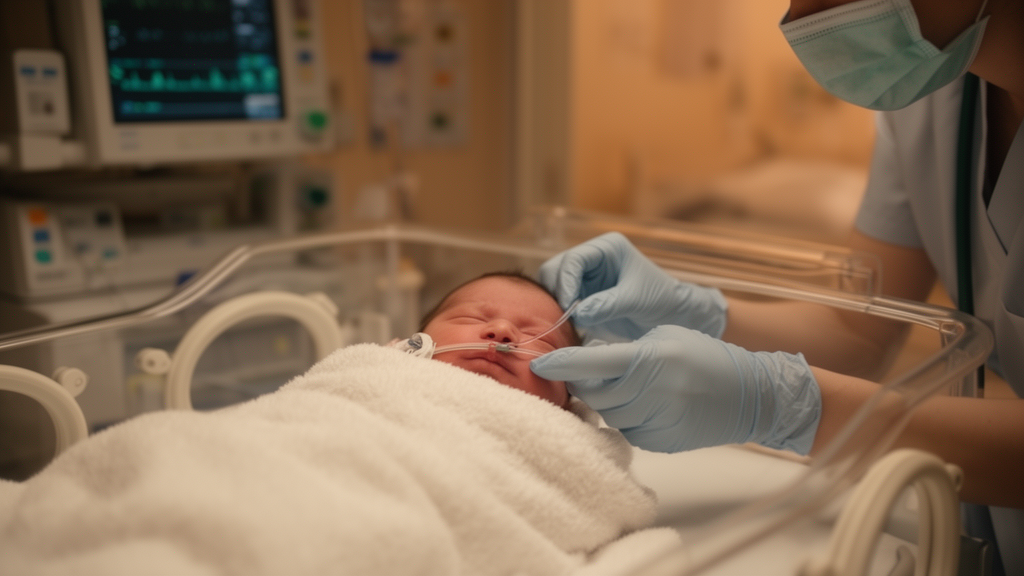
Every day in neonatal intensive care units around the world, clinicians slide a laryngoscope into the mouths of the smallest and most fragile patients to place a breathing tube or deliver surfactant to their underdeveloped lungs. The procedure, known as laryngoscopy, is brief but notoriously stressful and painful, triggering surges of stress hormones, swings in blood pressure and oxygen levels, and potential long-term consequences for a developing brain. International guidelines have long recommended that newborns receive premedication, drugs given before the procedure to blunt pain and distress, whenever time allows. Yet a new nationwide study from Belgium, published in BMC Pediatrics, reveals that in real-world practice a striking proportion of these procedures are still performed with no premedication at all, even when there is no life-threatening emergency to justify skipping it.
The research, led by Sophie Tribolet and Vincent Rigo of the neonatology division at University Hospital of Liège, together with a large team of collaborators across the country, drew on data from the SUPREMEneo prospective cohort. In June 2024, the investigators captured every laryngoscopy performed in all 19 neonatal intensive care units in Belgium, making it an exhaustive national snapshot rather than a sample from a handful of willing centers. The analysis focused on 142 laryngoscopies: 91 were performed to intubate newborns for mechanical ventilation, and 51 were performed to administer surfactant through a less invasive technique known as LISA, or less invasive surfactant administration, which has become the preferred approach for many preterm infants with respiratory distress syndrome. Fourteen of the intubations occurred in immediate life-threatening situations, where speed understandably takes precedence over comfort.
The headline numbers are sobering. Premedication was given before 56 of 77 non-emergency intubations, a rate of 73 percent, and before 35 of 51 LISA procedures, a rate of 69 percent. In other words, roughly three in ten elective, non-urgent laryngoscopies were carried out on unsedated newborns. The study also identified exactly where and when the practice falters. Premedication was significantly less likely when intubation was urgent, defined as needing to happen within ten minutes, and when the procedure took place in the delivery room rather than in the neonatal unit. For LISA procedures, no such delivery room penalty appeared, suggesting that the gap is not simply about location but about the perceived urgency and logistics surrounding intubation specifically.
Who performs the procedure also matters, in ways that differ between the two types of laryngoscopy. For LISA, premedication rates varied according to the operator’s professional status and their previous laryngoscopy experience, with statistical significance at p equal to 0.04 and 0.05 respectively. For intubation, the rates differed according to whether the operator had previously performed a successful laryngoscopy, at p equal to 0.01, but not according to operator status. These patterns hint at a cultural and educational dimension: clinicians who are more experienced, or more confident, may be more comfortable taking the extra minutes needed to sedate a baby, while those under pressure or in training may default to proceeding without drugs.
The pharmacology itself revealed remarkable heterogeneity. There was no single standard regimen across the country. The most commonly used drug was propofol, a short-acting anesthetic agent that provides rapid sedation but requires careful monitoring of blood pressure and breathing. Atropine, a drug given to protect against the slowing of heart rate that laryngoscopy can provoke, was administered before 37 of 128 non-life-threatening procedures, or 29 percent. Interestingly, atropine was given far more frequently in combination with fentanyl, an opioid, with or without a muscle relaxant, than alongside propofol, a difference that was highly statistically significant. This split reflects two competing philosophies of neonatal premedication: one favoring anesthetic agents with predictable short duration, the other favoring analgesia-based combinations with cardiovascular protection.
Perhaps the most actionable finding concerned protocols. Units that had a specific written premedication protocol behaved very differently from those without one. In units without protocols, 70 percent of non-emergency intubations and a staggering 90 percent of LISA procedures went ahead without premedication. In units with protocols, those figures fell to 24 percent and 53 percent respectively, differences that were statistically significant. The message is blunt: simply having a protocol, even before considering what it says, dramatically changes behavior. Standardization appears to convert premedication from an individual judgment call, vulnerable to habit and time pressure, into a default practice that clinicians must actively decide to bypass.
The researchers also asked clinicians why they skipped premedication, and the answers paint a nuanced picture. In 24 percent of unsedated laryngoscopies, the stated reason was the perception that the infant was comfortable or did not need it, a judgment that the authors implicitly challenge given the well-documented physiological stress response to laryngoscopy. Lack of venous access accounted for 19 percent of cases, a genuine practical obstacle in tiny premature infants whose veins are difficult to cannulate, though it raises questions about whether alternative routes or timing of line placement could help. Unit protocol was cited in 16 percent of cases, implying that some existing protocols may themselves be inadequate or permissive of omission, and personal habits accounted for 11 percent, an admission that routine rather than reasoning drives some decisions.
The context for these findings is a decade-long international debate. The American Academy of Pediatrics and the Canadian Paediatric Society both recommend premedication before elective neonatal intubation, and the French Neonatology Society has issued similar guidance. Yet audits in multiple countries have repeatedly shown that adherence lags far behind the recommendations. Part of the hesitation stems from legitimate clinical concerns: premedication drugs can cause hypotension, prolong the procedure if the baby becomes too sedated, and in the case of muscle relaxants, leave the infant apneic and dependent on the operator’s skill to secure the airway quickly. In units where operators have variable experience, these risks can feel more immediate than the longer-term harms of pain. The Belgian data showing that operator experience correlates with premedication rates suggests these concerns are being weighed differently by different hands at the bedside.
The stakes extend beyond the moment of discomfort. Repeated painful procedures in the neonatal period have been associated in longitudinal research with altered pain processing, differences in brain development, and poorer neurodevelopmental outcomes, although the evidence base for the benefits of any specific premedication regimen remains incomplete, which is itself part of why practice varies so widely. LISA, which avoids intubation and mechanical ventilation in many preterm infants, was developed partly to reduce procedural burden, but it still requires the same laryngoscopy to visualize the glottis and pass a thin catheter, so the pain problem does not disappear with the gentler technique. The Belgian study’s finding that 90 percent of LISA procedures in protocol-less units were done without premedication indicates that the shift toward less invasive surfactant delivery has not automatically carried analgesia with it.
The authors conclude that substantial inter-center variability persists, and that the development and implementation of premedication protocols may improve compliance and ultimately enhance the quality and safety of laryngoscopies in newborns. Because the study captured every NICU in a single country over a defined month, it offers an unusually complete picture of the gap between guideline and bedside, and its protocol findings provide a concrete lever for change: units seeking to improve need not wait for new drugs or new evidence, but can start by writing down, agreeing on, and enforcing a standard approach. For the smallest patients, who cannot advocate for themselves and whose pain is easy to underestimate, that administrative act may be one of the simplest available protections.
Subject of Research: Premedication practices before neonatal laryngoscopy in neonatal intensive care units
Article Title: Premedication practices prior to neonatal laryngoscopy: a nationwide observational study in Belgian NICUs
Article References: Tribolet, S., Legros, L., Laval, N., Derriks, F., Naessens, P., Debuf, M.-J., Van Poucke, J., Godart, V., Guevorkian, D., Schögler, A., Perceval, C., Ceulemans, L., Reibel, R., Plaskie, K., Debeer, A., Hocq, C., Rohaert, C., Avino, D., De Buyst, J., … Tauzin, M. (2026). Premedication practices prior to neonatal laryngoscopy: a nationwide observational study in Belgian NICUs. BMC Pediatrics. https://doi.org/10.1186/s12887-026-07813-3
Image Credits: AI Generated
DOI: 10.1186/s12887-026-07813-3
Keywords: neonatology, laryngoscopy, premedication, intubation, LISA, surfactant, NICU, propofol, pain management, preterm infants, clinical protocols, Belgium
News Source: Harold Sullivan. (October 9, 2026). Many Newborns Still Undergo Intubation Without Pain Relief, Belgian Study Finds. Scienmag.