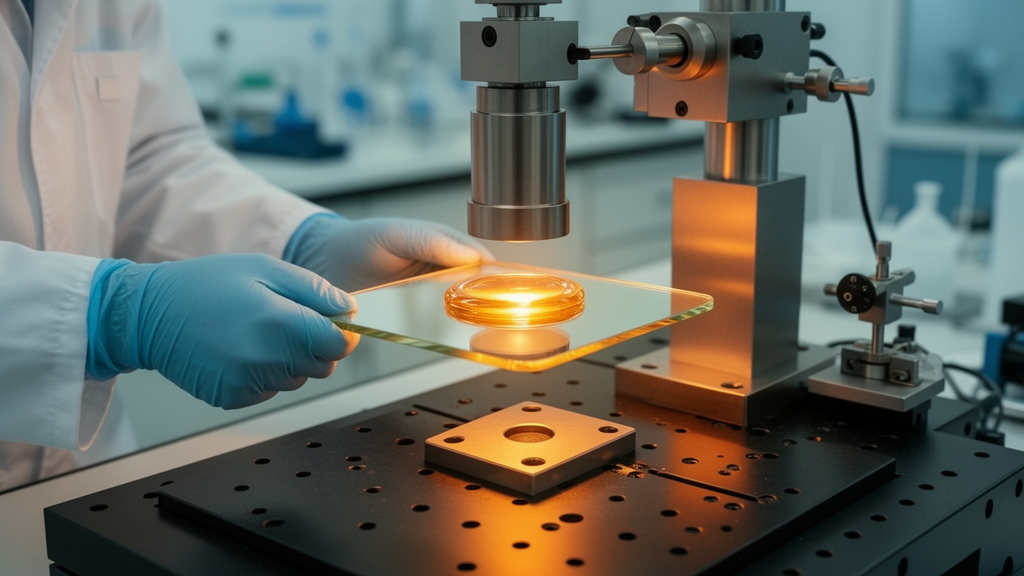
Magnetorheological polishing has long promised a way to finish delicate optical and precision components without scratching them, but the technique has always faced a stubborn constraint: the magnetic field itself. Now, a team of mechanical engineers in China has built an adjustable electromagnetic device that lets operators dial in the magnetic field in real time, and their experiments show just how much that control matters. By systematically varying the excitation current and the working gap between the magnet and the workpiece, the researchers drove the surface roughness of K9 optical glass specimens down from roughly 325 nanometers to as low as 41 nanometers, an improvement of nearly eightfold, in polishing runs lasting under an hour.
The study, published in the journal Mechanical Sciences, was led by Rensheng Wang of the School of Mechanical Engineering at the Liaoning Institute of Science and Technology in Benxi, together with colleagues Dongming Liang and Xiangna Kong and, from Yingkou Guangyu Casting, Qi Wang. Their focus was reciprocating magnetorheological polishing, or RMRP, a variant of the broader family of magnetorheological finishing techniques in which a magnetic field transforms a slurry of ferromagnetic particles and abrasive grit into a compliant, self-shaping polishing tool. The team’s central question was deceptively simple: how exactly do the two adjustable parameters of an electromagnet, the current flowing through its coil and the distance between the pole and the workpiece, shape the polishing outcome?
To understand why that question matters, it helps to look at what happens inside the polishing fluid. Magnetorheological polishing fluids typically blend four ingredients: ferromagnetic particles, polishing abrasives, a stabilizer, and a base fluid. When no field is present, the mixture flows like a liquid. Apply a magnetic field, however, and the ferromagnetic particles snap into ordered chains aligned with the magnetic induction lines, clamping the abrasive grains between them. The result is what researchers describe as a flexible magnetic polishing brush, a Bingham-type plastic medium that presses against the workpiece surface and shears away microscopic peaks of material. The strength of those chains, and therefore the force the brush can exert, depends directly on the magnetic induction intensity in the polishing zone. Too weak a field and the chains never form; too strong a field and the brush stiffens into something closer to a fixed abrasive, risking surface damage.
Traditional magnetorheological setups have relied largely on permanent magnets, often arranged in yokes or arrays, to generate the field. Permanent magnet yokes can deliver respectable induction intensities through the leakage magnetic principle, but their processing area is limited, which makes them poorly suited to large workpieces, and their field strength cannot be adjusted during operation. Multi-magnet arrangements and Halbach arrays can widen the magnetic path coverage, but adding poles inflates the size of the field-generating device and complicates the spatial layout of the polishing equipment. The Liaoning team’s answer was a dynamic, single-pole electromagnet built around a cylindrical core of DT4 electrical pure iron, a soft magnetic material chosen for its high relative permeability and low coercivity, meaning it magnetizes and demagnetizes easily. The core measures 26 millimeters in diameter and 70 millimeters in height, and it sits inside a non-magnetic engineering plastic coil skeleton wound with an excitation coil of 1.2 millimeter wire and 2,200 turns, connected to an external DC power supply.
The reciprocating concept is the other half of the design. Rather than sweeping the workpiece or the tool across a static field, the RMRP method moves the magnetic field itself back and forth across the specimen. The polishing brush formed in the fluid moves synchronously with the field, so a single pole can achieve full-area machining of a large specimen simply by changing position. Because the brush applies a consistent polishing force wherever it travels, the process tends toward uniform material removal. The moving field also continuously refreshes the magnetorheological fluid in the polishing region, drawing in new abrasive-laden fluid and carrying away debris, which the authors identify as essential to reliable machining quality. Structurally, the device is simple: one electromagnet, one coil, one power supply.
With the hardware defined, the team turned to simulation. Because the device is axisymmetric, they used ANSYS software to run two-dimensional magnetostatic field simulations, mapping the magnitude and spatial distribution of magnetic induction intensity across the polishing area. Two variables were swept: excitation current from 1 to 5 amperes in 1 ampere steps, and working gap from 0.25 to 1.5 millimeters in 0.25 millimeter steps. The ranges were chosen deliberately. Push the current too high and the coil overheats; open the gap too wide and the field decays below the threshold needed for material removal. The simulations showed that magnetic induction intensity in the polishing area rises with excitation current and falls as the working gap widens, exactly as Ampere’s circuital law and basic magnetic circuit reasoning predict. A narrower gap slashes the air-gap reluctance, boosting magnetic flux and, with a constant cross-sectional area, raising the induction intensity.
The spatial pattern proved equally important. At any fixed current or gap, the induction intensity across the polishing area follows a non-monotonic profile, rising to a peak and then declining as radial distance from the pole axis increases. The simulated induction lines form symmetrical closed loops around the electromagnet’s centerline, producing a petal-like structure because the magnetic circuit preferentially routes through fluid regions of higher relative permeability. To check the simulations against reality, the researchers applied an excitation current of 2.4 amperes and measured the field at eight points spaced 3 millimeters apart along the pole surface using a Gauss meter with its probe pressed against the core. The measured values tracked the simulated ones, increasing and then decreasing along the radial path, with discrepancies within 12.4 percent, a level of agreement the authors say validates the simulation approach.
The polishing experiments then translated field behavior into surface quality. The workpieces were discs of K9 optical glass, a borosilicate material prized for uniform light transmittance and stable physicochemical properties, widely used in optoelectronic systems, microwave components, and precision optics. Each specimen measured 30 millimeters in diameter and 8 millimeters thick, with initial roughness between 320 and 340 nanometers. During polishing, the specimen rotated at 300 revolutions per minute while an eccentric wheel ran at 20 revolutions per minute, with a 45-minute process time. Each parameter combination was tested three times, and the team applied standard deviation analysis and one-way ANOVA to confirm that variations in current and gap had statistically significant effects on both surface roughness and material removal rate, with P values below 0.05.
The current experiments revealed a trade-off. Material removal rate climbed steadily with excitation current, because stronger fields produce stronger magnetic chains and a firmer grip on the abrasives. But surface roughness did not follow the same monotonic path: between 4 and 5 amperes, roughness actually worsened slightly. The explanation lies in shear yield strength. At higher currents the polishing brush stiffens, constraining the abrasives so they behave more like fixed grit, which speeds machining but increases the risk of scratching the surface. The sweet spot came at 4 amperes, where roughness dropped from 327 nanometers to 42 nanometers. The gap experiments mirrored the pattern from the other direction. Material removal rate fell as the gap widened and the field weakened, while roughness first improved and then degraded, since a very narrow gap produces an overly stiff brush and a very wide gap produces too little removal. At the optimum gap of 0.75 millimeters, roughness fell from 322 to 41 nanometers. Microscopy confirmed the transformation: polished surfaces emerged flat, smooth, and uniform compared with their pre-polish state.
What distinguishes the work, the authors argue, is the combination of wide magnetic coverage, high and adjustable induction intensity, and continuous fluid renewal in a compact package. For manufacturers of large optical components, the practical message is that the two knobs of an electromagnet are not interchangeable levers. The working gap, the simulations showed, is actually more sensitive a control on field strength than the excitation current, so precision gap setting deserves as much attention as the power supply dial. As demand grows for ultra-smooth surfaces on lenses, wafers, and complex-geometry components, the study offers a quantitative roadmap: keep the field strong enough to build the brush, soft enough to spare the surface, and moving enough to keep fresh abrasive flowing across every square millimeter of the work.
Subject of Research: Influence of excitation current and working gap on magnetic field performance and surface finish in reciprocating magnetorheological polishing
Article Title: Analysis of the influence of magnetic field on polishing results in reciprocating magnetorheological polishing
Article References: Wang, R., Liang, D., Kong, X., & Wang, Q. (2026). Analysis of the influence of magnetic field on polishing results in reciprocating magnetorheological polishing. Mechanical Sciences, 17(2), 873-881. https://doi.org/10.5194/ms-17-873-2026
Image Credits: AI Generated
Keywords: magnetorheological polishing, RMRP, magnetic field device, excitation current, working gap, surface roughness, K9 optical glass, electromagnet, ultra-precision machining, magnetic induction intensity, material removal rate, optics fabrication
News Source: Denise Maddox. (October 9, 2026). Magnetic Field Tuning Slashes Glass Surface Roughness to Nanometer Scale. Scienmag.