When a patient arrives in an intensive care unit with strokes scattered across multiple territories of the brain and oxygen levels that no one can explain, clinicians usually suspect the obvious culprits: a pulmonary embolism, a shunt in the lungs, or a severe respiratory infection. In a case reported in Intensive Care Medicine by a team from the Medical Intensive Care Unit of CHU de Bordeaux in France, the answer turned out to be stranger than almost anyone would have guessed. The patient’s profound oxygen deprivation, which worsened dramatically whenever the patient sat up, was ultimately traced to a nineteen-centimetre fluid-filled cyst in the liver that was physically squeezing the heart out of shape, redirecting blood through a small hole between the upper chambers that had been silently present since birth.
The clinical picture was alarming from the outset. Magnetic resonance imaging of the brain revealed an acute infarct, an area of dead tissue caused by interrupted blood supply, in the territory of the right anterior cerebral artery. Twenty-four hours later, a follow-up diffusion-weighted scan showed a second, fresh infarct, this time in the cerebellum, a completely different vascular territory supplied by a different arterial system. Strokes appearing in multiple discrete vascular territories within such a short window strongly suggested an embolic mechanism, meaning that material, most likely clots or debris, was travelling through the bloodstream and lodging in successive downstream destinations. Yet the accompanying hypoxaemia, the abnormally low oxygen content of the arterial blood, could not be accounted for by any lung pathology visible on imaging.
The first diagnostic breakthrough came from recognising a peculiar pattern: the patient’s oxygenation depended on posture. Objective measurements confirmed what the team suspected. While lying supine and receiving five litres per minute of supplemental oxygen, the patient’s arterial partial pressure of oxygen was 75.8 millimetres of mercury, with an oxygen saturation of 96.5 percent, values that are abnormal but not catastrophic. When the patient was seated upright, however, despite a much higher oxygen flow of fifteen litres per minute, the partial pressure of oxygen collapsed to 56.3 millimetres of mercury and the saturation fell to 87 percent. This phenomenon, in which hypoxaemia worsens in the upright position, is known as orthodeoxia, and when it is accompanied by breathlessness on sitting it forms part of a rare entity called platypnoea-orthodeoxia syndrome.
Orthodeoxia is a physiological fingerprint that points towards a very specific mechanism. In the upright position, gravity redistributes venous blood, and if there is a communication between the right and left sides of the heart, blood can be shunted from the venous circulation directly into the arterial circulation, bypassing the lungs entirely. Unoxygenated venous blood then mixes with oxygenated blood, and the arterial oxygen level falls. The classic anatomical substrate for this is a patent foramen ovale, a flap-like opening between the right and left atria that is present in every foetus, normally seals after birth, and persists in roughly a quarter of adults. In most people it remains closed because left atrial pressure slightly exceeds right atrial pressure, keeping the flap pressed shut.
Transoesophageal echocardiography provided the definitive evidence. The imaging showed an atrial septal aneurysm, a redundant and mobile portion of the wall separating the two atria, a finding known to be associated with patent foramen ovale and with embolic risk. The clinicians then performed a contrast study, injecting agitated saline into a vein so that the microbubbles opacify the right atrium. With the patient lying flat, only a minimal number of microbubbles crossed into the left atrium. But when the manoeuvre was repeated with the patient in a raised position, more than twenty microbubbles appeared in the left atrium within three cardiac cycles. That dramatic positional difference confirmed a large, position-dependent right-to-left intracardiac shunt, and it explained the orthodeoxia precisely. Notably, there was no echocardiographic evidence of pulmonary hypertension, which is the usual driving force behind significant right-to-left shunting.
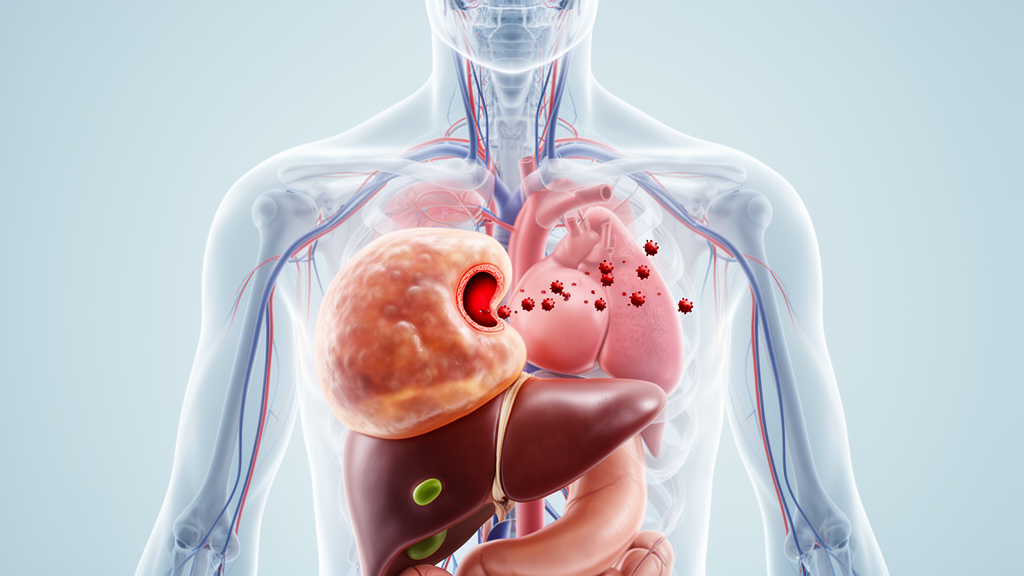
This absence of pulmonary hypertension was the central puzzle. Why would blood flow from the right atrium to the left atrium at normal pressures? The answer emerged from a coronal thoracoabdominal computed tomography scan, which excluded pulmonary embolism and pulmonary arteriovenous malformations but revealed a simple hepatic cyst measuring nineteen centimetres. The cyst was compressing and displacing the right-sided cardiac chambers so severely that it likely altered the spatial relationship between the inferior vena cava, the right atrium and the interatrial septum. In effect, the giant cyst acted as an internal anatomical wedge, redirecting the stream of venous blood returning from the lower body so that it was aimed directly at the patent foramen ovale. When the patient sat upright, gravity and the distorted anatomy conspired to drive a torrent of venous blood through the flap and into the arterial circulation.
The therapeutic sequence that followed provided a striking natural experiment that confirmed the haemodynamic relevance of the shunt. Percutaneous drainage of the cyst yielded three and a half litres of fluid, and within hours the patient no longer required any supplemental oxygen. Five days later, as the cyst reaccumulated, the hypoxaemia returned in full. The team then closed the patent foramen ovale percutaneously, deploying a device across the interatrial communication, and the patient achieved complete oxygen independence within two hours. This reversible chain of events, cyst decompression restoring normal oxygenation, cyst recurrence abolishing it, and shunt closure curing it permanently, is about as close to a proof of causation as clinical medicine can offer without a randomised trial.
The cerebral infarcts, however, remain a more cautious story. The authors of the report are careful to distinguish between what was proven and what was merely plausible. The multiterritorial pattern of the strokes suggested an embolic mechanism, and paradoxical embolism, in which a venous thrombus crosses through a right-to-left shunt and enters the arterial circulation, was considered credible. Yet no venous thrombosis was ever identified, so the embolic source remains unconfirmed. The team also monitored the patient with continuous telemetry for seven days and detected no atrial fibrillation, but they acknowledge that this duration cannot exclude occult paroxysmal atrial fibrillation, a rhythm disturbance that is a well-known cause of embolic stroke and can evade even days of monitoring. In other words, the patent foramen ovale clearly explained the positional hypoxaemia, whereas its causal role in the cerebral infarcts remains uncertain, an honest nuance that is often lost when such cases are retold.
The practical lessons for intensivists are the reason this case was published as an imaging teaching exercise. Severe hypoxaemia that is disproportionate to the findings on pulmonary imaging, particularly when it is posture-dependent, should prompt contrast echocardiography performed in both supine and raised positions, because a shunt that is trivial when a patient lies flat can become massive when the patient is upright. The case also demonstrates that a large right-to-left shunt can occur in the complete absence of pulmonary hypertension when extracardiac anatomical distortion, here a giant hepatic cyst, redirects venous flow towards the interatrial septum. For readers outside medicine, the story is a vivid reminder that the body is a mechanical system as much as a chemical one: a fluid-filled sac the size of a melon, growing quietly inside the abdomen, can reshape the geometry of the beating heart, open a door that evolution intended to close, and send unoxygenated blood and possibly emboli streaming into the arteries of the brain. Diagnosing it required nothing more exotic than a bubble study performed twice, in two different positions, and the willingness to ask why a patient’s oxygen levels changed simply by sitting up.
Subject of Research: Position-dependent right-to-left intracardiac shunting through a patent foramen ovale caused by extracardiac anatomical compression, associated with multiterritorial ischaemic strokes and orthodeoxia.
Article Title: Multiterritorial ischaemic strokes with unexplained hypoxaemia
Article References: Couteau, L., Bouaoud, M., Prevel, R., & Orieux, A. (2026). Multiterritorial ischaemic strokes with unexplained hypoxaemia. Intensive Care Medicine. https://doi.org/10.1007/s00134-026-08620-1
Image Credits: AI Generated
DOI: 10.1007/s00134-026-08620-1
Keywords: patent foramen ovale, platypnoea-orthodeoxia syndrome, ischaemic stroke, hypoxaemia, paradoxical embolism, echocardiography, hepatic cyst, right-to-left shunt, intensive care, atrial septal aneurysm, orthodeoxia, critical care imaging
News Source: Ophelia Keating. (October 8, 2026). A Giant Liver Cyst, a Hidden Heart Hole and Strokes That Baffled Doctors. Scienmag.