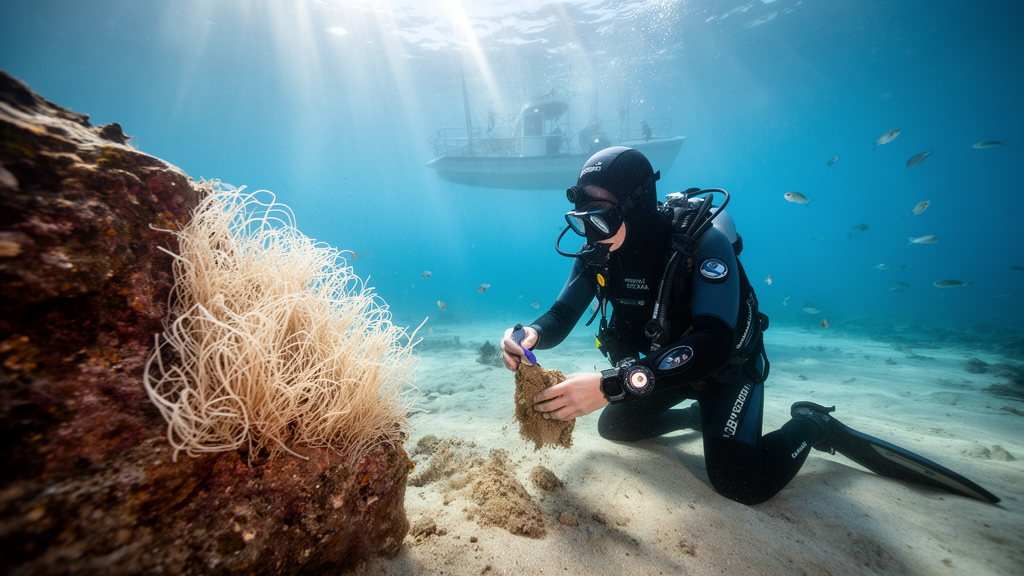
Beneath the glittering surface of the Mediterranean Sea, among sunlit seagrass meadows and in the cold darkness of deep-sea sediments, lives a kingdom of organisms that most people never think to look for: fungi. A new study published in the journal Microbial Ecology has pulled together decades of scattered observations into a single, comprehensive dataset, revealing both the remarkable diversity of marine fungi in the Mediterranean and the striking gaps in what scientists actually know about them. The work, led by Pietro Marchese of the Water Research Institute at Italy’s National Research Council, together with colleagues from France, Italy and Switzerland, compiles 4,623 fungal records drawn from 125 previously published reference articles, covering 914 unique fungal taxa across environments ranging from coastal shallows to the deep sea.
The scale of the effort reflects a long-standing problem in marine mycology. Fungi have been recorded in marine environments around the world for well over a century, typically growing on inert or living substrates in shallow temperate waters as well as in deep, cold and dark habitats far from the reach of sunlight. Yet the knowledge accumulated about these organisms has remained fragmented across research articles published in many different scientific fields, from botany to microbiology to oceanography. According to the authors, this scattering of data has undermined any comprehensive understanding of fungal biodiversity and function in the sea, slowing the transition from a basic awareness of biodiversity patterns toward a quantitative ecological understanding grounded in what fungi actually do in their ecosystems.
To break through that fragmentation, the research team assembled a curated dataset of fungal records from the Mediterranean Sea and annotated each record with its potential function and trophic behavior, following the criteria of FUNGuild, a widely used framework for assigning ecological roles to fungi. FUNGuild classifies fungi into functional guilds based on how they obtain nutrients, distinguishing for example saprotrophs that decompose dead organic matter, pathogens that attack living hosts, and symbionts that live in mutually beneficial relationships with other organisms. By applying this standardized annotation to thousands of historical records, the team transformed a scattered literature into a machine-readable resource that can be analyzed, mapped and compared across studies.
The numbers tell a story of both richness and imbalance. The 4,623 records gathered from the 125 selected articles span the full environmental range of the Mediterranean, from coastal areas to deep-sea habitats, and resolve into 914 unique taxa. Among these, the Dikarya, the large fungal group that encompasses the ascomycetes and basidiomycetes, the two most familiar divisions of the fungal kingdom, dominate the record. Ascomycetes in particular have long been the workhorses of marine mycology, readily identifiable on submerged wood, algae and animal hosts. In contrast, the zoosporic lineages, fungi that produce motile spores propelled by flagella and that include many water molds and other aquatic specialists, are markedly underrepresented in the compiled data.
That underrepresentation matters more than it might first appear. Zoosporic fungi are known to play significant roles in aquatic food webs, parasitizing algae and other microorganisms and recycling nutrients in planktonic communities. If they are systematically missing from the Mediterranean record, the dataset cannot yet claim to portray the full functional architecture of the sea’s fungal life. The authors are candid about this limitation: the compiled dataset highlights biases in mycological biodiversity knowledge, and those biases are precisely what make the resource valuable. By making the gaps explicit and quantifiable, the study gives future researchers a clear map of where to direct their sampling effort, whether toward underexplored basins, underrepresented lineages, or ecological functions that have rarely been tested.
Geography emerges as another of the study’s central findings. Fungal records in the dataset are concentrated on the western side of the Mediterranean basin, a pattern that almost certainly reflects the distribution of research activity rather than the true distribution of fungi. The western Mediterranean, with its dense network of marine stations in France, Italy and Spain, has historically attracted far more mycological attention than the eastern reaches of the sea. This kind of sampling bias is a familiar headache for biogeographers working in many taxa and many regions, and the new dataset makes it possible to see the skew in the Mediterranean fungal record with unusual clarity. Correcting it will require coordinated surveys in the southern and eastern basins, where the fungal diversity of Posidonia meadows, lagoons and deep hypersaline habitats remains largely uncharted.
Perhaps the most sobering conclusion of the study concerns function. Although the team succeeded in annotating the potential trophic behavior of the recorded fungi using the FUNGuild criteria, they found that fungal functions were rarely thoroughly investigated in the underlying literature. In other words, most of the 125 source articles identified which fungi were present but stopped short of asking what those fungi were doing. This is a critical gap, because ecological function is where fungi earn their place in the marine story. Saprotrophic marine fungi break down tough plant polymers such as cellulose and lignin that wash into the sea, accelerating the return of carbon and nutrients to the food web. Pathogenic fungi can regulate populations of algae and invertebrates, sometimes with dramatic effects during disease outbreaks. Symbiotic fungi associated with algae, seagrasses and marine animals may influence host health and stress tolerance in ways that are only beginning to be explored.
The Mediterranean Sea is an especially compelling arena for this kind of synthesis. As a semi-enclosed basin connected to the Atlantic through the narrow Strait of Gibraltar, it hosts a distinctive biota shaped by millions of years of isolation, dramatic salinity gradients and, more recently, pronounced warming. The sea is considered one of the planet’s biodiversity hotspots, and it is also one of the regions most rapidly transformed by climate change, with rising temperatures, acidification and the influx of invasive species reshaping its ecosystems. Fungi are woven into all of these processes, from the decomposition of organic matter in warming waters to the emerging diseases of marine organisms, yet until now no single resource has brought the Mediterranean’s fungal record together in a form suitable for large-scale ecological analysis.
The new dataset is designed to change that. By pairing every record with functional annotation, the authors have created a foundation for studies aimed at comprehensively mapping fungi and their functions in the Mediterranean Sea. Such mapping could inform models of carbon cycling in the basin, help predict where fungal pathogens might flare up as waters warm, and guide the search for biotechnologically useful marine fungi, an area of growing interest given the enzymes and bioactive compounds that marine fungi are known to produce. The open-access publication of the work means that researchers across the Mediterranean countries, and well beyond them, can build directly on the compiled records rather than repeating the laborious literature trawl that produced them.
The study also carries a broader message about how science handles scattered knowledge. Marine fungi sit at the intersection of mycology, marine ecology and microbiology, and no single field has claimed responsibility for synthesizing what is known about them. The Mediterranean compilation demonstrates that even without new fieldwork, a rigorous re-examination of existing literature can yield a resource of genuine scientific value, complete with standardized functional annotations and an honest accounting of its own biases. As the authors note, the transition from knowing that fungi are widespread in the sea to understanding quantitatively what they do there has been slow, and datasets like this one are the bridge across that gap. For a kingdom of life that may number in the millions of species worldwide, and that remains one of the least explored corners of marine biodiversity, the Mediterranean’s 914 recorded taxa represent not an endpoint but a beginning: a first, carefully annotated sketch of a hidden world that future surveys will fill in, basin by basin and function by function.
Subject of Research: Biodiversity and functional annotation of marine fungi recorded in the Mediterranean Sea
Article Title: Biodiversity and Functional Annotation of Fungi Recorded in the Mediterranean Sea
Article References: Marchese, P., Bovio, E., Chinaglia, S., Tarallo, A., Ferrari, E., Martínez, A., & Garzoli, L. (2026). Biodiversity and Functional Annotation of Fungi Recorded in the Mediterranean Sea. Microbial Ecology. https://doi.org/10.1007/s00248-026-02904-1
Image Credits: AI Generated
DOI: 10.1007/s00248-026-02904-1
Keywords: marine fungi, Mediterranean Sea, fungal biodiversity, FUNGuild, trophic modes, mycobiota, Dikarya, zoosporic fungi, deep-sea ecology, biodiversity dataset, fungal ecology, sampling bias
News Source: Morgan Morrow. (October 8, 2026). Hidden Kingdom of the Deep: Scientists Map Thousands of Fungal Records Across the Mediterranean Sea. Scienmag.