When a broken leg bone refuses to heal and the fracture site becomes chronically infected, patients face one of the most daunting scenarios in modern orthopedics: a limb that is simultaneously falling apart biologically and under siege from bacteria. A new study from a French tertiary referral center specializing in complex bone and joint infections now offers the most nuanced long-term picture yet of a last-resort surgical option called vascularized fibular grafting, in which surgeons transplant a segment of living bone, complete with its own blood supply, from one leg to another. The research, published in the Journal of Bone and Joint Infection, followed 22 adults treated between 2014 and 2023 and applied a sophisticated statistical approach that the authors argue is essential for interpreting results honestly in this field.
The condition at the heart of the study, infected non-union, is defined by the combination of two failures: the bone has not consolidated for at least six months with no radiographic progress over the preceding three months, and a fracture-related infection has been confirmed according to international consensus criteria. Confirmation requires at least one hard finding, such as a sinus tract communicating with the fracture, purulent drainage, identical microorganisms cultured from at least two deep tissue samples, or histopathological evidence of infection. At surgery, the Marseille team routinely obtained at least five deep tissue specimens, incubating cultures for a minimum of ten days to capture slow-growing organisms. The stakes are high because bacterial biofilms on implants and dead bone shield pathogens from both the immune system and antibiotics, making spontaneous healing essentially impossible without major surgery.
The 22 patients in the cohort illustrate just how refractory these cases can be. Ninety-five percent had post-traumatic infected non-unions, mostly after high-energy road traffic accidents, and 82 percent had originally sustained open fractures, which carry a high risk of contamination. The median patient was 45 years old, and the median interval between the initial trauma and the reconstructive procedure was 14 months, with one patient not reaching reconstruction until more than 15 years after the original injury. Before arriving at the vascularized graft option, patients had undergone a median of four previous operations, and 41 percent had already failed a Masquelet induced-membrane reconstruction, a two-stage technique that coaxes the body to grow a membrane around a cement spacer before bone grafting. These were, in short, patients for whom conventional reconstruction had already run out of road.
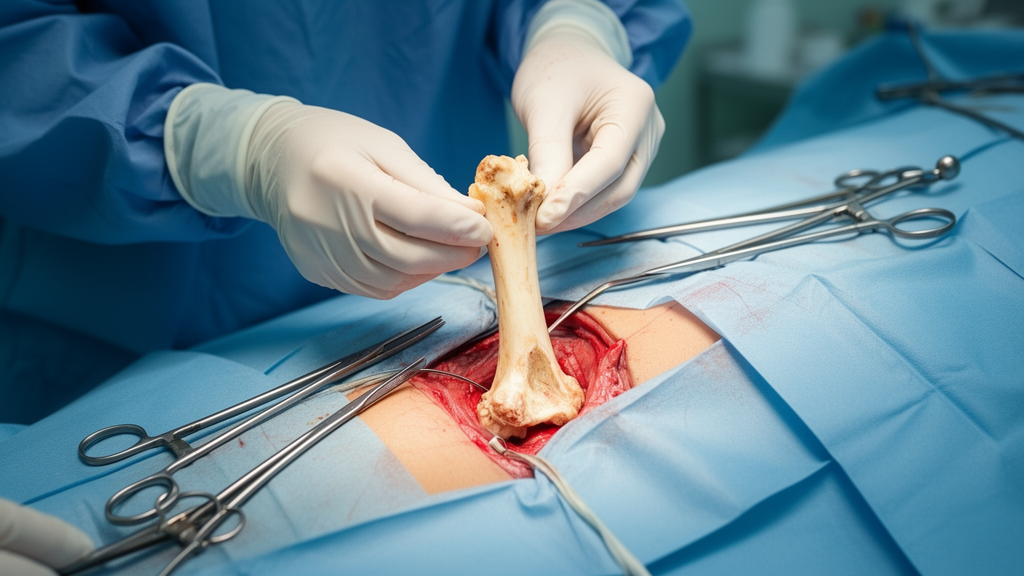
Vascularized fibular grafting, first described in the 1970s, takes advantage of the fibula, the slender bone running alongside the tibia, which can be harvested with its feeding vessel, the peroneal artery, and transplanted as free living tissue. In a single operative session, a combined orthopedic and plastic surgery team first performed radical debridement of infected bone and soft tissue, then harvested the graft from the opposite leg in most cases, preserving at least five centimeters of proximal fibula and seven centimeters of distal fibula to protect knee and ankle stability. The graft was inserted into the healthy bone segments bridging the defect, fixed with internal or external hardware, and connected to recipient vessels through microsurgical anastomoses, with the posterior tibial vessels preferred when anatomy allowed. The median bone defect measured 90 millimeters and the median graft 115 millimeters, lengths that exceed what most non-vascularized techniques can reliably bridge.
The biological rationale for this approach is what makes it so appealing in infected fields. Because the transplanted fibula arrives with intact microcirculation, it does not depend on the often scarred and poorly vascularized recipient bed for survival. Living bone maintains its own osteogenic potential, remodels under load, and, crucially, its preserved blood flow may improve local immune defense and the delivery of antibiotics to the infected site, a decisive advantage against biofilm-associated organisms such as Staphylococcus aureus, coagulase-negative staphylococci, Pseudomonas aeruginosa, and, in one case, even Candida albicans. Eighty-two percent of the infections were polymicrobial, and antimicrobial therapy, individualized by infectious-disease specialists according to intraoperative cultures, continued for a median of 22 weeks after surgery. Notably, no patient remained on suppressive antibiotics at final follow-up, suggesting that in successfully treated cases the infection was truly eradicated rather than merely contained.
The headline results are encouraging but come with an important caveat about time. Bone consolidation, defined as radiographic bridging of at least three of four cortices on orthogonal views together with painless full weight-bearing, was achieved in 17 of 22 patients, or 77 percent. Infection remission occurred in 16 patients, and overall treatment success, the combination of both, in 16 patients, or 73 percent. Nine patients healed with the vascularized graft alone, at a median of 14 months, while seven required a secondary bone graft because consolidation was delayed, and their median time to union stretched to 38 months. Strikingly, all seven patients who underwent secondary grafting ultimately achieved union, although the authors caution that because the procedure was performed selectively at varying time points, this observation cannot be interpreted as proof of a causal benefit.
The methodological heart of the paper lies in its competing-risk analysis, a statistical framework that treats amputation and death not as censored observations, as traditional Kaplan-Meier methods do, but as genuine alternative outcomes that permanently preclude consolidation. This distinction matters because Kaplan-Meier curves can overestimate healing rates when patients leave the risk set for reasons other than the event of interest. Using cumulative incidence functions, the team calculated that the probability of consolidation was only about 18 percent at 12 months, rising to 41 percent at 24 months, 59 percent at 36 months, and roughly 76 percent by the end of follow-up. In other words, judging the success of a vascularized fibular graft at the one-year mark dramatically understates what the procedure can eventually deliver, a finding with direct implications for surgeons and patients deciding whether to persist with reconstruction or abandon the limb.
Not every story ended well, and the study is candid about the price of failure. Six patients, 27 percent of the cohort, had unfavorable outcomes: four amputations, one persistent non-union, and one death. The amputations stemmed from distinct pathways, including persistent infection despite early radiographic progress, ongoing pain and major depression in one patient who requested the procedure, and vascular thrombosis compromising the flap in another. Complications were documented on both the recipient and donor sides, including leg length discrepancies in five patients with a maximum of 65 millimeters, lower-limb malformation in two, a fractured fixation plate, graft non-union requiring multiple reoperations, and arteriovenous thrombosis in two patients, one of whom ultimately lost the limb. These numbers underline that vascularized fibular grafting is a technically demanding microsurgical undertaking that requires careful patient selection and multidisciplinary backup.
The authors are appropriately measured about the limits of their evidence. The study was retrospective, single-center, and small, precluding regression analyses to identify predictors of success, and follow-up duration was heterogeneous, with a median observation time of 21.5 months but a range extending to 90 months. Functional outcomes, quality of life, and patient satisfaction were not systematically collected, and donor-site complications may have been underestimated because they were not prospectively recorded. Consolidation rates in the broader literature, which range from 70 to 90 percent in mixed cohorts that include tumor and congenital reconstructions, are not directly comparable to this exclusively infected, multiply-failed population. Still, the central message stands: for selected patients with infected non-union of the femur or tibia, a living bone transplant can save a limb that would otherwise be amputated, but healing is a marathon measured in years, not months, and only long-term follow-up with methods that respect competing risks can reveal the true odds.
Subject of Research: Long-term outcomes of vascularized fibular grafting as limb-salvage surgery for infected non-union of the lower limb
Article Title: Long-term outcomes of vascularized fibular grafting for infected non-union of the lower limb: a competing-risk analysis
Article References: Le Hir, A., Seng, P., Delarbre, D., Ambrosino, R., Kachouh, N., Legré, R., & Stein, A. (2026). Long-term outcomes of vascularized fibular grafting for infected non-union of the lower limb: a competing-risk analysis. Journal of Bone and Joint Infection, 11(5), 579-590. https://doi.org/10.5194/jbji-11-579-2026
Image Credits: AI Generated
Keywords: vascularized fibular graft, infected non-union, fracture-related infection, limb salvage, bone consolidation, competing-risk analysis, osteomyelitis, microsurgery, bone grafting, amputation, biofilm infection, orthopedic surgery
News Source: Ophelia Keating. (October 8, 2026). Living Bone Transplants Slowly Heal Devastating Leg Infections, Long-Term Study Finds. Scienmag.