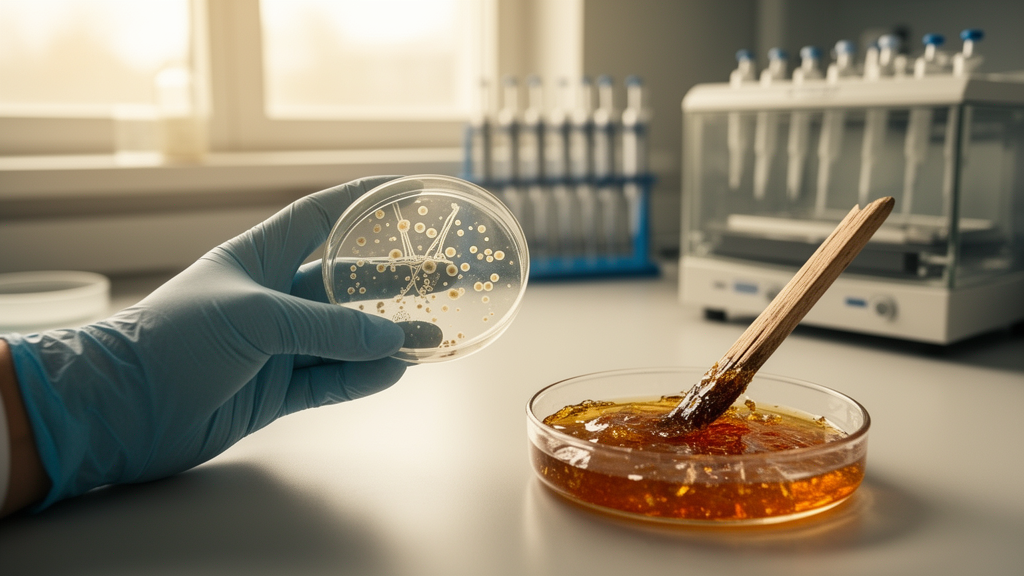
For centuries, healers across Northern Europe have smeared wounds with salves made from the sticky resin of the Norway spruce, a folk remedy that modern medicine has slowly begun to take seriously. Now, a new laboratory study has tackled one of the most important unanswered questions about this ancient treatment: whether bacteria can learn to resist it. The answer, based on a carefully controlled serial-passage experiment, appears to be reassuring. After twenty days of continuous exposure to sub-inhibitory concentrations of medical-grade spruce resin, three of the most troublesome wound-infecting bacteria in clinical medicine showed no confirmed development of resistance.
The study, published in the journal MicrobiologyOpen, focused on Staphylococcus aureus, Pseudomonas aeruginosa, and Enterococcus faecalis, three species that dominate the microbiology of difficult wounds and are notorious for their capacity to develop resistance to conventional antibiotics. The researchers repeatedly grew these bacteria in liquid culture containing concentrations of spruce resin below the level needed to stop growth entirely, a condition that in classical antibiotic therapy is precisely the situation that breeds resistance. Yet when the team measured the minimum inhibitory concentration, or MIC, of the resin at the start, midpoint, and end of the experiment, none of the three organisms came close to the predefined threshold that would signal genuine resistance: a fourfold or greater increase in inhibitory concentration.
The experimental design followed established guidelines from the Clinical and Laboratory Standards Institute for dilution antimicrobial susceptibility testing, adapted for resistance evaluation through serial passage. The resin itself was collected by hand from sustainably managed Finnish forests and purified according to a patented method before being dissolved in ethanol and diluted into Mueller-Hinton broth at concentrations ranging from 10 percent down to just over 0.15 percent. Cultures were transferred daily into fresh medium containing the same sub-inhibitory resin concentration, giving the bacterial populations a sustained opportunity to adapt over ten and then twenty consecutive passages. Every assay was performed in duplicate, and the duplicate trials produced identical MIC endpoints at every time point, lending unusual consistency to the results.
At baseline, the resin inhibited Pseudomonas aeruginosa at a concentration of 5 percent, Staphylococcus aureus at 1.25 percent, and Enterococcus faecalis at 2.5 percent, making the staphylococcus the most susceptible of the three and the pseudomonad the most tolerant, a pattern consistent with the well-known intrinsic hardiness of Gram-negative bacteria. Over the following twenty days, susceptibility remained broadly stable. The inhibitory concentration for Pseudomonas rose from 5 percent to 10 percent by Day 20, a twofold shift, while Staphylococcus aureus doubled from 1.25 percent to 2.5 percent by Day 10 and then held steady. Enterococcus faecalis did not budge at all, remaining at 2.5 percent throughout the entire experiment.
Crucially, the researchers built safeguards into the study to distinguish genuine adaptation from mere laboratory artifact. Because ethanol was used as the solvent, matched vehicle-control cultures were passaged in ethanol without any resin, and validation arms were passaged in plain nutrient broth before being tested against resin or ethanol. These controls remained stable over time and showed no progressive drift, which means the transfer procedure and medium changes did not artificially induce resistance. Tellingly, the Day 20 increase seen in Pseudomonas aeruginosa under resin exposure was not mirrored in the validation arms, supporting the interpretation that the modest shift was minor and not clearly indicative of progressive resistance selection. The vehicle controls also demonstrated that ethanol alone could not explain the inhibitory activity observed at lower resin concentrations, since the ethanol-only endpoints for Staphylococcus and Enterococcus sat at 10 percent, far above the resin-containing test values.
The contrast with conventional antibiotics is striking. In previously published serial-passage experiments, methicillin-resistant Staphylococcus aureus exposed repeatedly to the topical antibiotic mupirocin developed a 64-fold increase in MIC, fusidic acid produced a 256-fold increase, and retapamulin a 16-fold increase. Ciprofloxacin has generated 32-fold MIC increases in both Staphylococcus aureus and Pseudomonas aeruginosa after just 25 passages, and resistance selection has been demonstrated in Enterococcus faecalis with linezolid. Against that backdrop, the twofold fluctuations observed with spruce resin fall well below the fourfold resistance threshold and, according to the authors, do not necessarily indicate stable resistance, especially when they are not supported by consistent drift in the control arms.
Why might a natural resin be so resistant to resistance? The answer likely lies in its chemistry. Spruce resin is not a single active molecule but a complex natural mixture in which resin acids predominate, accompanied by lignans and p-coumaric acid. Earlier mechanistic work has shown that when Staphylococcus aureus is exposed to resin, resin salve, or the resin acid abietic acid, the cells develop thickened walls, aggregate together, alter their fatty-acid composition, and lose their membrane potential, pointing to damage of the bacterial cell envelope and interference with energy metabolism rather than the blockade of any single defined target. Terpenic resin acids are thought to act through nonspecific membrane and cell-wall effects, including disruption of the proton gradient and possible uncoupling of oxidative phosphorylation. A multi-target mode of attack of this kind is classically considered far less amenable to the single-mutation escape routes that bacteria exploit against conventional antibiotics.
The new findings build on a substantial body of earlier evidence. The first modern in vitro work, published in 2007, showed that home-made spruce resin salve inhibited clinically relevant wound bacteria, with the clearest effects against Gram-positive organisms and demonstrable activity against methicillin-resistant Staphylococcus aureus and vancomycin-resistant enterococci. Later European Pharmacopoeia challenge-test studies extended the picture to Escherichia coli, Pseudomonas aeruginosa, Klebsiella pneumoniae, Bacillus subtilis, and Candida albicans, finding that 10 percent resin in the salve medium was sufficient to prevent microbial survival. More recently, a spruce resin-based salve was shown to eradicate mixed Pseudomonas-Staphylococcus biofilms and penetrate their layers, even when the isolates were highly tolerant to bacitracin, neomycin, and polymyxin B. Clinical studies, including a randomized multicentre trial on severe pressure ulcers, have added wound-healing and safety data to the antimicrobial story.
The authors are careful to spell out the limits of what their experiment can show. A twenty-day design cannot exclude slower adaptive responses that might emerge during longer exposure, and phenotypic MIC measurements cannot rule out genetic adaptation that occurs before substantial MIC shifts become detectable. The study used well-characterized reference strains rather than clinical isolates, which may harbor pre-existing resistance determinants that could alter their response to repeated resin exposure. Biofilm growth, which is the norm in chronic wounds, may also change resistance-selection dynamics compared with the planktonic cultures used here. The researchers therefore call for extended experiments reaching fifty or more passages, continuous-flow and biofilm-based models, whole-genome sequencing of baseline and endpoint isolates, fitness and cross-resistance assessments, and testing of multidrug-resistant clinical strains including MRSA, vancomycin-resistant enterococci, and resistant Pseudomonas aeruginosa.
Even with those caveats, the practical implications for wound care are meaningful. Chronic wounds expose microbes to variable and sometimes sub-inhibitory levels of topical antimicrobials, because wound exudate can reduce bactericidal efficacy and biofilms increase tolerance, exactly the conditions under which resistance to classical antibiotics flourishes. The finding that medical-grade spruce resin, used in products such as Abilar, ilon Wundxtra Salbe, and SutriHeal Forte, maintained its inhibitory activity across twenty days of repeated sub-inhibitory exposure strengthens the rationale for its continued topical use. It suggests that any adaptive response to this ancient forest remedy, if present at all, was limited and species-dependent under the conditions tested. Longer and more clinically faithful studies will be needed to confirm the picture, but for now the spruce resin story, running from folk medicine to modern microbiology, has gained one of its most important scientific supports yet.
Subject of Research: Resistance development potential of Norway spruce resin against wound-infecting bacteria assessed by serial passage
Article Title: Serial‐Passage Assessment Shows No Confirmed Resistance Development to Norway Spruce (Picea Abies) Resin in Bacterial Species Relevant to Wound Infection
Article References: Yamileva, K., Parrotta, S., Ghanbarirad, M., & Multia, E. (2026). Serial‐Passage Assessment Shows No Confirmed Resistance Development to Norway Spruce ( Picea Abies ) Resin in Bacterial Species Relevant to Wound Infection. MicrobiologyOpen, 15(5), Article e70436. https://doi.org/10.1002/mbo3.70436
Image Credits: AI Generated
DOI: 10.1002/mbo3.70436
Keywords: Norway spruce resin, antimicrobial resistance, serial passage, wound infection, Staphylococcus aureus, Pseudomonas aeruginosa, Enterococcus faecalis, minimum inhibitory concentration, natural antimicrobials, biofilm, topical treatment, Picea abies
News Source: Kristina Jarvis. (October 8, 2026). Spruce Resin Shows No Resistance Development in Wound Bacteria During 20-Day Test. Scienmag.