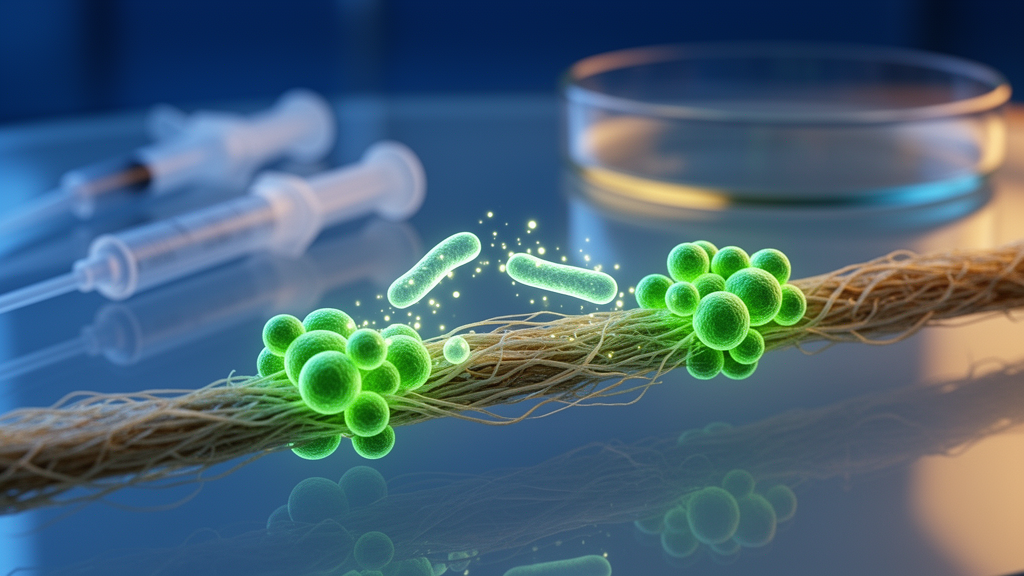
Bacterial cellulose has long been one of microbiology’s most intriguing materials: a pure, nanofibrillar form of cellulose produced not by plants but by microbes, with potential uses ranging from food ingredients to biomedical scaffolds. Yet coaxing acetic acid bacteria into making industrially useful quantities of this biopolymer has remained a stubbornly strain-dependent and variable endeavor. Now, a team of Italian researchers reports a systematic way to solve that problem, not by engineering a single super-strain, but by assembling and optimizing synthetic microbial communities whose members work together to boost cellulose output. The study, published in Applied Microbiology and Biotechnology, demonstrates that a carefully chosen consortium of helper bacteria and yeasts can match the productivity of the best cellulose-producing monoculture the researchers had available.
The research, carried out by Federico Lasagni, Robab Ezazi, Marilisa Giavalisco, Stefano Cassanelli, Alessandro Ulrici, Maria Gullo and Teresa Zotta, was funded by the PRIN 2022 project SynBioCell, which targets sustainable bacterial cellulose production for food and health applications, and was supported by the Italian national node MIRRI-IT of the European Research Infrastructure MIRRI-ERIC. The work addresses a well-recognized bottleneck. Acetic acid bacteria, or AAB, are acknowledged as high producers of bacterial cellulose, but the amount they synthesize fluctuates considerably depending on the strain and on a range of environmental and nutritional factors. That variability has practical consequences: any strategy that makes cellulose production more reliable and more productive is of immediate relevance to bioprocess developers.
Instead of relying on trial and error, the team turned to design of experiments, a chemometric framework that allows many variables to be screened and optimized with a statistically controlled number of trials. Their strategy unfolded in two sequential stages. First, two Plackett-Burman designs, screening designs prized for their efficiency in identifying which factors among many actually matter, were used to construct and screen synthetic microbial communities, or SynComs. These communities were assembled from three functional groups: acetic acid bacteria, lactic acid bacteria, and yeasts. In total, twelve different SynComs were built and tested, spanning combinations of AAB alone, AAB with lactic acid bacteria, AAB with yeasts, and communities containing all three groups.
The logic behind mixing species is ecological as much as biochemical. In natural fermentation ecosystems, such as those governing vinegar and kombucha production, acetic acid bacteria rarely act alone. Lactic acid bacteria and yeasts can alter the pH, consume or release metabolites, and create conditions that either help or hinder cellulose-producing strains. By treating community composition itself as an experimental variable, the researchers could ask a question that monoculture studies cannot address: does the identity of the neighbors matter as much as the identity of the producer? The Plackett-Burman screening answered emphatically that it does. The composition of the SynComs significantly affected bacterial cellulose production, and several communities outperformed some of the acetic acid bacteria monocultures tested alongside them.
Having narrowed the field, the researchers moved to the second stage: a circumscribed central composite design, or CCC, a response-surface methodology that fits a mathematical model describing how the response, in this case cellulose titre, changes across a continuum of culture conditions. This allowed the team not merely to pick the best condition among those tested, but to predict where the true optimum lies, including at combinations of factor levels never directly run in the experiment. The factors optimized included glucose concentration, temperature, and cultivation time, three of the most influential levers in any microbial fermentation process.
The outcome was a consortium containing both lactic acid bacteria and yeasts as helper strains alongside the cellulose producer. Under the optimized conditions, 50 grams per liter of glucose, a temperature of 32 degrees Celsius, and a cultivation period of seven days, this SynCom reached a bacterial cellulose titre of 10.40 plus or minus 0.40 grams per liter. For comparison, the best performer among the acetic acid bacteria monocultures, a strain carrying a deletion in the gdh gene, designated the AAB monoculture Δgdh K2G30, produced 10.79 plus or minus 0.36 grams per liter. The difference between the engineered community and the single best strain was within experimental uncertainty, meaning the consortium effectively matched the champion monoculture.
Just as important for process development, the measured production level agreed closely with the model’s forecast. The circumscribed central composite design’s regression model predicted a cellulose titre of 10.53 grams per liter under the same conditions, a figure the experimental result confirmed within its error range. That agreement matters because it validates the entire statistical pipeline: if the response-surface model had diverged sharply from reality, the optimization would have been little more than an elaborate curve fit. Instead, the researchers can now use the model to explore neighboring conditions and to reason about scale-up with quantitative confidence.
The study’s authors are careful about what remains unknown. Although the community-level results are striking, the roles and interactions among the individual community members have not yet been resolved. Whether the lactic acid bacteria and yeasts are supplying growth factors, buffering acidity, scavenging inhibitory byproducts, or reshaping the metabolic flux of the cellulose producer is a question for future metabolic and population dynamics analyses. Such work, tracking which species persist, in what proportions, and what they exchange over the course of a seven-day fermentation, will be essential before synthetic communities can be deployed reliably at industrial scale, where community stability under continuous operation becomes a critical concern.
Even so, the conceptual advance is considerable. Bacterial cellulose is chemically identical to plant cellulose but free of lignin and hemicellulose, which makes it attractive for wound dressings, tissue engineering scaffolds, and novel food textures. Production costs, however, have limited its adoption, and much of the field has focused on genetic engineering of producer strains such as Komagataeibacter xylinus. This study offers a complementary route: rather than modifying the producer’s genome, modify its social environment. The finding that several SynComs outperformed some acetic acid bacteria monocultures suggests that helper organisms can unlock productivity that a single strain cannot reach on its own, and that this effect can be captured systematically rather than stumbled upon.
The methodological lesson may prove as influential as the biological one. Sequential design of experiments, moving from Plackett-Burman screening to central composite response-surface optimization, gave the researchers a disciplined path from twelve candidate communities to one optimized recipe and one validated set of culture conditions, all with a manageable number of experiments. As synthetic microbial communities attract growing interest across biotechnology, from waste valorization to probiotic formulation, the ability to assemble and tune them statistically, rather than intuitively, could become standard practice. For bacterial cellulose specifically, the results point toward more versatile fermentation processes in which consortia, not lone strains, do the manufacturing, a perspective the authors present as a new direction for future development in food and biomedical applications.
Subject of Research: Design-of-experiments-guided assembly of synthetic microbial communities to optimize bacterial cellulose production
Article Title: DOE-guided assembly and optimization of Synthetic Microbial Communities for bacterial cellulose production
Article References: Lasagni, F., Ezazi, R., Giavalisco, M., Cassanelli, S., Ulrici, A., Gullo, M., & Zotta, T. (2026). DOE-guided assembly and optimization of Synthetic Microbial Communities for bacterial cellulose production. Applied Microbiology and Biotechnology. https://doi.org/10.1007/s00253-026-14059-7
Image Credits: AI Generated
DOI: 10.1007/s00253-026-14059-7
Keywords: bacterial cellulose, synthetic microbial communities, acetic acid bacteria, lactic acid bacteria, yeasts, design of experiments, Plackett-Burman design, central composite design, Komagataeibacter xylinus, fermentation optimization, biopolymer, industrial microbiology
News Source: Morgan Morrow. (October 8, 2026). Designer Microbial Teams Match Top Cellulose Producers Using Statistical Design. Scienmag.