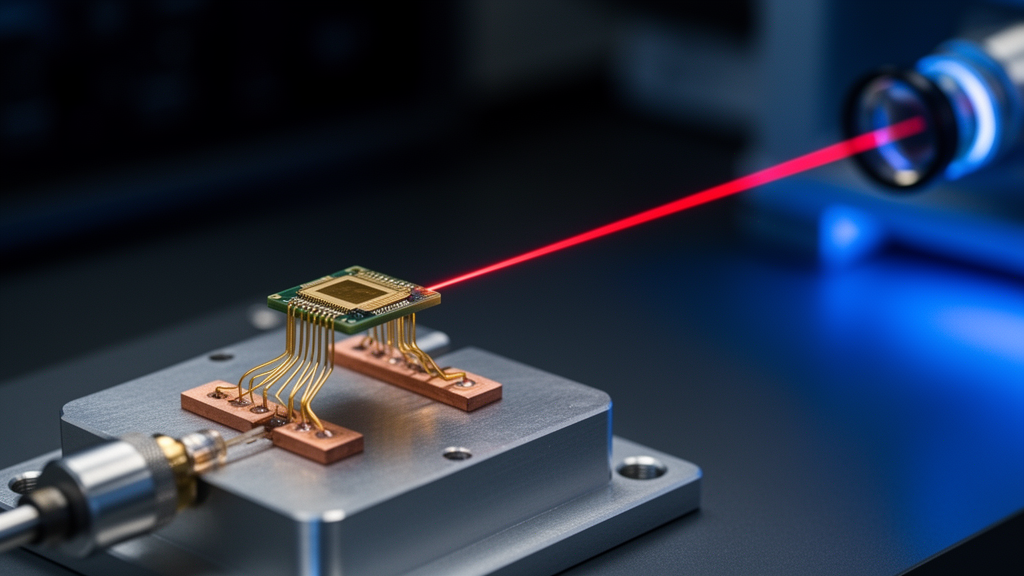
For decades, one of the most delicate feats in photonics has been persuading a semiconductor laser to stop being noisy. Diode lasers are cheap, tiny and mass-producible, but their light jitters by tens of kilohertz to megahertz, hopelessly far from the hertz-level purity demanded by optical atomic clocks, fibre-optic sensing networks, LiDAR and coherent communications. A technique called self-injection locking, in which a sliver of the laser’s own light is reflected back into the diode from an ultra-high-quality optical resonator, can quiet the laser by more than six orders of magnitude. Yet the technique has always carried a frustrating catch: the quiet state exists only at carefully chosen operating points, and keeping it requires active electronic control. Now a team at the Swiss Federal Institute of Technology Lausanne (EPFL) reports in Nature Photonics a design that removes the catch entirely, producing what they call an endlessly self-injection-locked laser that stays locked at every drive current, with no feedback loops, dithering or calibration of any kind.
The problem the EPFL researchers, led by Mikael Reichler, Simone Bianconi and Tobias Kippenberg, set out to solve is rooted in the physics of optical feedback. In a conventional self-injection-locked system, a distributed-feedback (DFB) diode is coupled to a silicon nitride microresonator whose resonances act like an extremely selective mirror. Light reflected from the resonator pulls the laser frequency toward the resonance, and the laser’s noise collapses. But two conditions must be satisfied simultaneously: the free-running laser frequency must sit close enough to a cavity resonance, and the phase of the back-reflected light must fall within a narrow window. Temperature drifts, fabrication tolerances and the natural tuning of the laser with injection current all conspire to break these conditions. In practice, as the drive current is swept, the laser repeatedly falls out of lock into its noisy free-running state, and engineers must surround the chip with photodetectors and electronic feedback loops to hold it in place, inflating size, power consumption, cost and complexity.
The EPFL team’s insight was to identify a previously unrecognized control parameter that governs how the laser behaves as it tunes from one cavity resonance to the next. They call it feedback-phase dispersion: the difference in the phase of the back-reflected light between consecutive resonances of the microresonator. Because the resonator supports a comb of resonances separated by its free spectral range, and because the phase of the reflected light is periodic, the relative phase from one resonance to the next determines whether the laser, while tuning, always has a good locking state available or instead passes through regions where only poor locking exists. If the locking ranges of adjacent resonances overlap in the right way, the laser is forced to hop directly from one narrow-linewidth state to another, never touching the free-running regime.
Crucially, the researchers found that this dispersion can be engineered geometrically, and at a scale far coarser than the optical wavelength. The phase of light reflected from the resonator depends on the round-trip delays in the bus waveguide that feeds the resonator and the drop waveguide that extracts it, as well as on the position of the drop coupler along the resonator’s spiral path. A simple expression relates the feedback-phase dispersion to these delays and to the resonator’s free spectral range. For a typical 1-gigahertz free spectral range, the relevant length scale is about 30 centimetres, meaning the coupler positions need only be controlled to within centimetres rather than nanometres. That is a manufacturing-friendly tolerance, and it is what makes the approach scalable rather than a laboratory curiosity.
To make the feedback deterministic, the team equipped their spiral silicon nitride resonators with a drop port terminated by an integrated Sagnac loop mirror, which robustly excites the counterpropagating resonator mode and reflects it back to the laser. Without such a mirror, the feedback comes from random Rayleigh backscattering, and its phase fluctuates unpredictably from device to device. With the mirror, the phase evolution becomes stable and, more importantly, predictable from the layout. The researchers fabricated three resonator variants with different port placements and measured their light-current curves. The device without a drop port showed irregular, fluctuating resonance shapes, while the mirror-terminated devices showed stable, reproducible phase evolution that matched the design formula closely, confirming that feedback-phase dispersion is a genuine, engineerable quantity.
The demonstration of endless locking itself is striking. The team butt-coupled an off-the-shelf DFB diode emitting at 1,548 nanometres to a spiral resonator with a free spectral range of 1.44 gigahertz and an intrinsic quality factor of 11.3 million, engineered to have a positive feedback-phase dispersion of 0.16π. When the coupling between the diode and the chip was deliberately weakened, the light-current curve showed the familiar signature of failure: locked plateaus separated by bright intervals in which the laser fell free-running. When the coupling was raised to its design value, the plateaus merged, and the laser transitioned directly from one locked state to the next. Beating the output against a stable reference laser while sweeping the current over more than two full periods of the feedback-phase oscillation revealed a spectrogram in which the laser never once dropped into a free-running state, hopping instead across multiple resonances whenever doing so improved the linewidth.
The contrast case sealed the argument. A second resonator, nearly identical in every parameter except that its port placement produced a negative feedback-phase dispersion of −0.57π, showed exactly the predicted pathology: sections of the current sweep in which the laser unlocked and ran free. Numerical simulations reinforced the picture, showing that positive dispersion values allow the laser to select a high-quality locking state at every possible free-running frequency, whereas values near zero or negative leave gaps in which only weak locking exists. The team defines an endlessly locked laser quantitatively as one whose linewidth reduction factor exceeds 1,000 across the entire drive current range, and their device met that bar comfortably.
The measured performance places the chip among the best integrated lasers ever reported. Sweeping the injection current from 154 to 300 milliamperes in 2-milliampere steps, with no active control of current or phase, the researchers recorded frequency noise reductions of more than 5,000 relative to the free-running diode at every single step. Intrinsic linewidths fell below 10 hertz, a reduction of at least a factor of 10,000, approaching the fundamental thermorefractive noise floor of the silicon nitride resonator itself, the point at which tiny temperature fluctuations in the glass set the ultimate limit. The team also integrated monolithic piezoelectric actuators onto the chip, which strain the resonator to tune its resonances rapidly and with low hysteresis. Driving these actuators with a 10-kilohertz triangular waveform produced mode-hop-free frequency chirps spanning 1.5 gigahertz, exceeding the resonator’s free spectral range, at every injection current, with state-of-the-art linearity.
What elevates the result beyond a record is its generality. The authors show through simulations that the design rule, a relatively low free spectral range combined with a non-zero, preferably positive feedback-phase dispersion, should extend to Fabry–Pérot diodes, to resonators with free spectral ranges beyond 2 gigahertz when the dispersion is near 0.6π, and to photonic platforms operating from the ultraviolet through the mid-infrared. The underlying physics applies equally to bulk crystalline microresonators. With output power of several milliwatts, comparable to state-of-the-art precision lasers, and a footprint set by a single diode chip and a photonic integrated circuit, the architecture converts self-injection locking from a finicky laboratory procedure into a turnkey component. For applications from optical clocks and quantum sensors to coherent LiDAR and fibre sensing, that could mean hertz-level coherence no longer confined to optics tables, but manufactured by the millions on wafers and deployed wherever a quiet, stable beam of light is needed.
Subject of Research: Self-injection-locked silicon nitride photonic integrated lasers with engineered feedback-phase dispersion for robust ultralow-noise operation
Article Title: Endlessly self-injection-locked photonic integrated lasers
Article References: Reichler, M., Bianconi, S., Zhang, Y., Liffredo, M., Villanueva, L. G., & Kippenberg, T. J. (2026). Endlessly self-injection-locked photonic integrated lasers. Nature Photonics, 20(10), 1146-1152. https://doi.org/10.1038/s41566-026-01985-1
Image Credits: AI Generated
DOI: 10.1038/s41566-026-01985-1
Keywords: self-injection locking, photonic integrated circuits, silicon nitride, narrow-linewidth lasers, microresonators, semiconductor lasers, feedback phase, frequency noise, optical atomic clocks, LiDAR, piezoelectric tuning, EPFL
News Source: Denise Maddox. (October 8, 2026). Chip-Scale Laser Stays Perfectly Locked at Every Drive Current. Scienmag.