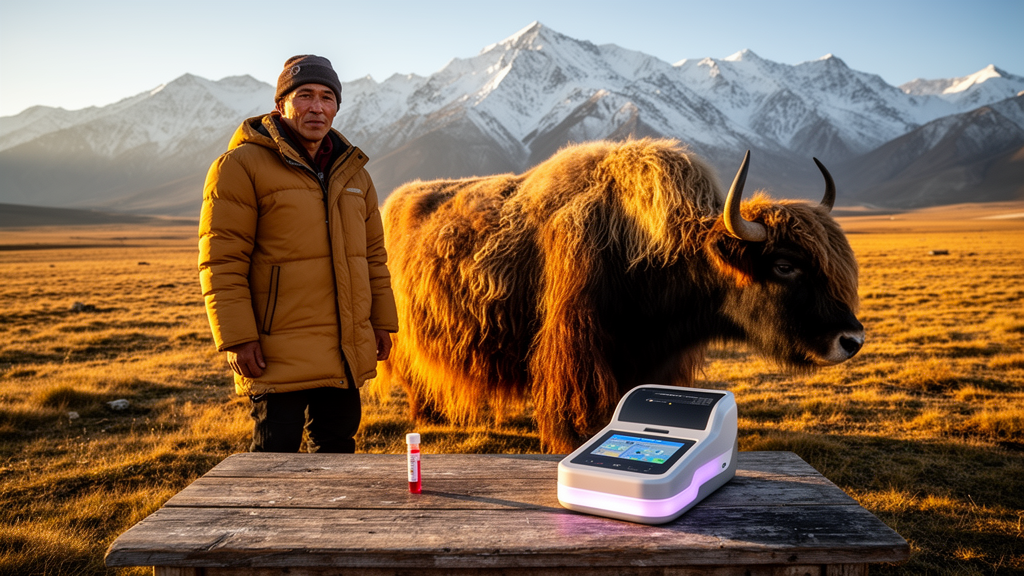
On the windswept rangelands of China’s Qinghai Plateau, the yak has reigned for millennia as the only large domestic animal capable of thriving at extreme altitudes. Now, a team of Chinese researchers has taken a major step toward decoding the genetic underpinnings of the species’ body size. In a study published in Archives Animal Breeding, scientists from Qinghai University identified four single-nucleotide polymorphisms (SNPs) in the yak insulin-like growth factor 1 receptor gene, IGF1R, and demonstrated that these tiny DNA variants are significantly associated with measurable growth traits, including body height, body length, and chest circumference. The findings could pave the way for molecular marker-assisted selection in yak breeding programs, potentially transforming an industry that supports communities across the Asian highlands.
The research focused on the IGF1R gene, a central player in the growth hormone signaling pathway that governs skeletal development, muscle growth, and overall body conformation in mammals. As the receptor for insulin-like growth factor 1, IGF1R mediates the core biological functions of the IGF system, which is involved in cell proliferation, differentiation, and metabolism. The gene is widely expressed across tissues, including liver, muscle, bone, heart, lung, and brain, and plays critical roles during both embryonic and postnatal development. Because of this pivotal position in the growth axis, the researchers considered IGF1R a prime candidate for harboring genetic variants that influence economically important traits in livestock.
To investigate, the team selected 400 healthy, three-year-old female Qinghai Plateau yaks from a cooperative in Qilian County, Haibei Tibetan Autonomous Prefecture. Each animal was measured for five key growth indicators: body weight, oblique body length, body height, chest circumference, and cannon bone circumference. Blood samples were then collected from the jugular vein, anticoagulated, and stored at minus 80 degrees Celsius. Genomic DNA was extracted and its quality verified using spectrophotometry, with all samples exceeding 50 nanograms per microliter in concentration and maintaining an optical density ratio above 1.8, ensuring reliable material for downstream genetic analysis.
The genotyping approach relied on polymerase chain reaction amplification of IGF1R fragments, followed by Sanger sequencing. Primers were designed from the reference yak IGF1R sequence deposited in GenBank, and amplified products were verified by agarose gel electrophoresis before purification and sequencing. The yak IGF1R gene spans 305,476 base pairs and contains 21 exons and 20 introns. From the sequencing data, the team identified four SNPs: one, designated g.7383084C>T, located in exon 13, and three others, g.7383136G>A, g.7383137C>T, and g.7383177G>A, located in the adjacent intron 13. Sanger chromatograms clearly distinguished homozygous individuals, showing single fluorescent peaks, from heterozygotes, which displayed overlapping peaks corresponding to both nucleotides.
Statistical analysis of the population genetics revealed that all four loci were in complete Hardy–Weinberg equilibrium, indicating a relatively stable genetic state within the sampled herd. Three of the variants, g.7383084C>T, g.7383136G>A, and g.7383137C>T, exhibited moderate polymorphism, with polymorphism information content values between 0.25 and 0.5, suggesting sufficient allelic diversity to be useful for genotype-phenotype association studies. The fourth variant, g.7383177G>A, showed low polymorphism and limited variability. Genotype counts varied considerably across loci: for instance, at the exonic site, 182 animals carried the CC genotype, 182 carried CT, and 36 carried TT, while at the last intronic site, 382 of the 400 yaks carried the GG genotype and only 18 carried GA.
The association analysis, which accounted for age and environment as covariates in a fixed statistical model, produced striking results. All four SNP loci were significantly or highly significantly associated with body height and body length. At the exonic g.7383084C>T site, the variant was also linked to body weight and chest circumference, with CC and CT carriers showing significantly higher body weight than CT-adjacent patterns, and chest circumference increasing from CC to CT and TT animals, hinting at a possible positive dose-related effect of the T allele. At g.7383137C>T, heterozygous animals tended to excel in body height, chest circumference, and cannon bone circumference, while homozygous TT animals showed the greatest body length, a pattern that complicates simple additive interpretations.
Beyond individual loci, the researchers performed linkage disequilibrium and haplotype analysis using Haploview software. The four SNPs showed only weak linkage with one another, with pairwise D-prime values all below 0.8 and r-squared values below 0.33. From the combinations of alleles across the four sites, the team identified six haplotypes at frequencies above 3 percent, with Hap2 dominating at a frequency of 0.263. When the five common diplotype combinations, meaning paired haplotypes inherited from both parents, were tested against the growth traits, all five showed significant or highly significant associations with at least some measurements. One combination, H2H6, stood out as the optimal diplotype, associated with significantly higher body weight, withers height, body length, and chest circumference than most alternatives.
The biological plausibility of these associations is rooted in the molecular function of IGF1R. The receptor mediates IGF1-dependent signaling that directly regulates chondrocyte proliferation, longitudinal bone growth, and systemic skeletal development, all fundamental processes shaping body size. Notably, the exonic variant g.7383084C>T turned out to be a synonymous substitution: both alleles encode the amino acid aspartic acid, so the protein sequence is unchanged. Yet the authors caution against dismissing synonymous variants as functionally neutral. Such mutations can influence codon usage bias, messenger RNA stability and secondary structure, translation efficiency, co-translational protein folding, and exonic splicing regulatory elements, any of which could alter receptor production and, in turn, growth.
The three intronic variants are equally intriguing from a mechanistic standpoint. Two of them, g.7383136G>A and g.7383137C>T, sit just 9 and 10 base pairs downstream of exon 13, placing them within near-exon intronic regions that can participate in splice-site recognition and early spliceosomal assembly. Variants in these positions may perturb splice donor recognition, exon definition, or intronic splicing enhancers and silencers, potentially causing exon skipping, intron retention, or activation of cryptic splice sites. Such aberrant transcripts could change receptor isoform composition or expression levels. The researchers also note that the observed genotype patterns were not strictly linear for all traits, with heterozygote superiority appearing at some loci, which may reflect dominance effects, overdominance, or linkage with other functional variants in the local haplotype background.
The broader significance of the study extends beyond yak biology. IGF1R polymorphisms have been linked to growth, carcass, and meat quality traits across cattle, sheep, and pigs, but genetic effects often vary by breed, as seen when copy number variants of IGF1R associated with body size in Jinnan and Qinchuan cattle but not in Nanyang or Xianan cattle. The new yak data confirm that sequence variation in both exonic and flanking intronic regions of the gene contributes to phenotypic diversity across species and genetic backgrounds. With China’s yak population exceeding 15 million head, more than 95 percent of the global total, the practical implications are substantial. Incorporating these molecular markers into breeding programs could enhance selection efficiency, shorten breeding cycles, and support sustainable development of the yak industry, benefiting the plateau communities that depend on these remarkable animals for meat, milk, draft power, and cultural continuity.
Subject of Research: Associations between IGF1R gene polymorphisms and growth traits in Qinghai Plateau yaks
Article Title: Unveiling potential genetic markers: associations of IGF1R eon 13 and Intronic polymorphisms with growth traits in yak
Article References: Liu, X., Han, Y., Sun, Y., Gou, F., Chen, J., Jiang, W., & Zhao, Q. (2026). Unveiling potential genetic markers: associations of IGF1R eon 13 and Intronic polymorphisms with growth traits in yak. Archives Animal Breeding, 69(4), 553-561. https://doi.org/10.5194/aab-69-553-2026
Image Credits: AI Generated
Keywords: yak, IGF1R, SNP, growth traits, molecular markers, haplotype, marker-assisted selection, Qinghai Plateau, livestock genetics, linkage disequilibrium, synonymous mutation, animal breeding
News Source: Juliet Wilcox. (October 8, 2026). Yak Growth Gene Study Reveals DNA Markers That Could Reshape Plateau Breeding. Scienmag.