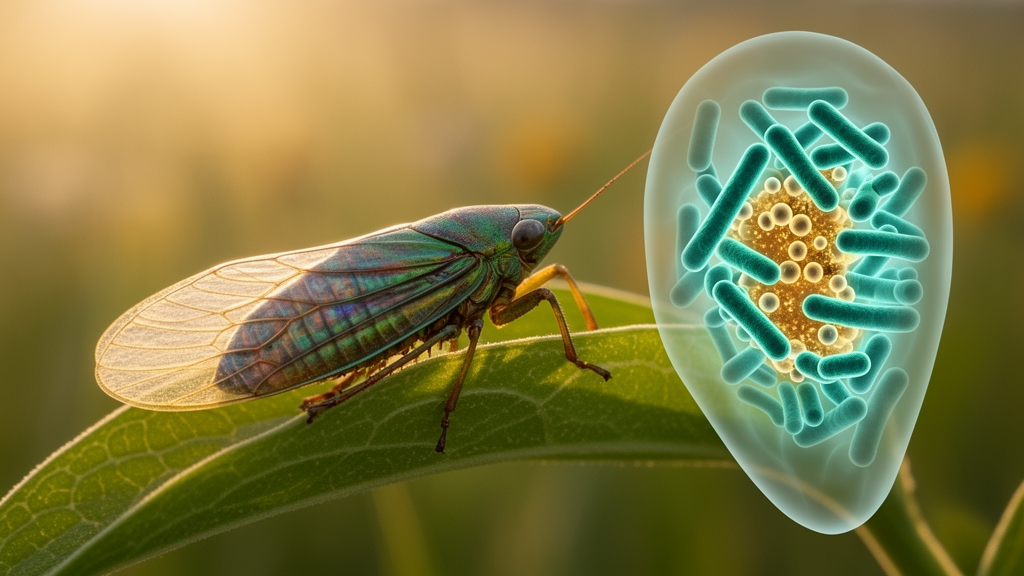
Some of the most consequential evolutionary events on Earth may be unfolding invisibly, inside the bodies of insects. In a synthesis published in the Journal of Systematics and Evolution, researchers from the Institute of Botany, Chinese Academy of Sciences, have proposed a comprehensive framework explaining how endosymbionts—the bacteria and other microorganisms that live permanently within insect cells and tissues—can drive the formation of cryptic species: populations that look nearly identical on the outside yet are genetically distinct and, in many cases, no longer capable of interbreeding. The work, authored by Hongxia Hou, Yuao Wang, Yangyi Jia, Xinxin Li, Guohao Zu, Zhipeng Chen, and Dawei Huang, draws together scattered lines of evidence from aphids, whiteflies, parasitoid wasps, and other insects into a single conceptual model of how microbial partners can quietly split one species into many.
Cryptic species represent one of the great challenges to cataloging biodiversity. Because they cannot be distinguished by morphology alone, they are frequently discovered only through genetic sequencing, crossing experiments, or detailed ecological studies, and many are almost certainly miscounted as single species today. Traditional theories of speciation emphasize geographic isolation, ecological specialization, and sexual selection as the engines that divide populations. The new framework adds a powerful and often overlooked actor to that cast: the heritable microbes that insects carry. Endosymbionts are extraordinarily widespread across insect groups and are transmitted primarily from mother to offspring, but they can also move horizontally between unrelated hosts, allowing the same bacterial lineages to shape the evolution of many different insect species over deep time.
The authors divide endosymbionts into two functional categories whose roles are complementary. Obligate, or primary, endosymbionts are indispensable for host survival. They support growth, development, and stress resistance by synthesizing key nutrients, including essential amino acids and vitamins, that the insect’s own genome cannot produce. Facultative, or secondary, endosymbionts are not required for survival, but they exert profound influence over host phenotypes through reproductive manipulation, immune regulation, and environmental adaptation. Together, the two classes jointly satisfy the host’s core needs in nutrient acquisition, reproductive strategy, and environmental tolerance, meaning that the insect and its microbes cannot be understood as fully separate evolutionary units.
The first pillar of the proposed framework is ecological adaptation divergence. Endosymbionts can steer populations onto different evolutionary trajectories by regulating host nutrient metabolism, environmental stress tolerance, and niche selection, thereby generating the genetic differentiation that natural selection can consolidate. The evidence spans several well-studied systems. Aphids depend on their obligate symbiont Buchnera to synthesize essential amino acids, a dependency that underpins their ability to exploit specific host plants. In whiteflies, endosymbionts such as Rickettsia influence host plant selection and nutrient metabolism, potentially shifting which ecological niches different populations can occupy. These microbial capabilities effectively change the adaptive landscape on which insect populations evolve.
The framework’s ecological pillar extends into agriculture as well. The researchers highlight cases in which Arsenophonus and Wolbachia act synergistically with host cytochrome P450 genes to enhance tolerance to neonicotinoid insecticides. Insects carrying such protective symbionts can survive chemical control measures that devastate susceptible populations, promoting the expansion and genetic differentiation of resistant lineages. In this scenario, the microbe does not merely help its host endure a stress—it creates an ecological opportunity, opening a treated environment to one population while excluding another. Divergence of this kind can proceed even when the two populations remain in close geographic proximity, a pattern difficult to explain through purely geographic models of speciation.
The second pillar concerns gene transfer and genetic remodeling. Endosymbionts can integrate fragments of their own genomes into the nuclear genome of their hosts through horizontal gene transfer, a process that alters host physiological traits and can establish genetic barriers between host lineages. One striking example cited in the synthesis is the springtail Folsomia candida, whose genome contains an integrated Wolbachia sequence of approximately 0.5 megabases—a substantial block of bacterial DNA embedded within an animal genome. This integration is associated with genomic differentiation and the promotion of reproductive isolation. In whiteflies, bacteria-derived lysine synthesis genes cooperate with the endosymbionts Portiera and Rickettsia to promote host reproduction and fitness, illustrating how transferred genes can become functionally woven into the host’s biology.
Such genomic integration has consequences that go beyond individual traits. Once microbial genes become fixed in a host lineage’s genetic material, they can no longer be freely exchanged with lineages that lack them, and the physiological dependencies they create may make hybrid combinations less viable. Over long-term coevolution and adaptive consolidation, the boundary between symbiont contribution and host genome blurs, and each lineage accumulates a distinct genetic architecture. In the framework proposed by the Chinese Academy of Sciences team, this process of genomic remodeling provides a durable substrate for speciation, converting transient microbial associations into permanent heritable differences among populations.
The third and most direct pillar is reproductive manipulation. Certain endosymbionts establish reproductive barriers and block gene flow through mechanisms including cytoplasmic incompatibility, parthenogenesis induction, male killing, and feminization. Cytoplasmic incompatibility, or CI, is identified as the primary mechanism by which Wolbachia induces reproductive isolation: when infected males mate with uninfected females, embryonic mortality results, creating a postzygotic reproductive barrier that wastes the reproductive effort of mismatched pairs. Because the bacterium is inherited maternally, infected females retain the ability to produce infected offspring, giving the symbiont a systematic advantage that spreads CI-inducing strains through populations and, crucially, divides them.
The empirical examples of reproductive manipulation are concrete. Type B and non-type B populations of whiteflies are completely reproductively isolated, and the isolation is attributed to their carriage of different Wolbachia strains—two morphologically indistinguishable forms locked apart by their microbial passengers. In the parasitoid wasp Encarsia hispida, infection with Cardinium significantly increases the proportion of females, reducing effective mating opportunities and thereby promoting cryptic speciation. Mechanisms such as male killing and feminization operate along similar logic: by skewing sex ratios and altering mating patterns, they restructure the reproductive networks within populations and can sever the threads of gene flow that would otherwise hold a species together.
Taken together, the three pillars form a coherent pathway from microbial infection to new species. Endosymbionts drive ecological divergence by conferring different physiological capabilities on their hosts, supplying the raw impetus for population differentiation under natural selection. Through long-term coevolution, genomic integration, and adaptive consolidation, they fix symbiont genes into host genetic material, deepening the divide. And through reproductive manipulation, they directly establish reproductive barriers, creating the initial obstacles to gene flow that allow divergence to persist even when populations overlap. The authors argue that this framework demonstrates that endosymbionts provide a viable route to the formation of cryptic insect species, significantly advancing understanding of the micro-level mechanisms by which biodiversity is generated—a reminder that the next new species may be born not on a distant island, but within the cells of an insect carrying invisible passengers.
Subject of Research: Endosymbiont-mediated mechanisms of cryptic speciation in insects
Article Title: Scientists propose an endosymbiont-mediated framework for cryptic speciation in insects, synthesizing the underlying mechanisms and supporting evidence
Article References: Scientists propose an endosymbiont-mediated framework for cryptic speciation in insects, synthesizing the underlying mechanisms and supporting evidence. (n.d.). Original publication
Image Credits: AI Generated
DOI: Not provided
Keywords: endosymbionts, cryptic species, speciation, insects, Wolbachia, cytoplasmic incompatibility, horizontal gene transfer, Buchnera, whiteflies, aphids, reproductive manipulation, biodiversity
News Source: Gavin Prescott. (October 8, 2026). Hidden Insect Species May Owe Their Origins to the Microbes Living Inside Them. Scienmag.