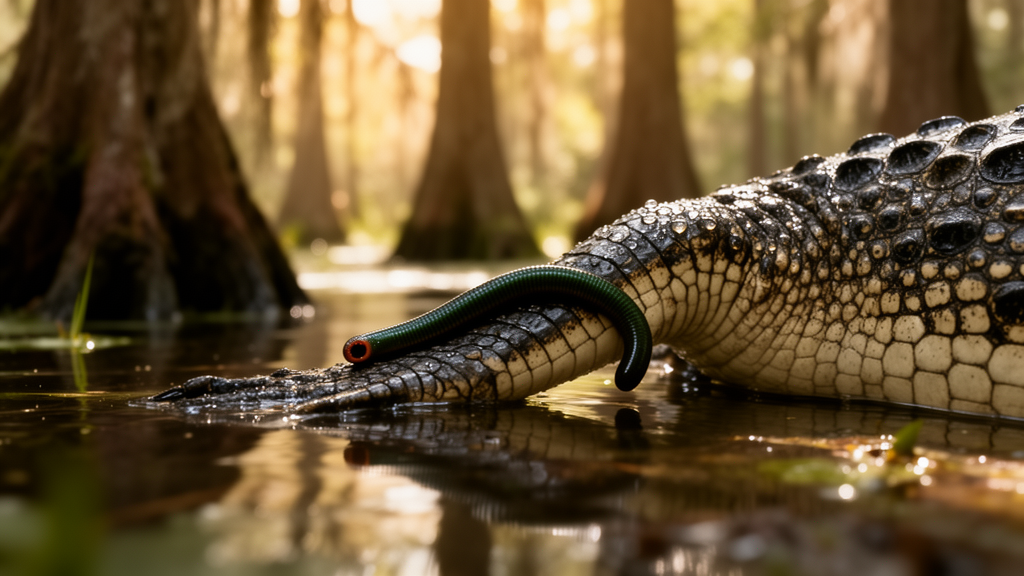
Hidden on the armored hide of the American alligator, small flat leeches of the genus Placobdella are quietly running one of nature’s most intimate microbial partnerships. A new open-access study in the journal Microbial Ecology has taken the most detailed look yet at the bacteria living inside these reptile parasites, sequencing the whole-body microbiomes of leeches collected from alligators across the southeastern United States. The results reveal a surprisingly consistent set of microbial companions, hints of ongoing symbiont swapping between leech species, and a clear demonstration that when these animals are removed from their natural environment, their inner microbial world begins to collapse.
Blood is a deceptively poor meal. It is rich in protein and iron but notoriously deficient in B vitamins and other essential nutrients that animals cannot manufacture on their own. Blood-feeding organisms, from ticks to vampire bats to tsetse flies, have therefore repeatedly evolved relationships with bacteria that can synthesize the missing nutrients. In leeches, the best-known example is Reichenowia, a bacterial symbiont housed in specialized organs and thought to help offset the nutritional shortcomings of a blood-only diet. While Reichenowia has been documented in Placobdella before, the broader microbial community of these leeches, and the ecological forces that shape it, have remained largely unexplored.
To fill that gap, a team led by Logan M. Morris and Shana K. Goffredi of Occidental College, working with collaborators at Clemson University, the Tom Yawkey Wildlife Center, and the University of Georgia, sampled Placobdella leeches from American alligators (Alligator mississippiensis) in seven states, from North Carolina to Texas. The fieldwork depended on an unusually broad network of state wildlife agencies, refuges, and private landowners, reflecting the logistical challenge of collecting parasites from a large, powerful apex predator. The sampling effort captured seven distinct Placobdella clades, and, notably, four of those lineages had never before been reported from alligators, including several that appear to be undescribed species.
The researchers characterized the leech microbiomes using sequencing of the 16S rRNA gene, a standard molecular tool that identifies bacteria by reading a conserved region of their genetic code. Across the seven clades, the microbiomes were dominated by four major bacterial groups: Actinobacteriota, Alphaproteobacteria, Bacteroidota, and Pseudomonadota, the phylum that includes the former class Betaproteobacteria, to which Reichenowia belongs. That combination of dominant taxa, repeated across leeches from widely separated wetlands, suggests a candidate core microbiome, a stable set of microbes that persists regardless of where the host animal happens to live.
Yet the story is not one of rigid host control. When the team tested whether microbiome composition tracked leech clade, geographic location, or habitat type, none of these factors emerged as a strong organizing force. Instead, the communities were only loosely structured, with location-specific bacterial signatures appearing here and there rather than a clean pattern of separation. This mixture of a conserved core and a variable periphery points to a microbiome assembled through two simultaneous processes: long-term, persistent symbiotic interactions inherited or maintained through the leech life cycle, and ongoing acquisition of environmental microbes from the surrounding water and the alligator itself.
One of the most striking findings came from captivity. Leeches held under controlled conditions showed significant declines in microbial diversity, losing much of the richness seen in wild-caught animals. Only four bacterial taxa persisted through the captivity period. This natural experiment, unplanned but highly informative, suggests that the diverse wild microbiome depends on continuous input from the environment, while a small, resilient set of bacteria, likely including the most functionally important symbionts, clings on even when external sources are cut off. The four persistent taxa therefore represent strong candidates for the functional heart of the Placobdella microbiome.
The comparison with the host’s own surfaces added another layer. When the researchers compared leech microbiomes with microbial communities on alligator skin, they found limited overlap. In other words, the leeches are not simply picking up whatever bacteria happen to be sitting on the alligator’s hide. Their internal communities are distinct, consistent with the idea that a combination of host filtering and symbiont maintenance, rather than passive contamination, shapes what lives inside a feeding leech.
The Reichenowia results were particularly intriguing from an evolutionary standpoint. As expected, each Placobdella species generally carried its own distinct Reichenowia lineage, a pattern consistent with long-term coevolution between host and symbiont, in which bacterial lineages diverge alongside their host species. But the sequencing also revealed multiple low-abundance Reichenowia variants within individual leeches, and, remarkably, an identical Reichenowia variant was detected in two Placobdella species living in the same location. That shared variant hints that symbiont transmission between sympatric leech species may occur, whether through shared feeding sites, environmental reservoirs, or horizontal transfer events that standard models of strict vertical inheritance would not predict.
Together, these findings paint a picture of microbiome assembly in blood-feeding leeches as a dynamic balance. A conserved candidate core, presumably anchored by nutrient-providing symbionts like Reichenowia, is maintained across species and landscapes, while a shifting cast of environmental bacteria is acquired and lost depending on circumstances. The detection of previously unknown Placobdella lineages on alligators also expands the known diversity of these parasites and suggests that the microbiome stories of many leech species remain untold. Because leeches move between hosts and environments, they may serve as useful indicators of microbial exchange within wetland ecosystems.
The study also carries practical implications. Captivity-induced loss of microbial diversity is a cautionary signal for anyone maintaining parasitic or symbiont-bearing animals in the laboratory, since the loss of key microbes could alter host nutrition, immunity, or behavior in ways that confound experiments. For conservation biologists monitoring alligator populations in the southeastern United States, the leech microbiome offers a new lens on host health and environmental exposure. And for microbiologists, the work adds Placobdella to the growing list of blood-feeding animals whose dependence on bacterial partners illuminates how symbiosis makes extreme lifestyles possible. As sequencing surveys like this one accumulate across host species and habitats, the emerging theme is clear: even the simplest-looking parasite communities are built on layered, persistent, and still-evolving microbial foundations.
Subject of Research: Microbiome diversity and symbiont dynamics in Placobdella leeches parasitizing American alligators
Article Title: Microbiome Diversity, Persistence, and Potential Symbiont Dynamics in Placobdella Leeches from American Alligators
Article References: Morris, L. M., Boucher, M., Service, C., Anderson, J. T., Rainwater, T. R., Parrott, B. B., & Goffredi, S. K. (2026). Microbiome Diversity, Persistence, and Potential Symbiont Dynamics in Placobdella Leeches from American Alligators. Microbial Ecology. https://doi.org/10.1007/s00248-026-02897-x
Image Credits: AI Generated
DOI: 10.1007/s00248-026-02897-x
Keywords: Placobdella, American alligator, leech, microbiome, Reichenowia, symbiosis, blood-feeding, 16S rRNA sequencing, Microbial Ecology, parasites, wetlands, bacterial symbionts
News Source: Morgan Morrow. (October 8, 2026). Alligator Leeches Reveal a Hidden Core Microbiome Built for a Blood-Only Diet. Scienmag.