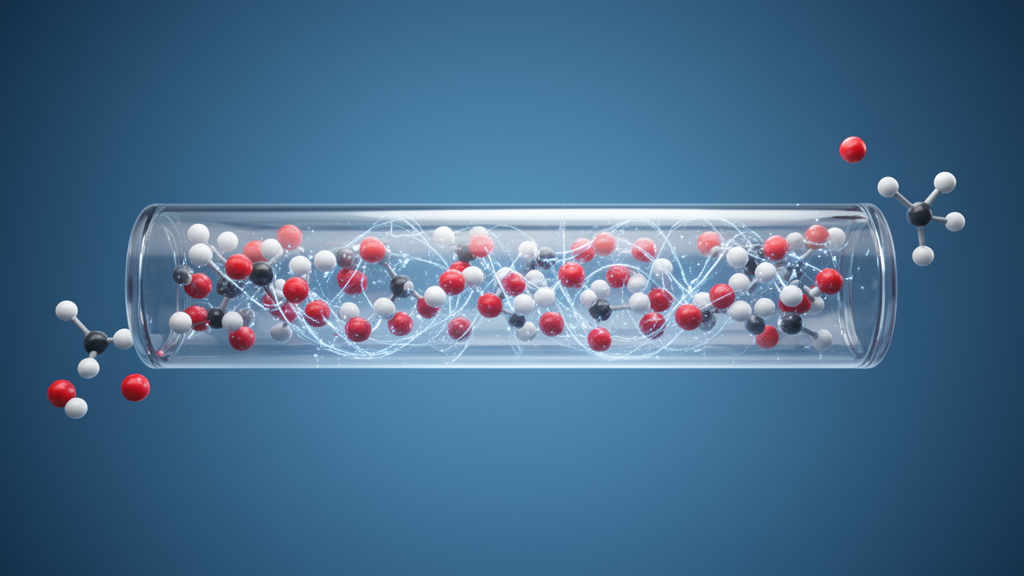
Water is the most familiar liquid on Earth, yet its molecular behavior keeps surprising scientists. In a study published in Nature, a multi-institution team led by researchers at Stanford University, MIT, Vanderbilt University and Oak Ridge National Laboratory has captured the first direct, molecular-level look at how hydrogen bonding changes when water is forced into spaces only a few molecules wide. Using a technique called vibrational electron energy loss spectroscopy, or vEELS, the team measured the O–H stretching vibrations of individual water molecules confined inside single carbon nanotubes, and found that at small enough diameters the familiar hydrogen-bond network of liquid water essentially falls apart.
Hydrogen bonds are the glue of liquid water. Each water molecule can donate and accept hydrogen bonds with its neighbors, and the strength and geometry of that network govern nearly everything water does, from its high boiling point to its role as a universal solvent. When a hydrogen bond forms, it weakens and lengthens the covalent O–H bond inside the molecule, which lowers the frequency at which that bond vibrates. When a molecule has no hydrogen-bond partners, its O–H stretch shifts to a higher frequency, close to the so-called free O–H stretch seen in water vapor. That makes the O–H stretching frequency an exquisitely sensitive reporter of local hydrogen-bonding conditions, and it is exactly the signal the researchers set out to measure.
Optical vibrational studies have long suggested that water near interfaces and inside tiny pores behaves differently from bulk water, showing altered O–H stretching frequencies. But conventional optical spectroscopy cannot resolve structures at the scale of individual molecules and surface forces, so the experimental picture of confined water has remained indirect. The new work overcomes that limitation by bringing vibrational spectroscopy into the transmission electron microscope, where the electron beam can be focused onto a single nanotube and the energy lost by electrons to molecular vibrations can be recorded with nanoscale spatial resolution.
The experimental platform was as important as the instrument. The team grew individual carbon nanotubes, cut them with a focused ion beam, and exposed them to humidity above 99 percent so that water would condense and fill the tubes. The tubes were sealed and transferred into the electron microscope, where vEELS spectra were collected from water-filled and empty tubes alike. The researchers confirmed that the vibrational peaks they measured were far broader than their instrumental resolution, meaning the linewidths reflected the physics of the confined water rather than artifacts of the measurement. They also distinguished the water signal from the excitonic transitions of the carbon nanotube itself, which occur in the same energy range but follow a different dependence on tube diameter.
The results were striking. In larger nanotubes, with an inner diameter of about 2.3 nanometers, the confined water showed the bonded O–H vibrations characteristic of bulk liquid water, indicating that a normal hydrogen-bond network had formed. But in narrower tubes, around 1.4 nanometers, the O–H stretch blueshifted to a frequency near the free O–H stretch of water vapor, the signature of molecules in a highly dispersed, essentially non-hydrogen-bonded environment. In other words, when water is squeezed into a channel barely wide enough for a single file or a small cluster of molecules, it stops behaving like a liquid and starts behaving more like isolated molecules hovering near a hydrophobic surface.
To interpret the spectra, the team turned to theory. They modeled the O–H bond as a quantum vibrational oscillator, using a Morse potential that captures how the stretching frequency depends on hydrogen-bond strength, and connected the observed spectral features to specific local hydrogen-bonding configurations. Complementary molecular dynamics simulations, powered by machine-learning interatomic potentials trained on density functional theory, reproduced the vibrational density of states of confined water and showed how the balance between bonded and free O–H modes shifts with tube diameter, water density and temperature. The bonded-to-free peak ratio grew nearly linearly with increasing diameter and density, providing a quantitative framework for why different nanotubes can show such diverse spectra.
The simulations also clarified the energetics of confinement. Water enters hydrophobic carbon nanotubes spontaneously, a phenomenon long studied because of its relevance to fast mass transport through sub-2-nanometer pores, and the new data show what happens to the hydrogen-bond network once it is inside. The theoretical analysis revealed the quantum and dynamic character of hydrogen bonds under confinement: bonds that are fleeting, strained and frequently broken, in contrast with the continuously rearranging but collectively connected network of the bulk liquid. This connects to a broader body of work on nuclear quantum effects in water, which have been shown to influence both the vibrational spectra and the electronic structure of aqueous systems.
The team did not stop at room temperature. Using a cryogenic transfer stage built for the electron microscope, they cooled water-filled nanotubes down to 100 kelvin and watched the vibrational spectra change. The temperature-dependent measurements revealed signatures of complex structural phase transitions in the confined water, with an additional bonded O–H mode appearing at low temperature that the simulations suggest may correspond to a form of ice. Confined water is known to form exotic phases, including ordered ice nanotubes inside carbon nanotubes, and phase diagrams computed for water in nanotube pores predict melting and freezing behavior far removed from bulk water. The new single-tube spectra provide a direct vibrational window onto those transitions in individual, real-world nanotubes rather than ensembles.
The ability to see hydrogen bonding directly at the nanoscale has implications well beyond fundamental physical chemistry. Water confined in single-digit nanopores drives the exceptional flow rates observed in carbon nanotube membranes, the selectivity of advanced filtration and desalination materials, and the behavior of electrolytes in batteries and biological ion channels. Interfacial water also plays a central role in electrochemistry, catalysis and the strange surface chemistry of aqueous droplets, where recent studies have shown strong electric fields and unusual reactivity. A measurement tool that can read out the local hydrogen-bond environment of water inside an individual nanostructure gives engineers and scientists a new way to test and refine the models behind those technologies.
The study also demonstrates how far electron microscopy has come as a spectroscopic tool. Vibrational EELS in the infrared regime, made possible by monochromated electron beams, now delivers spatially resolved vibrational information that optical methods cannot match for individual nanostructures, and the researchers have released their raw data and analysis notebooks openly so that others can build on the approach. As the technique matures, the same strategy could be applied to other confined fluids, electrolytes and molecular species inside nanoscale channels, opening a route to watching chemistry happen one nanometer at a time. For water itself, the message of the new work is clear: strip away its neighbors, and even the most studied liquid on the planet becomes something unfamiliar, its hydrogen bonds giving way to a dispersed, vapor-like world inside the smallest of spaces.
Subject of Research: Hydrogen bonding of water confined inside individual carbon nanotubes measured by vibrational electron energy loss spectroscopy
Article Title: Hydrogen bonding in water under extreme confinement
Article References: Xu, X., Kuehne, M., Walker, H. A., Bao, D.-L., Jin, X., Tu, Y.-M., Ritt, C. L., Martis, J., Idrobo, J. C., Pantelides, S. T., Strano, M. S., Hachtel, J. A., & Majumdar, A. (2026). Hydrogen bonding in water under extreme confinement. Nature. https://doi.org/10.1038/s41586-026-10858-0
Image Credits: AI Generated
DOI: 10.1038/s41586-026-10858-0
Keywords: water, hydrogen bonding, carbon nanotubes, nanofluidics, vibrational spectroscopy, EELS, confinement, phase transitions, molecular dynamics, machine learning potentials, nanopores, Hydrogen
News Source: Denise Maddox. (October 8, 2026). Water Loses Its Hydrogen Bonds When Squeezed Into Nanotubes, Landmark Study Shows. Scienmag.