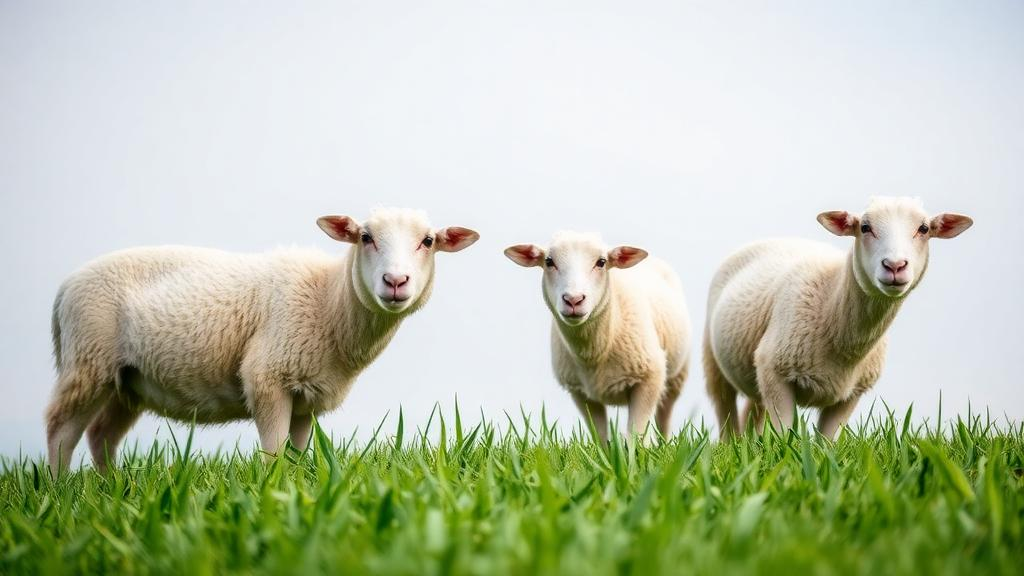
In a finding that sounds like science fiction but comes straight from the feedlot, Chinese researchers report that sheep fed a grass variety mutated by a trip to space produced meat with a measurably better flavor profile. The study, published in Food Chemistry: X, tracked Hu lambs whose diets were supplemented with a space-mutated strain of giant reed (Arundo donax L.), a fast-growing perennial grass. The animals’ muscle tissue underwent a striking metabolic shift: long-chain fatty acids were diverted away from mitochondrial burning and toward storage, boosting intramuscular fat and reshaping the volatile compounds that give cooked mutton its characteristic aroma. The result was lamb that smelled less rancid and fatty, and more fresh, sweet, and fruity.
The story begins in 2013, when buds of Arundo donax were flown aboard the Shenzhou-10 spacecraft. Exposure to the space environment—cosmic radiation, microgravity, and other stressors—induced genetic and phenotypic changes in the plant material. Back on Earth, researchers propagated the buds through tissue culture and carried out successive rounds of selection, ultimately producing a stable mutant line they call space-mutated Arundo donax, or SA. Giant reed is already an attractive candidate for forage because of its enormous biomass and tolerance for marginal environments, but the wild-type plant has drawbacks: its fiber content is high and it overwinters poorly. The space-mutated line retained the parent plant’s hardiness while showing improved nutritional characteristics, with hay containing 19.12 percent crude protein on a dry-matter basis.
To test whether SA could improve meat quality and not just fill stomachs, the team ran a 67-day feeding trial with 30 three-month-old Hu lambs, a Chinese breed prized for its meat. The lambs were split into three groups of ten. A control group received a standard ration based on alfalfa hay and protein supplements from soybean and cotton meal. A second group had its alfalfa hay entirely replaced with SA hay, while a third group had SA substituted for the protein supplements in its concentrate. All rations met the Chinese national standard for meat-type sheep, and the animals grew normally throughout the trial, confirming that SA is a viable feed ingredient.
After the feeding period, six lambs of similar weight from each group were humanely slaughtered, and samples of the longissimus thoracis muscle—the cut that becomes ribeye and similar steaks—were snap-frozen for analysis. Histological examination revealed that muscle fibers in both SA-fed groups had significantly smaller diameters and cross-sectional areas than those of the control animals, a change generally associated with improved tenderness. More importantly, the intramuscular fat content was significantly higher in both SA groups. Intramuscular fat, known as marbling in beef circles, is a key reservoir of flavor precursors and a major determinant of juiciness and overall eating quality.
The mechanism behind this fat boost appears to lie in the carnitine shuttle, the cellular machinery that ferries long-chain fatty acids into mitochondria, where they are burned for energy. The rate-limiting step is catalyzed by an enzyme called carnitine palmitoyltransferase 1, or CPT1, which sits on the outer mitochondrial membrane. When the researchers measured CPT1 levels, they found them reduced in the SA-fed animals, particularly in the group whose protein supplements had been replaced. Consistent with this, lipidomic analysis showed that long-chain acylcarnitines—molecular signatures of fatty acids being shuttled into mitochondria—were consistently downregulated in SA-fed muscle. Fatty acids that would otherwise have been oxidized were instead redirected into storage as triglycerides and phospholipids.
Crucially, this metabolic rewiring did not come at the cost of oxidative stress. Reactive oxygen species levels were unchanged across all three groups, and malondialdehyde, a marker of lipid peroxidation, was actually significantly lower in the alfalfa-replacement group. That matters because excessive mitochondrial fat oxidation is known to generate reactive oxygen species and promote rancidity. The SA-fed lambs apparently achieved fat deposition without the oxidative damage that often accompanies it, possibly thanks to plant-derived secondary metabolites such as terpenoids, flavonoids, and alkaloids in the mutated grass, compounds known to modulate mitochondrial function and antioxidant defenses.
To see how these lipid changes translated into flavor, the team used headspace solid-phase microextraction coupled with gas chromatography–mass spectrometry to profile the volatile compounds in the meat. They identified 535 volatiles, dominated by aldehydes, ketones, and esters. In the alfalfa-replacement group, lipid oxidation products such as 2,3-octanedione were significantly reduced, while desirable aroma compounds—fruity lactones and esters like 5-heptyldihydro-2(3H)-furanone and 3-methylbutyl 3-methylbutanoate—were significantly increased. Using relative odor activity values to weigh each compound’s sensory contribution, the researchers identified 43 key odorants and found that SA feeding shifted the overall aroma profile away from oily, fatty notes and toward green, sweet, and fruity ones.
The final piece of evidence came from a correlation analysis linking the lipidome to the volatilome. Long-chain acylcarnitines such as carnitine C16:1, C18:1, and C20:2 showed robust positive correlations with lipid oxidation-derived volatiles like nonanal and 2,3-octanedione, the compounds responsible for rancid and greasy aromas. Meanwhile, plant-derived terpenoids such as beta-ionone and farnesene, which the animals presumably picked up from the SA forage, contributed fresh, floral, woody, and herbal nuances that enriched the flavor hierarchy and dampened undesirable gamey odors. Together, these data sketch out what the authors call a carnitine shuttle–lipid remodeling–flavor axis: the forage alters mitochondrial fat transport, which alters fat storage, which alters the chemistry of aroma formation during cooking.
The implications extend beyond a single breed of sheep. Mutton’s distinctive flavor, driven largely by branched-chain fatty acids and lipid-derived volatiles, is a major barrier to consumer acceptance in many markets, so a feed-based strategy for softening it could have real commercial value. Just as significant is the agricultural angle: giant reed grows vigorously on marginal land with few inputs, and a space-mutated line that doubles as nutritious forage could ease pressure on alfalfa and protein concentrate supplies. The study also adds to a growing body of evidence that space mutagenesis is a practical plant-breeding tool, not a novelty. As the authors note, future work with sensory panels, enzyme assays, and sampling across slaughter stages will be needed to confirm the mechanism, but the prospect of space-flown grass improving the taste of Sunday dinner is already on the table.
Subject of Research: Effects of space-mutated Arundo donax forage on carnitine-mediated lipid metabolism and mutton flavor in Hu sheep
Article Title: Dietary substitution with space-mutated Arundo donax L. remodels carnitine-mediated lipid oxidation and improves mutton flavor in Hu sheep
Article References: Nie, Y., Zhang, L., Han, C., Li, X., Wu, Y., Wang, C., & Ma, Y. (2026). Dietary substitution with space-mutated Arundo donax L. remodels carnitine-mediated lipid oxidation and improves mutton flavor in Hu sheep. Food Chemistry: X, Article 104555. https://doi.org/10.1016/j.fochx.2026.104555
Image Credits: AI Generated
DOI: 10.1016/j.fochx.2026.104555
Keywords: space mutagenesis, Arundo donax, Hu sheep, mutton flavor, carnitine shuttle, CPT1, lipidomics, intramuscular fat, volatile compounds, fatty acid oxidation, animal feed, food chemistry
News Source: Bethany Barker. (October 7, 2026). Space-Mutated Grass Feeds Sheep and Makes Their Meat Taste Better, Study Finds. Scienmag.