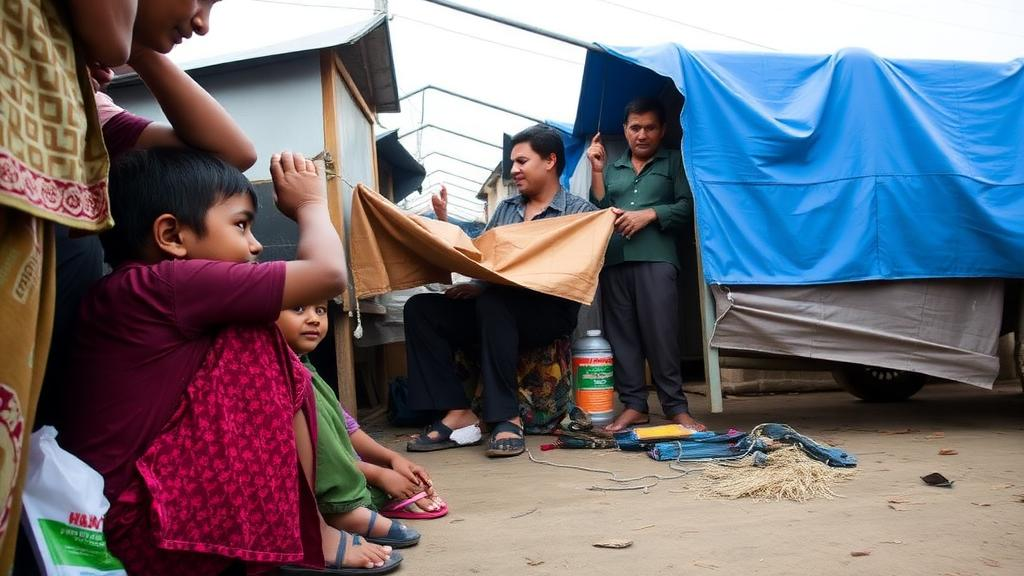
In the crowded slum neighbourhoods of Dhaka, Bangladesh, a visit to a healthcare provider is rarely a simple decision. Residents must weigh the cost of a consultation against the price of medicines, the length of the journey against the hours spent waiting in a queue, and the reputation of one provider against the advice of neighbours who have tried others. A new study published in BMC Public Health has, for the first time in this setting, systematically mapped out exactly which of these factors matter most to slum dwellers when they choose where to seek primary healthcare. The research, led by Md. Zahid Hasan of the University of Leeds and icddr,b together with colleagues in Leeds and Dhaka, lays the methodological groundwork for a discrete choice experiment, a survey technique that can quantify how people trade off competing features of health services when no option is perfect.
Discrete choice experiments rest on a deceptively simple premise: rather than asking people what they want in the abstract, researchers present them with a series of hypothetical scenarios, each describing a healthcare provider defined by a handful of characteristics, and ask which they would prefer. By varying those characteristics systematically across many choices, statisticians can estimate the relative weight that respondents place on each one, and even calculate how much of one attribute, such as money, a person would sacrifice to gain an improvement in another, such as shorter waiting time. The technique has become a mainstay of health economics in high-income countries, but its application in low- and middle-income settings has been constrained by a persistent problem: the attributes, the characteristics that define the choices, are often borrowed from studies conducted in entirely different contexts, where the drivers of healthcare decisions may be radically different.
That is the gap the new study set out to close. Rapid urbanisation across South Asia and much of the developing world has outpaced the growth of urban primary healthcare systems, and in cities like Dhaka the slum population relies on a bewildering patchwork of providers, from government clinics and non-governmental organisation facilities to private pharmacies, informal drug sellers and traditional practitioners. Despite the scale of this challenge, remarkably little research has asked the residents of these settlements what they actually value when choosing among such providers. Without that knowledge, policymakers designing urban health services are effectively guessing at the preferences of the very people they aim to serve, and the risk is that new facilities or financing schemes fail to attract patients because they overlook the features that matter most on the ground.
The research team approached the problem in two carefully sequenced phases designed to be transparent and replicable by others working in similar settings. The first phase was about breadth: casting a wide net to capture every plausible attribute of primary healthcare that might influence a slum dweller’s choice. The investigators drew on three complementary sources. They conducted a systematic review of the relevant literature to identify attributes used in previous healthcare choice studies. They ran four focus group discussions with community members in Dhaka’s slums, deliberately including both people who had used primary healthcare services in the previous year and those who had not, to capture the perspectives of users and non-users alike. And they carried out eight key informant interviews with supply-side stakeholders, the people who plan, fund and deliver urban health services, to understand the considerations from the provider perspective as well.
This triangulation of evidence produced a long list of twenty-five distinct attributes, ranging from clinical quality and staff behaviour to distance, cost and social recommendation. A list of that length is unmanageable for a discrete choice experiment: respondents presented with too many characteristics at once become overwhelmed, and the statistical burden of estimating preferences for dozens of attributes grows rapidly. The second phase of the study was therefore about reduction and refinement. The team narrowed the long list to twelve attributes and took them to the community itself, conducting a ranking exercise with fifteen slum residents who were asked to order the attributes by importance. They then consulted one-to-one with four urban health experts, who scrutinised the shortlist for feasibility, policy relevance and interpretability, and finally pretested the draft survey instrument with members of the target population to check that the attributes and their levels were actually understood as intended.
Out of this iterative process emerged six attributes for the final experiment: the travel time required to reach a healthcare centre, the waiting time once there, the type of healthcare provider, whether the provider had been recommended by neighbours or relatives, the consultation fee, and the expenditure on medicines. The selection is striking for what it reveals about healthcare decision-making in this setting. Two of the six attributes are purely temporal, capturing the total time burden of care from doorstep to consultation room. Two are financial, separating the visible, negotiated cost of the consultation from the often larger and less predictable cost of medicines, a distinction that matters enormously for households where out-of-pocket payments dominate health spending. And two are social and informational: the identity of the provider and the word-of-mouth endorsement of trusted community members, which in neighbourhoods where formal quality signals are scarce may serve as the primary heuristic for judging competence and trustworthiness.
The attribute levels, the specific values each characteristic can take in the hypothetical scenarios, were grounded directly in the qualitative data rather than in administrative records or expert assumptions. The range of travel times, fees and medicine costs reflected the real experiences described by focus group participants, ensuring that the choices presented in the eventual survey would be recognisable and plausible to respondents. This grounding in lived experience is one of the study’s most important methodological contributions, because attribute levels that fall outside the range of what people have actually encountered can distort preference estimates, producing results that are statistically tidy but practically meaningless for policy.
Perhaps the most instructive findings came during pretesting, when the researchers confronted a barrier that is easy to underestimate: literacy. Comprehension of the attributes and levels proved difficult for participants with low literacy, a common characteristic in slum populations where formal schooling may be limited or interrupted. The team responded by revising the wording of the survey and introducing graphical Q-cards, visual representations of each attribute and level that allow respondents to grasp the choices without relying on text. The lesson has broad implications for survey research in low-income urban settings worldwide, where instruments designed for educated populations can silently exclude or mislead the very respondents whose preferences are most needed. A choice experiment whose scenarios are misunderstood does not measure preferences; it measures confusion.
The study, which received ethics approval from the University of Leeds and BRAC University and was funded through the CHORUS Research Programme Consortium supported by the UK Foreign, Commonwealth and Development Office, is candid about its own scope: it does not report the preference results themselves, which await the full discrete choice experiment. What it delivers instead is something arguably more durable, a documented, step-by-step template for building choice experiments from the ground up in understudied, low-income urban environments. By showing how qualitative evidence, community ranking, expert consultation and iterative pretesting can be woven together to distil twenty-five candidate attributes down to six defensible ones, the authors offer researchers across the global South a practical worked example that resists the temptation to import attribute sets from unrelated contexts.
For the residents of Dhaka’s slums, the eventual payoff could be concrete. Once the choice experiment is fielded, its results will allow health planners to estimate, for example, how much a reduction in waiting time would increase uptake of a government clinic, or how sensitive patients are to consultation fees relative to medicine costs, evidence that can be used to design services people will actually use. In a world where more than a billion people live in informal settlements and urban health systems are straining to keep pace, understanding the arithmetic of healthcare choice at the household level is no longer an academic luxury. This study demonstrates that the tools of health economics can be adapted, with care and humility, to hear what the urban poor are actually saying about the care they want, and it hands the next generation of researchers a rigorous map for following the same path.
Subject of Research: Development of attributes and attribute-levels for a discrete choice experiment on primary healthcare provider preferences among urban slum dwellers in Bangladesh
Article Title: Developing attributes and attribute-levels for a discrete choice experiment on preference for primary healthcare providers among urban slum dwellers in Bangladesh
Article References: Hasan, M. Z., Webb, E. J., Tisha, K. I., Quayyum, Z., & Ensor, T. (2026). Developing attributes and attribute-levels for a discrete choice experiment on preference for primary healthcare providers among urban slum dwellers in Bangladesh. BMC Public Health. https://doi.org/10.1186/s12889-026-29585-2
Image Credits: AI Generated
DOI: 10.1186/s12889-026-29585-2
Keywords: discrete choice experiment, primary healthcare, urban slums, Bangladesh, Dhaka, health economics, attribute development, healthcare preferences, low- and middle-income countries, survey methodology, out-of-pocket payments, urban health
News Source: Ophelia Keating. (October 7, 2026). What Slum Dwellers in Dhaka Really Want from Their Local Health Clinics. Scienmag.