Stealth technology has always faced an awkward trade-off. Materials that absorb radar waves well tend to be heavy, narrow in bandwidth, or both, forcing engineers to choose between shielding an aircraft from detection and keeping it light enough to fly. A team of Chinese researchers now reports a composite that appears to thread that needle: hollow, pore-rich microspheres built from a high-entropy alloy and reduced graphene oxide, wrapped in an ethyl cellulose shell with an epoxy core, that absorb microwaves across nearly the entire C, X and Ku bands used by radar and communications systems.
The work, published in the Journal of Materials Science by Enyi He, Bo Song and colleagues at Huazhong University of Science and Technology and China Three Gorges University, centers on FeCoCrNiAl2, a five-element high-entropy alloy. Unlike conventional alloys built around a single dominant metal, high-entropy alloys mix several elements in roughly equal proportions, producing chaotic, distorted crystal lattices with unusual electronic and magnetic properties. In recent years these materials have attracted intense interest for electromagnetic applications precisely because that atomic disorder scatters and dissipates energy in ways ordinary alloys cannot.
But the alloy alone was not enough. The researchers combined it with reduced graphene oxide, or rGO, the defect-rich, electrically conductive form of graphene that has become a staple of microwave-absorption research. The critical variable turned out to be the ratio. When the mass ratio of FeCoCrNiAl2 to rGO was set at 3:1, the composite delivered its best performance, a balance the authors attribute to the synergistic interplay between the alloy’s magnetic losses and the graphene’s dielectric losses. Too much graphene and the material becomes overly conductive, reflecting waves at its surface instead of letting them in; too little and the dielectric loss pathway is starved.
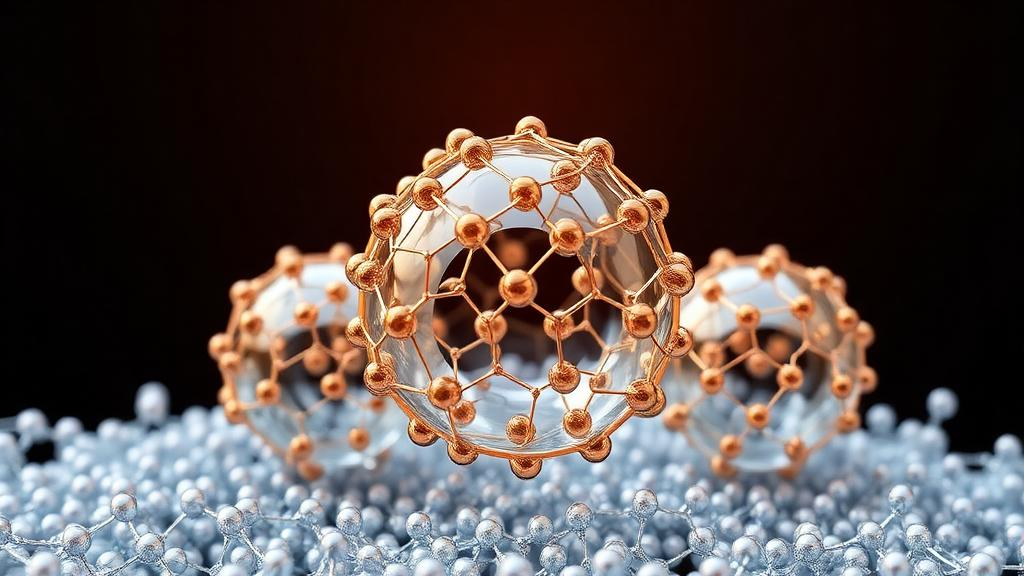
The architecture is as important as the chemistry. Using a microemulsion technique, the team built spherical particles in which ethyl cellulose forms the outer shell framework and epoxy resin fills the inner core. The resulting microspheres are hollow and riddled with pores, and that internal void space does real electromagnetic work. Every boundary between air, polymer, alloy and graphene is a dielectric-magnetic heterointerface, a place where the material’s electrical and magnetic response changes abruptly. At each such boundary, incident microwaves are partially reflected, partially transmitted and partially absorbed, so a single wave entering a microsphere can bounce and scatter many times before it escapes, losing energy at every encounter.
The numbers reported in the study are striking. At a sample thickness of just 2 millimeters, the composite achieves an effective absorption bandwidth of 3.6 gigahertz, spanning 10.8 to 14.4 gigahertz, right in the heart of the X and Ku bands where military radars and satellite links operate. At a thinner 1.5 millimeters, the material reaches a minimum reflection loss of minus 40.48 decibels at 17.08 gigahertz. In practical terms, a reflection loss of minus 40 decibels means that more than 99.99 percent of the incident microwave energy at that frequency is absorbed rather than bounced back, which is the figure of merit that matters most for radar evasion and electromagnetic interference control.
Perhaps the most useful property is tunability. By simply varying the sample thickness between 1 and 5 millimeters, the composite can be adjusted to absorb efficiently anywhere across a broad range from 3.8 to 18 gigahertz, essentially covering the entire C, X and Ku bands. Thin absorbers typically struggle at lower frequencies because the quarter-wavelength matching condition demands thicker samples, so a material that can be tuned across nearly three octaves of radar spectrum by thickness alone gives designers a single filler that can serve many roles in one platform.
Underlying all of this is a cascade of dissipation mechanisms working in parallel. The researchers identify dipole and interfacial polarization, conductive loss, natural and exchange ferromagnetic resonance, and eddy current loss as the contributors. Dipole polarization arises when bound charges in the defective graphene and polymer matrix lag behind an oscillating field. Interfacial polarization, the Maxwell-Wagner-Sillars effect familiar from composite dielectrics, accumulates charge at the heterointerfaces created by the hollow porous structure. On the magnetic side, the iron- and cobalt-rich alloy undergoes natural ferromagnetic resonance, while exchange coupling between neighboring magnetic moments and eddy currents induced by the alternating field add further channels through which electromagnetic energy is converted into heat.
Impedance matching is the quiet hero of the story. An absorber fails if its surface impedance differs too much from that of free space, because the wave reflects before it ever penetrates the material. The hollow, porous architecture and the deliberate blending of magnetic alloy with dielectric graphene tune the composite’s permittivity and permeability into a regime where waves enter readily and are then dissipated inside. The abundant interfaces improve that matching while simultaneously multiplying the internal reflection pathways, which is why the authors credit the microspherical design, not just the constituent materials, for the enhanced performance.
The choice of ethyl cellulose and epoxy also carries practical weight. Both polymers are well established in microencapsulation technology, from controlled-release pharmaceuticals to self-healing coatings, and previous work has shown that polymer microcapsules filled with carbonyl iron or other functional powders can be incorporated into structural composites. A microwave absorber built from such microspheres could in principle be blended into resins, coatings or even 3D-printing feedstocks, and several of the authors have previously explored graphene and carbonyl iron microspheres for additive-manufactured absorbing composites. That processing heritage suggests a plausible route from laboratory measurement to real-world radomes, drone skins and electronics enclosures.
The broader context is a fast-moving field. High-entropy materials, from alloys to diborides and carbides, are being systematically explored for wave absorption, with recent studies reporting broadband performance at extreme temperatures and low-frequency absorption through engineered exchange interactions. Graphene-based hybrids with ferrites, carbonyl iron and molybdenum disulfide have pushed reflection losses deeper and bandwidths wider for a decade. What distinguishes the new work is the combination of a high-entropy magnetic filler, a two-dimensional conductive filler and a hollow polymer-templated architecture in a single lightweight particle, with each element contributing a distinct loss mechanism. The researchers, funded by the State Key Laboratory of Materials Processing and Die and Mould Technology, describe their strategy as a new route toward high-performance, wideband electromagnetic absorbers. If the fabrication scales beyond the laboratory, materials like these could quietly become the skin of the next generation of stealthy aircraft, satellites and electronic devices, absorbing the very signals that would otherwise give them away.
Subject of Research: Microwave absorption properties of FeCoCrNiAl2-rGO high-entropy alloy and graphene composite microspheres
Article Title: Fabrication and enhanced microwave absorption properties of high-performance FeCoCrNiAl2-rGO composite materials
Article References: Fabrication and enhanced microwave absorption properties of high-performance FeCoCrNiAl2-rGO composite materials. (n.d.). https://doi.org/10.1007/s10853-026-13276-9
Image Credits: AI Generated
DOI: 10.1007/s10853-026-13276-9
Keywords: high-entropy alloy, reduced graphene oxide, microwave absorption, FeCoCrNiAl2, composite microspheres, impedance matching, radar stealth, electromagnetic interference, ethyl cellulose, epoxy resin, dielectric loss, magnetic loss
News Source: Neil Sanderson. (October 7, 2026). High-Entropy Alloy Meets Graphene in Hollow Microspheres That Swallow Radar Waves. Scienmag.