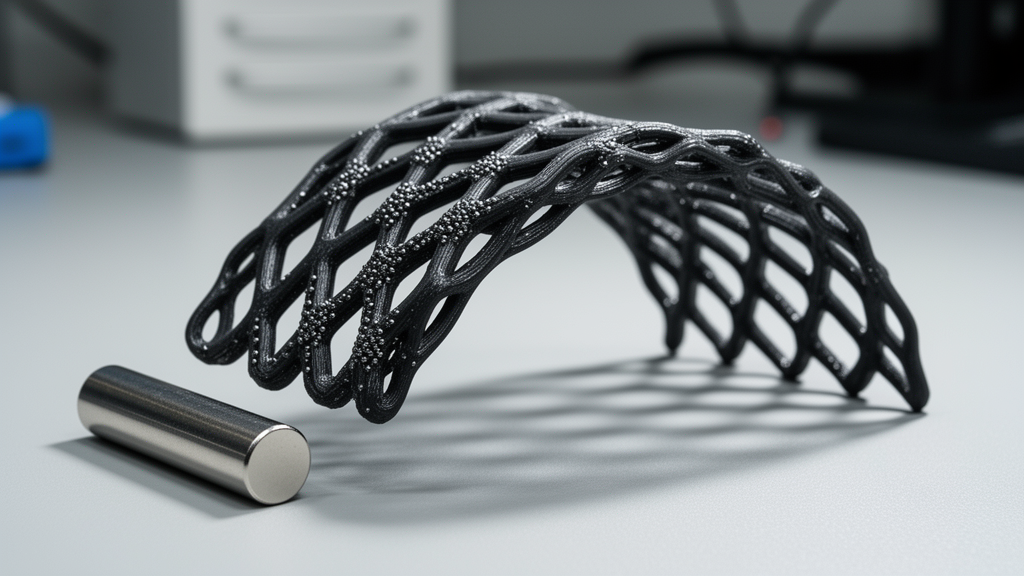
Researchers have successfully developed and fabricated styrene-ethylene-butylene-styrene-based magnetorheological elastomeric composites using direct ink writing three-dimensional printing. The manufactured material system incorporates neodymium-iron-boron powder as a functional filler at concentrations ranging from 0 to 60 weight percent. The experimental investigation targets the advancement of multifunctional soft materials that can achieve programmable deformation, which serves as a critical technological requirement for soft robotics, adaptive structures, and intelligent engineering systems.
Material characterization confirmed the chemical and physical stability of the polymer composite system following the introduction of the magnetic filler. Comprehensive evaluations conducted through X-ray diffraction and Fourier transform infrared spectroscopy revealed that incorporating the neodymium-iron-boron powder produced no detectable phase transformation within the elastomer. Furthermore, the spectroscopic measurements indicated that no unwanted chemical interactions occurred between the embedded filler particles and the surrounding styrene-ethylene-butylene-styrene matrix during material synthesis and deposition.
Rheological testing demonstrated favorable flow characteristics across the entire formulation spectrum. Additionally, three-interval thixotropy analysis demonstrated that post-deposition structural recovery improved progressively as the filler content increased.
Microstructural analyses validated the physical quality and structural consistency of the three-dimensional printed constructs. Microscopic observation revealed homogeneous filler dispersion of the neodymium-iron-boron particles throughout the elastomeric matrix. The characterization also demonstrated defect-free particle-matrix interfaces without apparent void formation or delamination, confirming that direct ink writing is an effective and suitable processing methodology for producing these complex composite architectures.
The printed magnetorheological elastomeric composites exhibited significant magnetic performance metrics that depended directly on filler loading. Measurements indicated a high remanent magnetization that increased substantially from approximately 7 emu/g to approximately 66 emu/g when the neodymium-iron-boron content was raised from 10 to 60 weight percent. Alongside the elevated remanent magnetization, the composite specimens demonstrated a high coercivity of approximately 8 kOe, providing the magnetic strength required for programmable actuation under applied magnetic fields.
The magnetic properties enabled sophisticated mechanical motion under changing external field conditions. The three-dimensional printed composites achieved fully reversible bidirectional actuation in response to both attractive and repulsive magnetic fields. To confirm the practical functionality of the design, the researchers completed a proof-of-concept demonstration that established the mechanical feasibility of carrying out simultaneous attraction and repulsion actuation within the printed elastomeric components.
Beyond their magnetic response, the magnetorheological elastomeric composites demonstrated thermally activated shape memory behavior. The experimental data revealed systematic variations in shape fixity and shape recovery corresponding to shifts in filler concentration. The authors attributed these observed shape memory responses to the mechanical interplay occurring between the original physically cross-linked styrene-ethylene-butylene-styrene elastomer network and the stress-induced temporary network established during thermomechanical programming.
Subject of Research: Direct ink writing of magnetorheological elastomeric composites for magnetic actuation and shape memory
Article Title: Direct ink writing of styrene-ethylene-butylene-styrene-based magnetorheological elastomeric material: Effect of neodymium-based filler loading on magnetic actuation and shape memory behaviour
Article References: Kumar, A., Sharma, V., Pandey, P. M., Kumar, P., & Kumar, N. (2026). Direct ink writing of styrene-ethylene-butylene-styrene-based magnetorheological elastomeric material: Effect of neodymium-based filler loading on magnetic actuation and shape memory behaviour. Journal of Materials Science. https://doi.org/10.1007/s10853-026-14164-y
Image Credits: AI Generated
DOI: 10.1007/s10853-026-14164-y
Keywords: direct ink writing, magnetorheological elastomers, styrene-ethylene-butylene-styrene, SEBS matrix, neodymium-iron-boron, NdFeB powder, magnetic actuation, shape memory behaviour, remanent magnetization, coercivity, bidirectional actuation, shear thinning, thixotropy analysis, particle-matrix interfaces, soft robotics, programmable deformation, thermomechanical programming
News Source: Denise Maddox. (November 23, 2026). 3D Printed Magnetic Elastomers Enable Reversible Actuation and Shape Memory. Scienmag.