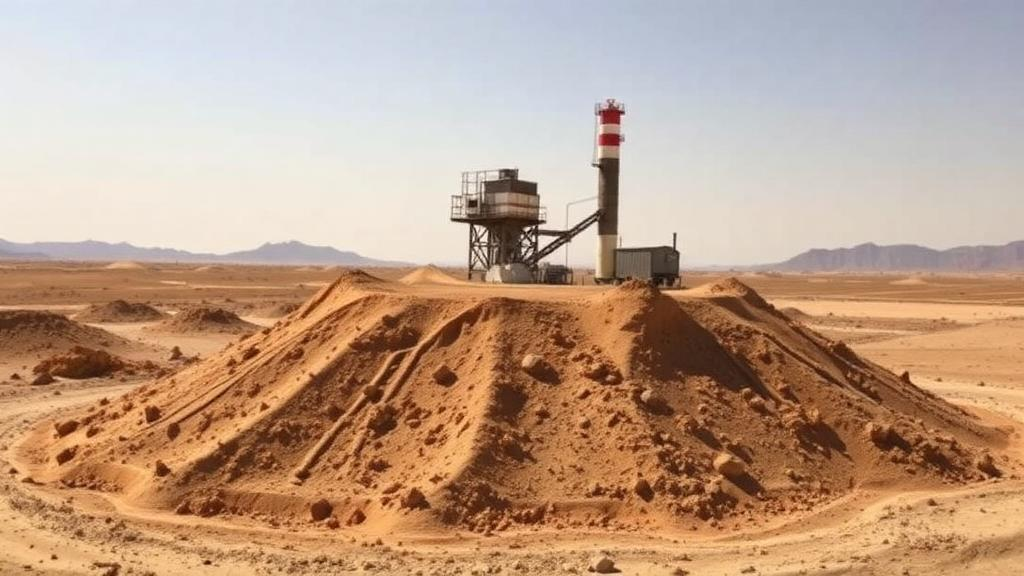
Desert sand is one of the most abundant and most useless materials on Earth for farming. Its grains are coarse, typically between 0.1 and 1 millimeter across, its silt and clay content falls below 5 percent, and it carries almost no organic matter. The consequences are stark: available water capacity under 0.1 cubic meters per cubic meter, cation exchange capacity below 5 meq per 100 grams, and permeability above 10 centimeters per hour, meaning water and nutrients simply drain away beyond the reach of roots. A new conceptual study published in Discover Soil argues that this could change, not through exotic chemistry, but by borrowing the industrial machinery of cement production.
The paper, authored by Sami Rashid Mohammed Shibah, proposes adapting cement grinding techniques to mechanically crush desert sand into fine, soil-like particles. The idea is deliberately provocative: the same comminution physics that turns limestone into cement powder could, in principle, transform poorly graded desert sand into a silt-sized material capable of holding water and nutrients. Crucially, the author is explicit that the work is strictly conceptual. No laboratory experiments or field trials were conducted; every number in the study is a model-derived estimate that awaits empirical validation.
The engineering core of the framework is Bond’s law, the classic comminution equation from mineral processing that relates the energy required to grind a material to the change in its particle size. Using a work index of 14 kWh per ton, based on published averages for silica sand, the model calculates that grinding desert sand from a feed size of 500 micrometers down to a product size of 50 micrometers would require approximately 13.5 kWh per ton. Sensitivity analysis shows the estimate ranges from 9.7 to 17.4 kWh per ton depending on the work index, and from 11.8 to 15.9 kWh per ton depending on the target fineness. In practice, the sand would be processed in ball mills or vertical roller mills operating in closed circuit with classifiers, which recycle oversize material until the desired fineness is reached.
To describe how the ground sand would behave, the study uses the Rosin-Rammler distribution, a standard mathematical function for characterizing particle size distributions in crushed materials. The model shifts the distribution from a pre-grinding characteristic size of 300 micrometers to 30 micrometers after grinding, with the mean particle size dropping from 340 to 28 micrometers. This is more than a cosmetic change. Finer particles dramatically increase specific surface area, which the framework links to modeled improvements of 32 percent in water retention and 74 percent in soil organic carbon holding. The ground material would also shift in classification terms from poorly graded sand toward a silt-like material, with a modeled plasticity index of 5 to 15.
Grinding alone, however, cannot create fertile soil. The framework therefore integrates amendments, most prominently biochar at application rates of 3 to 6 percent. Drawing on meta-analyses of biochar effects in sandy soils, the model predicts that biochar could increase available water capacity by 21 to 42 percent and cation exchange capacity by 20 to 50 percent. The relationship is modeled with non-linear regression to capture diminishing returns at higher application rates. Biochar also promotes the formation of aggregates, echoing what pedologists call pedostructures, the hierarchical organization of soil peds that distinguishes micro water held within aggregates by surface charges from macro water moving between them under gravity.
This distinction comes from hydrostructural pedology, the theoretical backbone of the study. Unlike traditional descriptive pedology, hydrostructural pedology applies thermodynamic principles to quantify water-soil interactions in the soil-plant-atmosphere system, physically modeling so-called green water dynamics. The framework also borrows from fluid mechanics: saturated flow is estimated with Darcy’s law and extended to unsaturated conditions via the Richards equation. The models predict that amended soil would see permeability fall from over 10 centimeters per hour to a more moderate 1 to 5 centimeters per hour, slow enough to retain water yet fast enough to avoid waterlogging.
The study confronts the practical problems head-on. Finely ground quartz-dominated sand is prone to caking, which the framework proposes to mitigate with 0.5 to 2 percent silicon dioxide or 1 to 3 percent modified dispersants, reducing caking by a modeled 10 to 50 percent. Energy supply is addressed through solar power: in the Rub’ al-Khali, where insolation reaches 6.5 to 7.5 kWh per square meter per day, a 10 kW photovoltaic array operating at 15 to 20 percent efficiency would generate 65 to 75 kWh daily, enough to grind roughly 4.8 to 5.6 tons of sand per day. Hybrid systems with concentrated solar power could optimize output, while automated panel cleaning would counter the 5 to 10 percent efficiency losses caused by desert dust.
Uncertainty is handled with unusual statistical rigor for a conceptual paper. Monte Carlo simulations with 10,000 samples, assuming a normally distributed work index, yield a mean energy requirement of 13.6 kWh per ton with a standard deviation of 1.4 and a 95 percent confidence interval of 11.1 to 16.6. Bayesian inference updates prior work-index estimates against literature variability, converging on a posterior mean of 14.0 kWh per ton. Sobol indices quantify which parameters drive variance in the outputs, and hypothesis tests on particle size distributions before and after grinding reject the null hypothesis of no change at p below 0.001, establishing the falsifiability the author says future experiments must preserve.
The economics, while scenario-based, suggest the concept is not obviously absurd. Grinding costs are estimated at 0.5 to 1.0 USD per ton with solar-adapted mills, while biochar at 200 to 300 USD per ton dominates the amendment budget. For an application of 8 tons of biochar per hectare, the model projects a net present value of 930 to 1500 USD per hectare over ten years, an internal rate of return of 86 to 120 percent, and a benefit-cost ratio of 1.2 to 2.0 under optimistic scenarios. Water savings of 30 to 70 percent from AI-driven irrigation, worth 500 to 1500 USD per hectare annually, and yield gains of 15 to 40 percent strengthen the case. The framework benchmarks itself against Liquid NanoClay technology, which has demonstrated field-scale sand-to-soil conversion at 1800 to 9500 USD per hectare with 50 percent water savings, and suggests hybrid approaches could reduce costs further.
The author is unambiguous about the study’s central limitation: the complete absence of empirical validation at any scale. The proposed pathway forward is phased, beginning with laboratory tests of particle size distribution, water capacity, and cation exchange capacity under ASTM standards, followed by small-plot trials of 1 to 5 hectares in Saudi Arabia’s Al-Jouf region monitored with tensiometers, and finally full-scale pilots of 10 to 50 hectares integrating solar grinding and AI irrigation. Randomized controlled trials comparing amended and control plots would provide falsifiable evidence, with long-term monitoring for stability. The potential prize is considerable: desertification affects over 2 billion people and degrades 12 million hectares annually, and Saudi Arabia’s Green Initiative targets the restoration of 40 million hectares. The framework also projects carbon sequestration of 0.5 to 2 tons of CO2 per hectare per year through biochar, aligning with UN Sustainable Development Goals on hunger, climate action, and land ecosystems. Whether cement mills can truly manufacture soil remains an open question, but the study provides a quantified, falsifiable starting point for answering it.
Subject of Research: Mechanical conversion of desert sand into agriculturally viable soil using adapted cement grinding techniques
Article Title: A conceptual framework for converting desert sand into agriculturally viable soil using adapted cement grinding techniques
Article References: Shibah, S. R. M. (2026). A conceptual framework for converting desert sand into agriculturally viable soil using adapted cement grinding techniques. Discover Soil, 3(1), Article 107. https://doi.org/10.1007/s44378-026-00253-6
Image Credits: AI Generated
DOI: 10.1007/s44378-026-00253-6
Keywords: desert sand, cement grinding, Bond's law, particle size distribution, biochar, soil amendment, hydrostructural pedology, solar-powered grinding, AI irrigation, Monte Carlo simulation, desertification, Saudi Arabia
News Source: Katie Riggs. (October 6, 2026). Cement Mill Physics Could Turn Desert Sand Into Farmable Soil, Study Proposes. Scienmag.