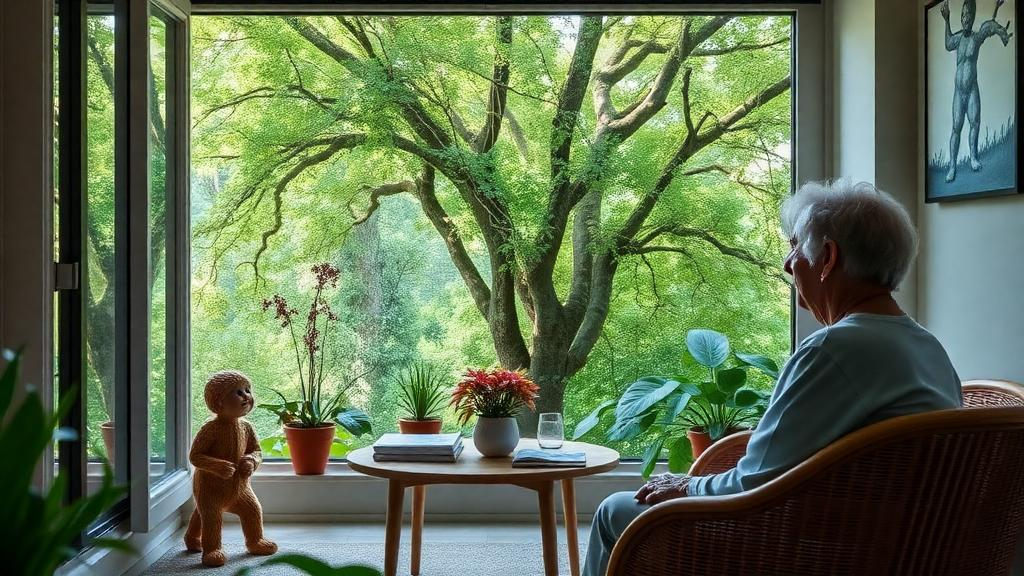
As the world’s population ages at an unprecedented pace, scientists are racing to identify the everyday environmental factors that might protect the aging brain. A new study from Nanjing, China, adds a striking piece to that puzzle: the greenery older adults actually see and experience around their homes appears to be measurably associated with how well their minds work. The research, published in BMC Public Health by a team at Nanjing Forestry University, suggests that not all greenery is equal in the eyes of the aging brain, and that the view from a living-room window may matter as much as the park down the street.
The study, led by YuJun Ding, Lu Liu, ZiHan Zhou and corresponding author Bing Zhao, set out to answer a deceptively simple question with unusually rigorous methods. Most previous research on greenspace and health has relied on satellite-derived vegetation indices, which measure how green a neighborhood looks from hundreds of kilometers above the Earth. But older adults, whose mobility is often restricted, experience their environment at ground level and from indoors. A dense tree canopy invisible behind apartment walls, or a park requiring a difficult journey, may contribute little to the daily sensory life of an eighty-year-old. The Nanjing team therefore designed their investigation around a multidimensional assessment of residential greenspace, capturing both what instruments measure and what residents actually perceive.
The setting was the Mochou Lake sub-district of Nanjing, a densely built urban area chosen as a representative case study. The researchers initially recruited 852 older adults across 44 residential communities, ultimately analyzing data from 850 participants. Each participant completed an offline survey collecting demographic information and two distinct measures of perceived greenspace: a single-item rating of perceived outdoor greenspace, capturing how green respondents judged their surrounding neighborhood to be, and a single-item rating of perceived window-view greenspace, capturing how much greenery they saw from their own windows. Cognitive function was assessed with the Chinese version of the Montreal Cognitive Assessment-Basic, a widely validated screening instrument sensitive to mild cognitive impairment.
Alongside these subjective reports, the team constructed what they describe as a high-precision dataset of objective greenspace exposure from an eye-level perspective. Rather than relying solely on satellite imagery, they collected on-site street view imagery arranged in a grid at 30-meter intervals across the study area. From these images, a fully convolutional network, a type of deep learning model trained for pixel-level image segmentation, quantified the Green View Index, the proportion of each image occupied by vegetation as a pedestrian would actually see it. This approach captures the vertical, human-scale greenery of street trees, hedges and courtyard plantings that satellite sensors largely miss, and it allowed the researchers to compute exposure at multiple buffer distances around each participant’s home.
To analyze the resulting data, the team turned to hierarchical linear modeling, a statistical framework built for exactly this kind of nested structure: individuals living within communities, where people in the same neighborhood share environmental conditions and cannot be treated as fully independent observations. The models estimated the associations of objective greenspace exposure, perceived outdoor greenspace and perceived window-view greenspace with global cognitive function, while sensitivity analyses and subgroup analyses tested whether the findings were stable across alternative model specifications and population strata.
The results were striking in their asymmetry. Perceived window-view greenspace showed the strongest positive association with cognitive function, with a standardized coefficient of 0.67 and a p-value below 0.001. Objective greenspace exposure, measured by the eye-level Green View Index, was also positively associated, with a coefficient of 0.53, again highly significant. But the single-item measure of perceived outdoor greenspace, the measure most similar to what many earlier studies have used, showed no significant association at all. In other words, the greenery residents could see from inside their homes, and the vegetation actually visible at street level, tracked cognitive health, while a general impression of neighborhood greenness did not.
The sensitivity analyses sharpened the picture further. The robust associations held for the Green View Index measured at 50-meter, 100-meter and 300-meter buffers, as well as for the composite objective exposure measure and for window-view perceptions. They did not hold for the Normalized Difference Vegetation Index, the satellite-based metric that dominates the international literature, nor for the 150-meter GVI buffer. The authors also tested whether household income modified the relationship between greenspace and cognition, a question with important equity implications, but found no significant greenspace-income interactions. The benefits, insofar as they exist in this sample, did not appear to be confined to wealthier residents.
What might explain the special role of window views? The researchers frame their findings in light of attention restoration theory, a influential framework in environmental psychology holding that exposure to natural scenes replenishes depleted attentional resources through effortless, involuntary engagement. A window with a green view delivers this restoration in small, repeated doses throughout the day, without requiring any travel, physical effort or planning. For older adults who spend most of their time indoors, the window may function as the primary portal to the natural world, a passive but persistent source of visual contact with vegetation. Everyday visual experience of nature, the study suggests, may be a more proximate environmental correlate of cognitive health than the abstract quantity of green space mapped by satellites.
The methodological contrast between the Green View Index and NDVI deserves emphasis, because it carries a caution for the entire field. NDVI, derived from instruments such as the Moderate-resolution Imaging Spectroradiometer, measures photosynthetic activity from above and cannot distinguish a hidden courtyard garden from a paved lot shaded by a canopy, nor can it register what a person confined to an apartment actually sees. The failure of NDVI to show a significant association in this study, while eye-level measures succeeded, suggests that some previously reported null or weak findings in the greenspace-cognition literature may reflect measurement mismatch rather than the absence of any real effect. The Nanjing results argue for integrating physical and perceived dimensions in greenspace assessment, combining street-level imagery, deep learning segmentation and resident-reported perceptions into a fuller portrait of environmental exposure.
The implications for urban planning are concrete. The authors call for age-friendly design that transcends traditional green quantity metrics and instead prioritizes visual permeability, the everyday visual experiences of nature that residents encounter without effort, and the synergistic enhancement of indoor window views and outdoor social affordances. In practical terms, that could mean preserving sightlines to vegetation when buildings are renovated, planting street trees at densities visible from upper floors, and designing green spaces that invite the casual outdoor social contact known to benefit older adults. As cities worldwide grapple with rising rates of cognitive decline and dementia, the Nanjing study offers a refreshingly actionable insight: protecting the aging brain may begin with something as simple, and as overlooked, as what people see when they look out their window. The research was funded by the National Natural Science Foundation of China and approved by the Academic Committee of the College of Landscape Architecture at Nanjing Forestry University, conducted under the principles of the Declaration of Helsinki with written informed consent from all participants.
Subject of Research: The association between residential greenspace exposure and cognitive function in older adults
Article Title: Association between residential greenspace exposure and cognitive health in older adults: evidence from Nanjing, China
Article References: Ding, Y., Liu, L., Zhou, Z., & Zhao, B. (2026). Association between residential greenspace exposure and cognitive health in older adults: evidence from Nanjing, China. BMC Public Health. https://doi.org/10.1186/s12889-026-29672-4
Image Credits: AI Generated
DOI: 10.1186/s12889-026-29672-4
Keywords: greenspace exposure, cognitive function, older adults, Green View Index, window views, NDVI, attention restoration theory, urban planning, healthy aging, Nanjing, BMC Public Health, environmental health
News Source: Ophelia Keating. (October 6, 2026). Green Views at Home Linked to Sharper Minds in Older Adults, Nanjing Study Finds. Scienmag.