Every spoonful of jam, every cloud-like meringue, and every silky panna cotta owes its existence to an invisible architecture built from proteins and polysaccharides. A comprehensive new review published in Food Science & Nutrition synthesizes more than 180 studies to map how gelling and foaming agents create the textures that define our favorite foods, and why the food industry is racing to reinvent them for a plant-based, clean-label era. The work, led by researchers examining literature through 2026, offers one of the most complete pictures yet of how these two fundamental functionalities operate, sometimes simultaneously, within complex food matrices.
The scale of the underlying analysis is considerable. The authors screened roughly 1,100 records from major scientific databases including Scopus, Web of Science, PubMed, ScienceDirect, and Google Scholar. After removing duplicates and screening titles and abstracts, 530 studies remained for closer inspection, and 430 underwent full-text assessment against predefined eligibility criteria. The final synthesis drew on 183 studies, spanning molecular mechanisms, physicochemical properties, and industrial applications of both natural and synthetic gelling and foaming agents. This systematic approach matters because knowledge about gelation and foaming has long been scattered across different food systems, from confectionery to dairy to beverages, limiting the development of a unified understanding.
At the molecular level, gelation is a story of networks. A gel forms when dissolved biopolymers assemble into a three-dimensional mesh that traps water and other components, producing the firmness, elasticity, and mouthfeel consumers recognize in jellies, desserts, and confectionery. The review details how different agents achieve this through distinct mechanisms. High-methoxyl pectin, the classic jam-setting polysaccharide, requires an acidic environment around pH 2.5 to 3.5 and high sugar concentrations of 55 to 75 percent. The acid reduces electrostatic repulsion between negatively charged pectin molecules, while sugar binds available water, allowing hydrogen bonds and hydrophobic interactions between methyl ester groups to stabilize junction zones into a thermoreversible network.
Low-methoxyl pectins and alginates take a different route entirely: ionic cross-linking. Alginate, extracted from brown seaweed, gels in the presence of calcium ions through the well-known egg-box model, in which divalent cations nest between the guluronate regions of adjacent polymer chains. This chemistry powers the spherification technique beloved of molecular gastronomy, where an alginate-containing liquid dropped into a calcium chloride solution instantly forms a thin, flexible membrane around each droplet, producing caviar-like spheres. Carrageenans from red seaweed follow yet another path, undergoing a coil-to-helix transition upon cooling before metal ions such as potassium and calcium aggregate the helices into networks. The ion type dictates texture: potassium yields firm, brittle gels with kappa-carrageenan, while calcium produces softer, more elastic structures with the iota form.
Agar demonstrates perhaps the most dramatic thermal behavior of any hydrocolloid. When heated above 85 to 95 degrees Celsius, agarose chains float as random coils; on cooling to between 32 and 45 degrees, they align into ordered double helices stabilized by hydrogen bonds, which then aggregate into a rigid three-dimensional network. The large gap between setting and melting temperatures gives agar gels exceptional thermal stability, remaining solid at room temperature and beyond. This hysteresis, combined with high clarity and low syneresis, explains why roughly 90 percent of extracted agar serves as a gelling agent in meat and fish products and as a texture enhancer in dairy, and why it has become the gelatin substitute of choice for vegetarian and vegan formulations.
Gelatin, the workhorse of confectionery, operates through temperature-induced protein assembly. Derived from the hydrolytic degradation of collagen, it consists largely of glycine, proline, and hydroxyproline, organized into alpha, beta, and gamma polypeptide chains. Dissolved in hot water, its triple-helix structure unwinds into individual strands; as the solution cools, these strands re-form hydrogen bonds and hydrophobic interactions, weaving a mesh that traps water and sets into the familiar semi-solid. Beyond desserts, gelatin retains juices in canned meats, stabilizes marshmallows and gummy candies, and even serves as an edible film material, though its animal origin increasingly conflicts with consumer demand for plant-based alternatives.
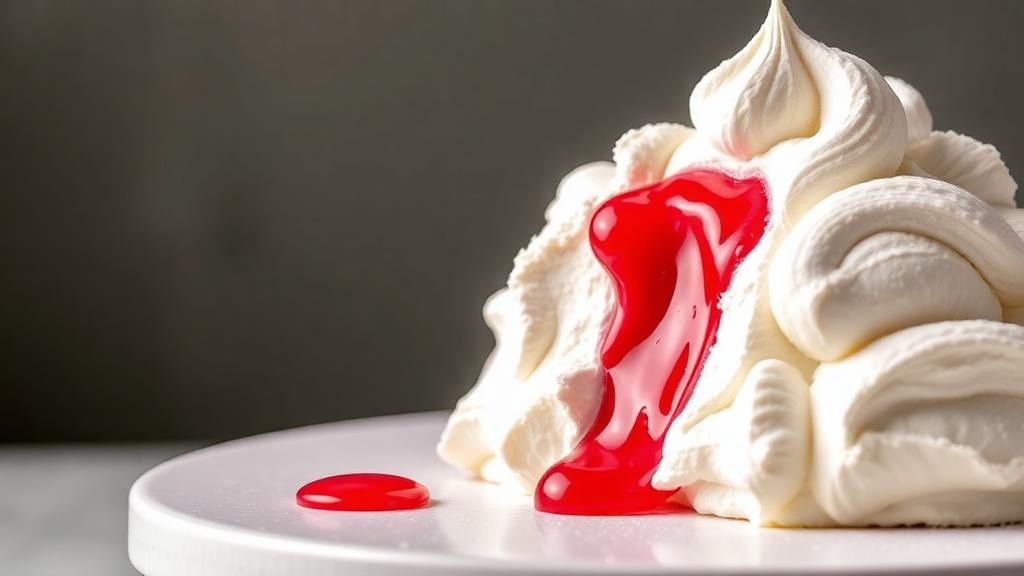
Foaming, the review’s second focus, is governed by a different physical principle: the stabilization of gas bubbles within a liquid or semisolid matrix. Proteins act as natural foaming agents because they are amphiphilic, carrying both hydrophilic and hydrophobic regions. When egg whites are beaten, proteins such as ovalbumin and ovotransferrin unfold and realign at the air-water interface, forming a thin elastic film that encapsulates air and lowers surface tension. Surfactants like soy lecithin and monoglycerides perform the same job more efficiently, aligning at the interface to prevent bubble coalescence. In whipped cream, partially coalescing fat globules form a network that locks air bubbles in place, reinforced by a secondary protein layer, producing the smooth, creamy texture essential to consumer satisfaction.
The practical stakes of foam stability extend across the entire food landscape. In bakery, angel food and chiffon cakes depend on egg-white foams that expand during baking, with cream of tartar added to lower the pH and enhance stability. In beverages, the head on beer and the microfoam on a cappuccino both rely on surface-active proteins forming resilient layers around bubbles. In gluten-free baking, where the gluten network is absent, methylcellulose and egg whites provide the aeration and structure needed for a light crumb. Even fats can sabotage the process: oils disrupt the films around air bubbles, forcing formulators to adjust ingredient proportions and processing techniques carefully.
The review also spotlights emerging alternatives driven by the clean-label movement. Aquafaba, the cooking water from chickpeas and other legumes, contains proteins, polysaccharides, and saponins that give it foaming capacity and stability comparable to egg whites in certain applications, making it attractive for vegan and allergen-free formulations. Xanthan gum, produced by bacterial fermentation, remains stable across a remarkable pH range of 2.0 to 12.0 and in high-salt environments, excelling as a foam stabilizer and suspension agent. Yet natural ingredients bring their own problems: batch-to-batch variability in composition, molecular weight, and purity, driven by species, harvest season, and extraction method, can shift gel strength and viscosity unpredictably, complicating industrial standardization.
The authors conclude that the future lies in hybrid systems and advanced processing. Combining polysaccharides with plant proteins may deliver enhanced stability, resistance to thermal degradation, and reduced syneresis in clean-label formulations, while technologies such as high-intensity ultrasound, cold plasma, and high-pressure processing offer ways to tailor the interfacial behavior and rheological properties of non-animal biopolymers to match conventional agents. Ion-induced gelation with gellan gum under high pressure, which sets cold-set desserts without heating, hints at how processing innovation can preserve temperature-sensitive ingredients. Bridging fundamental knowledge of macromolecular interactions with industrial-scale application, the review argues, will be essential for building the next generation of stable, sustainable, and sensory-optimized foods, ensuring that the invisible chemistry inside every jelly and foam keeps pace with what consumers expect on the label.
Subject of Research: Mechanisms and applications of gelling and foaming agents in food systems
Article Title: Review on Gelling and Foaming Agents in Food: Mechanism and Applications
Article References: Kassa, M. G., Teferi, D. A., Satheesh, N., & Asemu, A. M. (2026). Review on Gelling and Foaming Agents in Food: Mechanism and Applications. Food Science & Nutrition, 14(10), Article e72437. https://doi.org/10.1002/fsn3.72437
Image Credits: AI Generated
DOI: 10.1002/fsn3.72437
Keywords: gelling agents, foaming agents, hydrocolloids, pectin, gelatin, agar, carrageenan, alginate, aquafaba, food texture, clean label, plant-based proteins
News Source: Bethany Barker. (October 6, 2026). The Hidden Chemistry Behind Every Perfect Jelly and Fluffy Meringue. Scienmag.