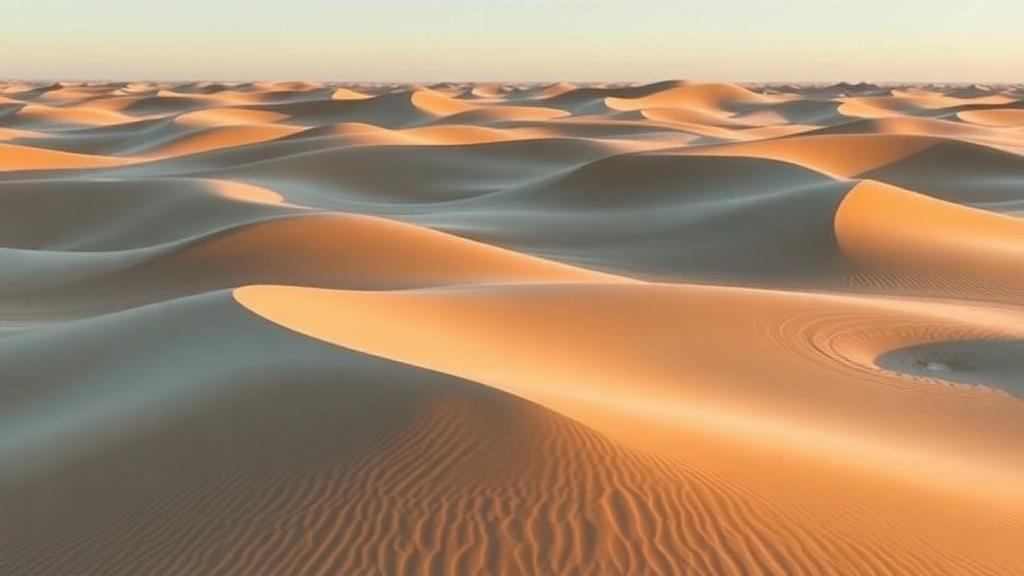
Along the Dutch coast, the battle against rising seas is increasingly fought not with concrete but with sand, wind, and grass. The concept is known as building with nature: rather than imposing rigid engineering on the shoreline, coastal managers harness the natural processes that already shape it, allowing dunes to grow, shift, and shield the land behind them. But hitching a ride on natural processes only works if those processes are genuinely understood. Now, new research from the Netherlands reveals that young dune landscapes are not the random accumulations of sand they might appear to be. Instead, they behave as self-organizing systems whose architecture follows a precise and surprisingly universal physical principle, one that scientists can recognize in salad dressing as easily as on a windswept beach.
The study, published in the Proceedings of the National Academy of Sciences, was led by ecologist Paul Berghuis, who is affiliated with Utrecht University and the Royal Netherlands Institute for Sea Research, known as NIOZ. Berghuis specializes in spatial ecology, a field concerned with the patterns that emerge from the interplay between organisms and their environment. His subject was the relationship between marram grass and sand, a pairing long known to be central to dune formation. Marram grass traps windblown sand around its stems, and over years the trapped sand accumulates into the embryonic dunes that eventually grow into the protective barriers shielding much of the Dutch coastline. What Berghuis set out to determine was not how a single plant builds a single dune, but how thousands of plants and dozens of dunes interlock into a coherent landscape.
To answer that question, Berghuis turned to a source of information that spans decades: aerial photographs. By analyzing these images through time, he searched for fixed patterns in the way young dune landscapes arrange themselves. The approach deliberately shifted the scale of inquiry. As Berghuis explains, quite a lot is already known about individual plants and the processes acting on them, but the deeper question concerns how the complex system of sand and vegetation fits together as a whole. That question dictated the scale at which the dunes were studied. Rather than treating the landscape as a collection of individually operating grasses and dunes, he examined it as a system that organizes itself at the landscape level. Seen that way, he found, the dune landscape displays characteristics of growth and resilience that cannot be predicted from the behavior of individual dunes or grasses alone.
The first surprise was what the patterns were not. In previously studied ecosystems that self-organize, such as mussel beds or the patchy vegetation of savannas, a regular arrangement typically emerges: spots of roughly the same size, spaced at roughly the same distances, repeating across the landscape like a biological wallpaper. Dune landscapes break that rule. Berghuis discovered that there is no fixed size to the dune bodies at all. The reason lies in the restless nature of sand. Wind moves grains again and again before they finally settle somewhere, and the places where they settle are not chosen at random. Where marram grass plants grow closely together, the sand is retained most effectively. At these high densities of vegetation, a dune continues to grow, and it often does so at the expense of its neighbors. Small dunes are left behind or disappear entirely, while larger dunes merge together into ever bigger bodies.
That behavior, in which large units grow while small ones shrink and vanish, is the signature of a well-known physical process called phase separation. Co-author Koen Siteur and other colleagues had previously argued that the spatial organization of certain ecosystems resembles this physics, and the dune findings confirm the analogy with striking precision. Phase separation is familiar from the kitchen: when oil and vinegar are shaken together to make salad dressing, the oil first disperses into countless small droplets suspended in the vinegar. Left to stand, however, the droplets coalesce. Large droplets grow at the expense of small ones, because the physics of the interface between oil and vinegar favors consolidation. The same logic, the researchers found, governs sand and marram grass. Densely vegetated dunes capture sand more efficiently, drawing it away from sparsely vegetated neighbors, so the landscape coarsens over time much as the oil in a dressing does.
Crucially, the resemblance is not merely visual. Siteur’s theory, developed in earlier work, describes how phase-separating systems can be recognized by a very specific fingerprint in their statistics, and Berghuis reports that the dunes carry exactly that fingerprint. The distribution of dune sizes, the way in which dunes merge with one another, and even the rate at which the merging slows down over time all match what the theory of phase separation predicts. This is a significant scientific advance, because it moves the field from description to explanation. As Berghuis puts it, the researchers now know not only how dunes behave but also why they do so. A landscape that once seemed to be the idiosyncratic product of local wind and plant conditions is revealed to obey a general physical law, placing coastal dunes in the same theoretical family as droplets, alloys, and other systems that separate into distinct phases.
The practical consequences of that insight are considerable, because the theory does more than describe patterns; it makes predictions about how such systems respond to disturbance. According to the theory, damage to the spatial pattern does not heal itself once it exceeds a critical threshold. In a dune landscape, this could happen when marram grass is disturbed by trampling, or when wind scours a small pit in the sand. Intuition might suggest that such wounds would gradually fill in and recover, as many ecosystems do. The theory says otherwise. The disturbances are not repaired; instead, the sand that would be needed to heal them migrates away to the more densely vegetated dunes elsewhere in the landscape, reinforcing the winners and abandoning the losers. Local damage, in other words, can become permanent even while the system as a whole appears healthy.
Berghuis’s measurements show exactly such a threshold value in the amount of marram grass present. Below a certain vegetation density, the self-repair mechanisms of the dune system fail, and degradation becomes self-perpetuating. At the same time, the theory predicts that the system as a whole remains resilient in a particular sense: the sand is not lost from the landscape but merely redistributed, flowing from damaged or sparse areas toward the densely vegetated dunes that continue to grow. This dual character, locally fragile but globally stable, is precisely the kind of behavior that phase-separation theory is built to capture, and it fundamentally changes how coastal managers should interpret the landscapes they oversee. A dune area can look robust in aggregate while individual dunes, once pushed past their local tipping point, never recover.
For the philosophy of building with nature, these findings arrive at an opportune moment. As sea levels rise, the Netherlands and other coastal nations are betting increasingly on natural dune growth as a flexible, self-reinforcing line of defense, one that can keep pace with changing conditions in ways that fixed structures cannot. But that bet depends on knowing where the system’s limits lie. The new research supplies a quantitative answer: local damage can be permanent once vegetation density falls below a critical threshold, even if the dune area as a whole remains healthy, so management must attend to the fine-grained pattern of grass cover and sand, not merely to the total volume of the dune field. For anyone who wants to build with nature rather than against it, Berghuis argues, insights of this kind are crucial. The dunes, it turns out, have been organizing themselves all along according to rules written in physics, and learning to read those rules may determine how well the coast weathers the century ahead.
Subject of Research: Spatial self-organization and phase-separation dynamics in coastal dune formation
Article Title: Local tipping points in dune landscapes: how does a dune system organize itself?
Article References: Local tipping points in dune landscapes: how does a dune system organize itself?. (n.d.). Original publication
Image Credits: AI Generated
DOI: Not provided
Keywords: coastal dunes, marram grass, self-organization, phase separation, spatial ecology, tipping points, coastal management, building with nature, Utrecht University, NIOZ, PNAS, sea level rise
News Source: Katie Riggs. (October 5, 2026). Dunes Follow a Hidden Physics: Young Coastal Dune Landscapes Self-Organize Like Phase-Separating Fluids. Scienmag.