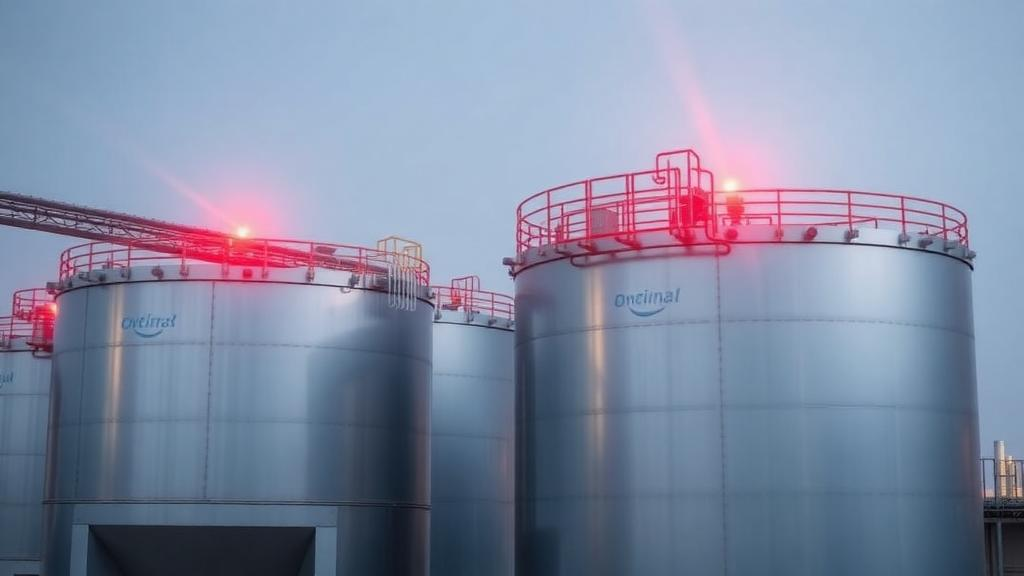
Industrial plants are, in many respects, enormous heat machines. Steelworks, cement kilns, glass furnaces and chemical reactors continuously produce vast quantities of thermal energy as a by-product of their core processes, and much of that energy simply drifts away unused. The reason is rarely a lack of will or technology; it is a mismatch in timing. Heat is generated when a process runs hot, but it is needed when a downstream step or a neighbouring facility demands it, and those moments seldom coincide. Thermal energy storage systems are designed to close exactly this gap, absorbing surplus heat at one moment and releasing it later. Among the most promising designs are packed-bed thermal energy storage systems, known in the literature as PBTES, in which hot air flows through a bed of solid particles and transfers its thermal energy directly to the storage material. When the stored heat is required, the flow direction is reversed and the energy is recovered. The approach sounds elegantly simple, yet operating such a system efficiently hides a deceptively difficult problem: nobody can see what is happening inside the tank.
Researchers at TU Wien have now developed a method that makes the invisible visible, at least in the mathematical sense. Their work, published in the journal Applied Thermal Engineering, demonstrates how the complete internal temperature state of a packed-bed storage system can be precisely determined during operation using only a small number of strategically placed temperature sensors. The study, which carries the title ‘Observer-based thermocline tracking and heat transfer coefficient estimation in packed bed thermal energy storage systems’, is a striking example of what happens when control engineering meets energy technology. Rather than attempting to measure everything, the team exploits a detailed mathematical model of the storage process to infer the quantities that no sensor can practically reach. The model, in effect, supplements the information that the physical instrumentation cannot deliver, reconstructing the full spatial temperature distribution from sparse measurements taken at the tank’s boundary regions.
The heart of the challenge lies in a narrow transition zone called the thermocline. Inside a packed-bed storage unit, a hot region and a cold region coexist, separated by this relatively thin boundary layer where the temperature gradient is steepest. As the storage system charges and discharges, the thermocline migrates through the bed of particles, and its position, shape and stability directly determine how efficiently the system operates and how much of the stored energy can actually be extracted for useful work. A diffuse or poorly controlled thermocline means that hot and cold zones blur into one another, degrading the quality of the heat that can be delivered. Tracking this moving front in real time is therefore the key to intelligent operation, but doing so by direct measurement would require an impractically dense array of sensors threaded through the storage material.
Stefan Jakubek from TU Wien explains the practical obstacle plainly: a complete measurement of the spatial temperature distribution would demand a large number of sensors inside the storage system, and particularly given the high temperatures and harsh conditions found in industrial plants, this is technically complex and expensive. Thermocouples buried deep within a bed of hot particles must survive thermal cycling, mechanical stress and potentially corrosive or dust-laden gas flows, and every additional probe adds cost, complexity and another potential point of failure. The alternative pursued by the Vienna team is fundamentally different in philosophy. Instead of saturating the tank with instrumentation, they place a handful of sensors at positions chosen for their informational value and let a mathematical observer do the rest, continuously computing what the interior must look like given the measurements and the known physics of the process.
The technical machinery behind this achievement draws on several research fields at once. The team combines the modelling of distributed physical systems, in which temperature varies continuously across space and time, with mathematical model reduction, a technique that compresses an otherwise computationally heavy model into a leaner form suitable for real-time use. Crucially, the reduction is performed in a way that preserves the properties of the original model that are essential to describing how the thermocline moves through the tank. The researchers also apply optimal sensor placement, asking systematically at which positions a temperature sensor yields the greatest amount of information about the overall state of the storage unit. Control-theoretic state observation then fuses the model with the sensor data, while online parameter identification allows the algorithm to adapt itself to the actual behaviour of the plant as it evolves during operation.
The result is an estimation method that does more than reconstruct temperatures. It simultaneously estimates the heat transfer coefficient between the gas flowing through the bed and the solid storage material, a parameter that describes how effectively thermal energy passes between the two phases. Martin Kozek, one of the researchers involved, notes that this parameter enables the team to describe how effectively heat is transferred between gas and solid, and he adds that it opens up another interesting avenue of research. The significance of this second output is easy to underestimate, but it may prove just as valuable as the temperature reconstruction itself. Heat transfer is not a fixed property of a storage plant; it changes over the lifetime of the facility in ways that reflect its physical condition.
Consider, for example, what happens inside an industrial storage unit that is charged with waste heat carried by dust-laden gas flows. Over months and years of operation, fine particles carried by the gas can deposit on the surfaces of the storage material, gradually coating the very interfaces across which heat must pass. The consequence is a slow degradation of the heat transfer coefficient, which in turn erodes the performance of the entire storage system. Because the new method estimates this coefficient continuously and online, deviations from its expected behaviour can serve as an early warning sign of fouling or other internal changes. In this way, the same algorithm that supports energy-efficient operation also doubles as a diagnostic instrument, providing information on the condition of the plant and enabling a shift towards condition-based maintenance, in which servicing is triggered by the actual state of the equipment rather than by rigid schedules or by failures that have already occurred.
The project also illustrates the value of disciplinary collaboration within a single university. The Institute of Energy Technology and Thermodynamics at TU Wien contributes deep expertise in thermal energy systems and heat storage, while the Institute of Mechanics and Mechatronics complements it with methods from mathematical modelling, control engineering and process automation. The two institutes conduct their joint research as part of the Christian Doppler Laboratory for Digital Twins of Distributed Parameter Systems, a framework dedicated to learning, monitoring and optimising complex physical systems in real time. The phrase ‘digital twin’ captures the underlying idea well: a continuously updated computational replica of a physical asset, fed by sparse measurements and refined by physics-based modelling, that mirrors the state of the real system closely enough to support decisions without invasive inspection. For packed-bed storage, that twin now runs on a handful of sensors and a reduced-order model.
The broader implications for the energy transition are considerable. Recovering industrial waste heat is widely regarded as one of the most attractive levers for raising energy efficiency and cutting greenhouse gas emissions, because the energy has already been generated and would otherwise be lost. Packed-bed thermal energy storage is particularly interesting in this context because it uses inexpensive solid storage materials and air as the heat transfer medium, making it suitable for the high-temperature regimes typical of heavy industry. What has been missing is a practical way to know, at any instant, how much usable energy the tank holds and where its thermal front sits. By solving that observability problem with minimal instrumentation, the TU Wien method lowers a genuine barrier to deploying these systems in demanding industrial environments, where dense sensor networks are neither affordable nor durable.
Looking ahead, the combination of thermocline tracking and continuous heat transfer estimation points towards storage plants that largely manage themselves. A control system equipped with such an observer can optimise charging and discharging strategies in real time, maximise the fraction of stored energy that is actually recoverable, and flag maintenance needs long before performance visibly declines. The research, validated through computational simulation and modelling on a fluidised-bed test rig at the university, demonstrates that sophisticated estimation techniques once confined to aerospace and process control can be brought to bear on the unglamorous but essential task of storing industrial heat. In a warming world that must squeeze every useful joule out of the energy it already produces, learning to see inside a hot steel tank without opening it may turn out to be one of the quietly consequential advances of the decade.
Subject of Research: Observer-based state estimation for packed-bed thermal energy storage systems
Article Title: A glimpse inside – without actually looking inside
Article References: A glimpse inside – without actually looking inside. (n.d.). Original publication
Image Credits: AI Generated
DOI: Not provided
Keywords: thermal energy storage, packed-bed storage, waste heat recovery, thermocline, state estimation, sensor placement, model reduction, heat transfer coefficient, digital twin, industrial energy efficiency, TU Wien, condition-based maintenance
News Source: Denise Maddox. (October 5, 2026). New Sensor Method Reveals Hidden Heat Inside Industrial Storage Tanks. Scienmag.