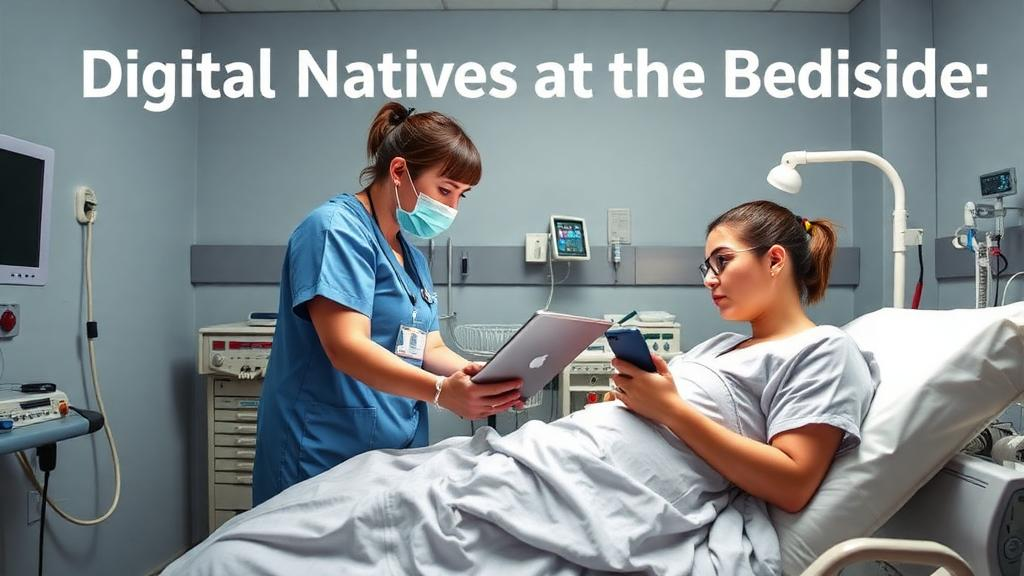
Intensive care units have become the most data-dense environments in modern hospitals, filled with smart infusion pumps, intelligent monitoring systems, automated early-warning platforms and connected devices that stream continuous streams of physiological information. A new qualitative study from Shanghai now offers one of the closest looks yet at how the youngest members of the nursing workforce experience this technological transformation. Researchers at Shanghai Tenth People’s Hospital, affiliated with Tongji University School of Medicine, interviewed 22 Generation Z nurses working in the intensive care unit of a tertiary hospital to understand how these digital-native clinicians perceive the smart technology that now surrounds every bedside. Their findings, published in BMC Nursing, paint a picture of genuine enthusiasm tempered by practical frustrations, and they carry direct implications for how hospitals around the world should train and support the nurses who will staff the intelligent wards of the future.
The research team, led by Yue Liu and corresponding author Jinxia Jiang, chose a descriptive phenomenological approach, a qualitative methodology designed to capture lived experience in rich detail rather than to measure variables statistically. Between October and November 2025, the investigators used purposive sampling to recruit nurses born into Generation Z, the cohort now forming the backbone of China’s nursing workforce, from the hospital’s ICU. Each participant took part in a semi-structured, in-depth interview, and recruitment continued until the researchers reached data saturation, the point at which new interviews stopped yielding new themes. The interviews were then analyzed using Colaizzi’s seven-step framework, a rigorous, widely used procedure in which researchers extract significant statements, formulate meanings, cluster them into themes and validate the emerging account against the full dataset. To safeguard trustworthiness, the team addressed credibility, dependability, transferability and confirmability, the standard criteria for qualitative rigor, and the study received ethics approval from the Institutional Review Board of Shanghai Tenth People’s Hospital with written informed consent from every participant.
From the transcripts, the researchers distilled three major themes and thirteen subthemes. The first theme, multidimensional empowerment in critical care, captured how smart technology improves work efficiency and conserves scarce human resources. In an ICU, where a single nurse may be responsible for several critically unstable patients at once, automated systems that track vital signs, calculate medication doses and flag deterioration can shave minutes off repetitive tasks and reduce the cognitive load of juggling multiple data streams. For nurses who grew up with smartphones and instant information, these tools feel like a natural extension of practice rather than an imposition. Participants described the technology as a partner that absorbs routine work, freeing them to spend more time on the hands-on, judgment-intensive aspects of nursing that machines cannot replicate.
The second theme, enhancement of patient safety in critical care, revealed how these nurses see smart systems as extending the safety frontline and constructing safety barriers around their patients. Continuous electronic monitoring can detect subtle physiological changes before a human observer might, and automated alerts provide a second line of defense against medication errors, missed deterioration and equipment mishaps. The Generation Z participants framed this as a meaningful expansion of what a single nurse can safely supervise, effectively widening the protective net stretched over each patient. In a specialty where seconds can determine outcomes, the nurses viewed the technology’s capacity for vigilance as one of its most valuable contributions, reinforcing their overall positive attitude toward the digitalization of critical care.
Yet the study is equally notable for what it found beneath that enthusiasm. The third theme, strategies for core breakthroughs and future development, gathered the participants’ candid assessments of where current systems fall short. Two problems stood out: alarm fatigue and inadequate system stability. Alarm fatigue is a well-documented phenomenon in intensive care, arising when monitors and smart devices generate so many alerts, many of them clinically trivial or triggered by overly sensitive thresholds, that nurses begin to tune them out. The paradox is sharp: a system designed to extend the safety frontline can, if poorly calibrated, erode the very vigilance it is meant to support. Participants also reported instability in the systems themselves, including interruptions and malfunctions that undermine confidence and add work rather than removing it.
These findings matter because the ICU is where smart technology is most widely adopted and where data are generated at the highest density in the entire hospital. Smart technology is transforming nursing by offering significant opportunities to alleviate global resource shortages, optimize clinical workflows, improve patient outcomes and enhance patient safety, and no setting tests those promises more demandingly than critical care. When the clinicians at the bedside are skeptical or overwhelmed, even the most sophisticated algorithms lose their protective value. Conversely, when technology aligns with how nurses actually work, it can multiply the reach of a stretched workforce. The Shanghai study suggests that Generation Z nurses, far from resisting digitalization, are largely ready to embrace it, provided the systems are reliable, the alarms are intelligently tuned and the training is systematic.
The generational lens is central to the study’s contribution. Generation Z nurses in China have unique characteristics shaped by their life experiences as the first cohort to grow up fully immersed in digital environments. That fluency may lower the barrier to adopting smart tools, but it does not automatically translate into seamless integration with clinical workflows, where devices must function flawlessly under pressure and where a false alarm carries real consequences. The researchers argue that managers and educators should therefore develop targeted intervention strategies spanning technological, organizational, educational and social dimensions. In practice, that means involving frontline nurses in configuring alarm thresholds, investing in system reliability, building structured training programs that go beyond one-off device demonstrations, and attending to the social dynamics of how young nurses learn from experienced colleagues in a technology-rich environment.
The study also arrives at a moment when health systems worldwide are grappling with nursing shortages and rising acuity of care. If smart technology can genuinely save human resources and improve efficiency, as the participants reported, then understanding the conditions under which it succeeds becomes a workforce strategy as much as a patient-safety one. The Shanghai findings suggest that the return on investment in ICU digitalization depends heavily on the human infrastructure around it: training that builds genuine competence and confidence, organizational processes that respond quickly to technical failures, and alarm governance that keeps alerts meaningful. The researchers explicitly frame their results as informing future intervention efforts, positioning the voices of these 22 nurses as a design brief for the next generation of critical-care technology.
Methodologically, the study’s descriptive phenomenological design and use of Colaizzi’s seven-step analysis give the findings a disciplined structure, and the pursuit of data saturation strengthens confidence that the three themes capture the range of experiences within this group. At the same time, the single-hospital setting in one Chinese megacity means the results describe one context rather than a universal pattern; transferability to other hospitals, health systems and cultures requires judgment on the part of readers. The authors themselves emphasize that the study is qualitative and exploratory, intended to illuminate perceptions and experiences rather than to quantify effects on outcomes such as mortality or error rates. Those causal questions await future interventional and quantitative research, for which this work now provides a grounded starting point.
What emerges most clearly from the Shanghai interviews is a portrait of a generation that neither fears the machines nor worships them. Generation Z nurses in this study saw smart technology as multidimensionally empowering and as a genuine guardian of patient safety, while insisting, with the directness of digital natives, that overly sensitive alarms and unstable systems are fixable defects that stand between current tools and their full potential. Their message to hospital leaders, educators and technology developers is essentially a demand for partnership: build systems worthy of the trust young nurses are prepared to extend, train them systematically, and the intelligent ICU could deliver on its promise of safer, more efficient and more humane critical care. As smart wards spread from Shanghai to hospitals everywhere, the experiences of these bedside digital natives may prove to be one of the most valuable datasets of all.
Subject of Research: Generation Z nurses' perceptions and experiences of smart technology use in intensive care units
Article Title: Generation Z nurses’ perceptions and experiences of smart technology use in critical care: a qualitative study in Shanghai, China
Article References: Liu, Y., Tang, J., Huang, X., Fu, X., Chi, C., & Jiang, J. (2026). Generation Z nurses’ perceptions and experiences of smart technology use in critical care: a qualitative study in Shanghai, China. BMC Nursing. https://doi.org/10.1186/s12912-026-05435-9
Image Credits: AI Generated
DOI: 10.1186/s12912-026-05435-9
Keywords: smart technology, Generation Z, nursing, intensive care unit, patient safety, alarm fatigue, qualitative research, phenomenology, Shanghai, nursing workforce, clinical workflow, health informatics
News Source: Ophelia Keating. (October 5, 2026). Digital Natives at the Bedside: Gen Z Nurses Reveal How Smart ICU Technology Helps and Hinders Care. Scienmag.