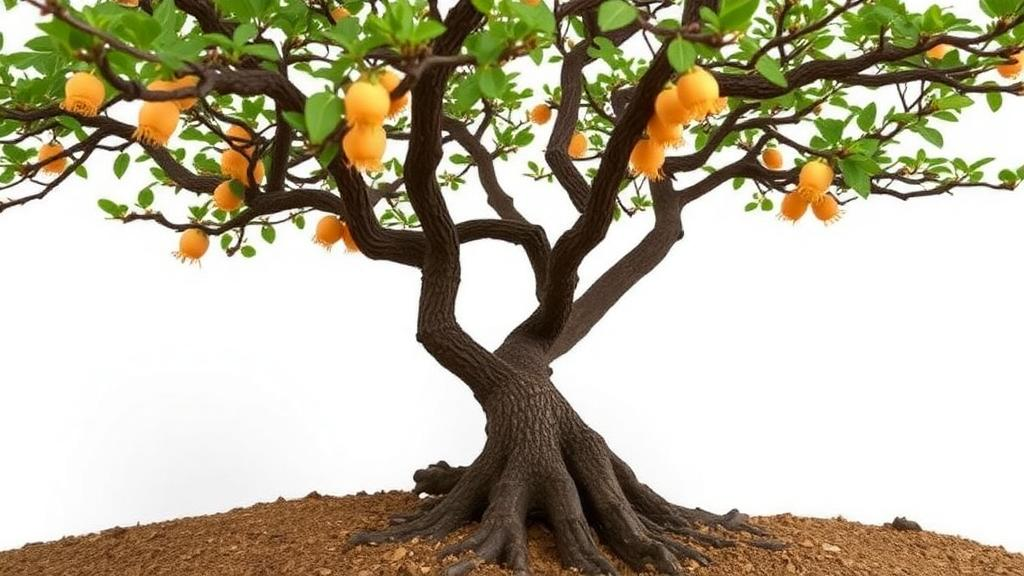
Deep in the fragmented forests of eastern China, one of the country’s rarest trees is quietly dependent on an invisible alliance beneath the soil. Heptacodium miconioides, the seven-son flower, is an endangered species whose dwindling populations survive only in scattered habitat patches. A new study published in Plant and Soil has now mapped, in remarkable molecular detail, the communities of arbuscular mycorrhizal fungi (AMF) that live inside its roots and in the surrounding rhizosphere soil, revealing how these symbionts are distributed, how their communities assemble, and what that means for saving the species.
Arbuscular mycorrhizal fungi are ancient symbionts that colonize the roots of most land plants, exchanging soil minerals such as phosphorus and nitrogen for plant carbon. For endangered plants clinging to survival in degraded and fragmented landscapes, these fungi can be the difference between thriving and failing, boosting nutrient uptake and stress tolerance when conditions turn harsh. Yet despite their conservation significance, the patterns and mechanisms governing AMF communities associated with rare plants in fragmented habitats have remained poorly understood, leaving a gap that conservation biologists have long wanted to fill.
To close that gap, a research team led by Yueling Li and Junmin Li of Taizhou University sampled roots and rhizosphere soils from five naturally fragmented populations of H. miconioides across eastern China. The team profiled the fungal communities using Illumina high-throughput sequencing of the 18S rRNA gene, a technique that reads the genetic barcodes of fungi present in each sample and allows researchers to identify which lineages dominate each microhabitat. By pairing these molecular data with measurements of soil chemistry and climate, the researchers could ask not only who lives where, but why.
The results revealed a striking compartmental split. The genus Glomus dominated both roots and rhizosphere soil, but it was significantly enriched inside the roots, suggesting that these fungi are particularly successful at establishing intimate colonization within the tree’s root tissue. In contrast, the genus Ambispora showed a clear preference for the rhizosphere, the narrow zone of soil directly influenced by root exudates. This root-versus-soil differentiation echoes a growing body of literature showing that the root endosphere and rhizosphere are not simply connected compartments but ecologically distinct habitats that filter fungal taxa in different ways.
Perhaps the most conceptually important finding concerns how these communities come together in the first place. Community assembly theory distinguishes deterministic processes, such as environmental selection that favors certain species under specific conditions, from stochastic processes, such as ecological drift and random dispersal, which shape communities by chance. Across most of the sampled regions and in both compartments, the AMF communities of H. miconioides were assembled largely by stochastic processes, with ecological drift prevailing. In other words, chance, more than environmental filtering, appears to govern which fungi colonize most of the tree’s fragmented populations.
But there was a telling exception. In the DPS region, deterministic forces took over, and specifically heterogeneous selection accounted for roughly 72 percent of rhizosphere community assembly. Heterogeneous selection occurs when environmental conditions vary strongly enough to push different communities in different directions, imposing distinct selective pressures across sites or microhabitats. The fact that this deterministic signal appeared only in one region and only in the rhizosphere underscores how strongly assembly mechanisms depend on geography and compartment, a regional contingency that the authors highlight as a key lesson for anyone attempting to generalize about mycorrhizal ecology in fragmented landscapes.
The study also used network analysis to examine how fungal taxa interact with one another. Here again, the two compartments told different stories. Rhizosphere-associated networks were more complex and more highly connected, consistent with the idea that soil communities experience a richer web of ecological interactions. Root-associated networks, by contrast, exhibited greater modularity, meaning the fungi inside roots cluster into more tightly linked, semi-independent subgroups. Modular structure in root communities may reflect functional specialization or the influence of the plant host in organizing its internal symbionts, and it suggests that the tree’s root environment imposes its own architectural logic on the fungal assemblage.
What drives these patterns environmentally? The researchers found that soil properties, including nitrate nitrogen, total phosphorus, and urease activity, together with climatic variables such as mean annual temperature and mean annual precipitation, exerted stronger regulatory effects on root AMF communities than on rhizosphere communities. These factors explained 15.27 percent of the variation in root communities but only 3.47 percent of the variation in rhizosphere communities. The asymmetry is intriguing: while the open soil community appears buffered and largely drift-assembled, the community inside the roots responds more sensitively to the chemical and climatic context, possibly because root colonization is metabolically costly and plants regulate symbiosis according to nutrient availability and stress.
For conservation practitioners, the implications are concrete. Because AMF communities differ between roots and soil, and because assembly rules shift from region to region, restoration efforts cannot assume that a single inoculum or soil treatment will work everywhere. The authors suggest that their findings provide fundamental references for the utilization of AMF in the conservation of H. miconioides, and the study builds on earlier work by the same group showing that these fungi can improve the species’ growth and drought stress tolerance. Matching fungal communities to local conditions, and understanding whether a given population’s symbionts are drift-assembled or selection-filtered, could improve the success of reintroduction and habitat restoration programs.
The broader significance extends well beyond one endangered tree. Habitat fragmentation is one of the dominant threats to global biodiversity, and its effects ripple underground, disrupting gene flow, altering microbial networks, and reshaping the symbioses on which plants depend. By documenting spatially explicit, compartment-specific patterns of AMF distribution and assembly in a naturally fragmented system, this study adds a crucial belowground dimension to fragmentation ecology. As sequencing costs fall and analytical frameworks for community assembly mature, the invisible fungal partners of rare plants are finally coming into focus, and with them, a new set of tools for keeping endangered species rooted in a fragmenting world.
Subject of Research: Arbuscular mycorrhizal fungal community assembly in the endangered plant Heptacodium miconioides under habitat fragmentation
Article Title: Root–rhizosphere differentiation and assembly mechanisms of arbuscular mycorrhizal fungi in the endangered species Heptacodium miconioides under habitat fragmentation
Article References: Li, Y., Luo, G., Ke, S., Lv, P., Jin, Z., & Li, J. (2026). Root–rhizosphere differentiation and assembly mechanisms of arbuscular mycorrhizal fungi in the endangered species Heptacodium miconioides under habitat fragmentation. Plant and Soil. https://doi.org/10.1007/s11104-026-09127-w
Image Credits: AI Generated
DOI: 10.1007/s11104-026-09127-w
Keywords: arbuscular mycorrhizal fungi, Heptacodium miconioides, habitat fragmentation, rhizosphere, community assembly, ecological drift, Glomus, Ambispora, endangered plants, soil microbiology, conservation, high-throughput sequencing
News Source: Morgan Morrow. (October 5, 2026). Hidden Fungal Partners May Decide the Fate of a Rare Chinese Tree. Scienmag.