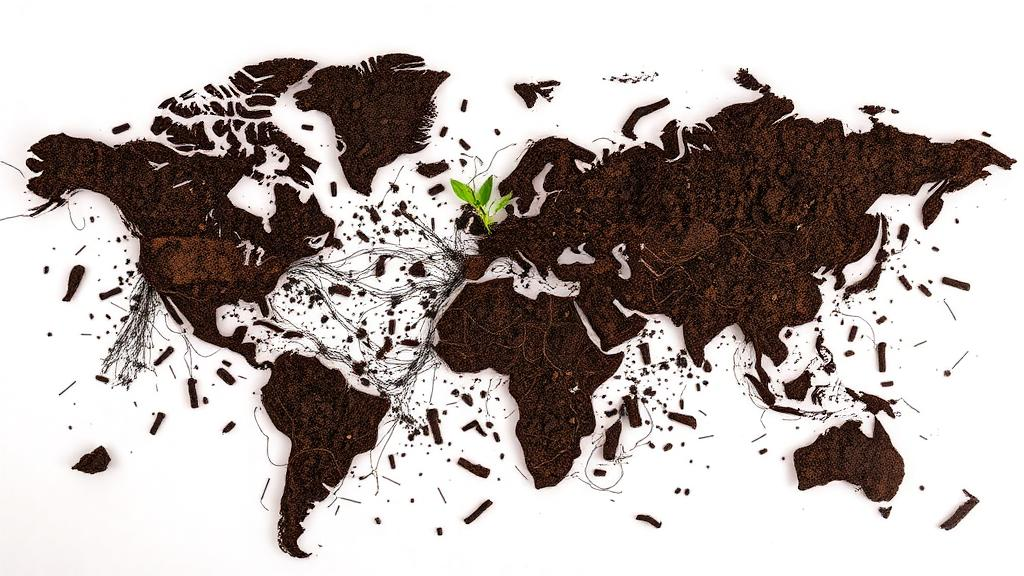
A quiet revolution is spreading beneath our feet, and a sweeping new analysis has finally mapped its contours. Researchers at Brazil’s Federal Rural University of the Semi-Arid have completed one of the most comprehensive bibliometric investigations to date of biochar, the charcoal-like material that scientists increasingly view as a lifeline for the planet’s most degraded agricultural soils. By crunching the metadata of 505 scientific publications spanning 2009 to 2024, the team has revealed not only how explosively this field has grown but also who leads it, where the intellectual hotspots lie, and what stands between biochar and its transformation from laboratory darling to global farming standard.
The numbers tell a striking story. After a careful search of the Web of Science database using terms combining biochar, soil quality, and tropical or semi-arid environments, the researchers identified 666 records and retained 505 for analysis. Publications have climbed steadily since 2014, peaking at 73 articles in 2024 alone. China dominates the landscape with 183 articles and 7,257 citations, followed by the United States with 70 publications and 4,174 citations, and Pakistan with 49 articles. Intriguingly, the leading producers are not themselves defined by tropical or semi-arid climates, yet the studies they publish focus squarely on dryland and vulnerable agroecosystems, revealing a global scientific division of labor in which wealthy research powers investigate the problems of the world’s most fragile farmland.
The collaboration networks uncovered by the analysis are equally revealing. Using co-authorship mapping and a metric called Total Link Strength, which quantifies the intensity of connections between countries, the team found China sitting at the epicenter of global biochar science with a link strength of 700, far ahead of the United States at 404, Australia at 290, Pakistan at 256, Saudi Arabia at 212, and Germany at 184. The thickest collaborative threads connect China with Pakistan, Saudi Arabia, Australia, and the United States. Pakistan and Saudi Arabia have emerged as regional hubs for the Middle East and South Asia, while Brazil, despite its obvious stake as a tropical nation, occupies an intermediate position with 32 publications and a comparatively modest link strength of 105, a signal that the researchers say points to an urgent need for stronger international partnerships.
At the level of individual scientists, the analysis identified Wang Qi as the most prolific author with 10 publications, acting as a bridge between research clusters, though his citation count of 88 lags behind Muhammad Arif, whose 7 papers have drawn 355 citations. This divergence illustrates a principle that echoes throughout the field: scientific impact depends not on volume but on depth and relevance. The temporal analysis of author networks between 2016 and 2022 shows a rising generation of researchers, including Zhang Dengkui, Zhou Xujiao, and Erastus Mak-Mensah, signaling renewal and expansion within a community once anchored by a smaller cadre of pioneers.
The intellectual foundations of the field rest on a handful of landmark papers. Co-citation analysis, which measures how often two works are cited together, places Laird’s 2010 study at the center with 47 connections and 1,116 citations, flanked by Agegnehu’s 2016 work and Lal’s 2009 contribution. These foundational references continue to guide new research even as recent publications gain ground, and their interdisciplinary reach, spanning soil physics, chemistry, agronomy, and environmental science, reflects the inherently cross-cutting nature of biochar research. Journals such as Science of the Total Environment, with 25 publications and 2,173 citations, and Geoderma, with just 11 articles but a remarkable 2,063 citations, serve as the primary vessels carrying this knowledge to the scientific community.
Perhaps the most consequential findings come from the keyword co-occurrence and thematic mapping, which reveal the field’s conceptual architecture. Four major clusters dominate: a core focused on biochar, soil, and carbon sequestration; an agronomic cluster built around yield, growth, and fertilizer; a production cluster examining pyrolysis temperature and physicochemical properties; and an emerging cluster centered on heavy metals, adsorption, and remediation. The temporal evolution unfolds in three distinct phases, from a characterization-focused period between 2014 and 2017, through a diversification into agricultural systems from 2018 to 2020, to a post-2021 consolidation around climate mitigation and soil sustainability.
The mechanistic evidence underpinning these themes is substantial. Meta-analyses cited in the study report an average increase of 61 percent in soil carbon following biochar application, driven by the formation of stable organo-mineral complexes, particularly in medium to fine-textured soils. Water and nitrogen use efficiency gains exceeding 14 percent have been documented, while synergistic combinations of biochar and nitrogen fertilizer have produced cumulative productivity improvements alongside reduced emissions of methane and nitrous oxide over five-year trials. Global balance studies estimate that large-scale biochar deployment could remove between 2.6 and 10.3 petagrams of carbon dioxide equivalent, potentially offsetting up to 6 percent of global emissions, a figure that positions biochar among the most promising carbon dioxide removal strategies currently available.
Why does biochar matter so much for tropical and semi-arid regions specifically? These landscapes face a punishing combination of low organic matter, high nutrient leaching, recurrent water stress, and accelerating degradation driven by intensive agriculture, deforestation, and climate change. Biochar, produced by heating biomass under oxygen-limited conditions, addresses several of these vulnerabilities simultaneously: its porous structure retains water in sandy soils, its alkalinity corrects the acidity typical of weathered tropical soils, its high cation exchange capacity holds nutrients against leaching, and its internal architecture provides habitat for beneficial microorganisms. Studies compiled in the analysis also show improved plant tolerance to salt and drought stress, mediated through better soil structure and reduced sodium uptake.
Yet the path to large-scale adoption is far from clear, and the bibliometric evidence exposes the field’s soft spots. Biochar’s properties vary enormously depending on feedstock and pyrolysis conditions, making results difficult to generalize. Long-term data on the material’s persistence and aging in soil remain scarce, methodological standardization is lacking, and the risk of contaminant introduction from poorly characterized feedstocks cannot be ignored. The viability of biochar-based carbon credits still awaits consolidated measurement, reporting, and verification frameworks. The researchers conclude that progress now depends on interdisciplinary approaches, decades-long field experiments across multiple biomes, and strengthened international collaborations that bring developing countries into the center of the research effort rather than its periphery.
The stakes could hardly be higher. As climate change intensifies and arable land continues to degrade, the world needs scalable, affordable technologies that restore soil while locking away carbon. This analysis suggests biochar has earned its place on that shortlist, but it also delivers a sober warning: without rigorous long-term science, standardized protocols, and genuine global cooperation, a technology born from ancient Amazonian dark earths risks remaining what it is today, a phenomenon of the literature rather than of the land.
Subject of Research: Bibliometric analysis of global biochar research trends for soil quality improvement in tropical and semi-arid regions
Article Title: Trends and hotspots in biochar research for soil quality improvement in tropical and semi-arid regions based on bibliometric analysis
Article References: Alves, A. B., de Souza, A. L. V., de Lima, I. C. F., da Costa, L. J., da Silva, L. C., Filho, M. F. C., de Lavôr, W. K. B., de Souza, D. C. S., da Silva, E. F., Silva, D. V., Batista, R. O., do Carmo, F. R., & de Sousa Antunes, L. F. (2026). Trends and hotspots in biochar research for soil quality improvement in tropical and semi-arid regions based on bibliometric analysis. Discover Soil, 3(1), Article 115. https://doi.org/10.1007/s44378-026-00275-0
Image Credits: AI Generated
DOI: 10.1007/s44378-026-00275-0
Keywords: biochar, soil quality, bibliometric analysis, carbon sequestration, soil remediation, tropical agriculture, semi-arid regions, pyrolysis, soil degradation, water retention, nutrient cycling, international collaboration
News Source: Alan Morgan. (October 4, 2026). Biochar Research Booms as Scientists Map the Race to Rescue the World’s Dying Soils. Scienmag.