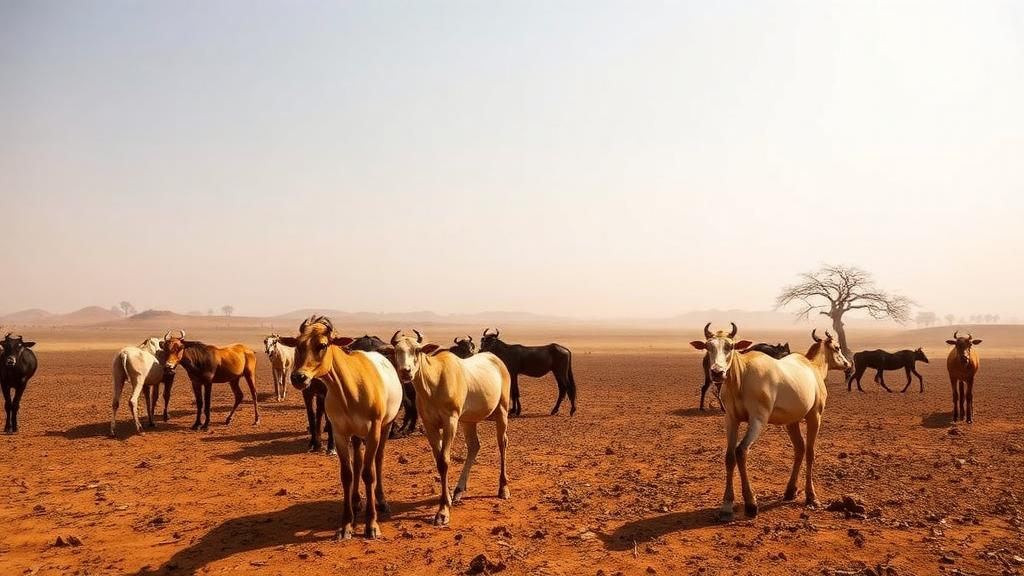
An international team of researchers has delivered a sobering warning just as a powerful El Niño event bears down on Africa: simply giving the continent’s poorest livestock farmers better weather forecasts will not shield them from the worst impacts of climate change. The study, led by the University of Sydney and Imperial College London and published in Nature Sustainability, shows that climate information only translates into protection when it is paired with practical measures that give households the financial and material capacity to act before drought strikes. Without that pairing, the researchers argue, the looming El Niño is likely to amplify existing inequalities across the rangelands of southern Africa, deepening the divide between wealthy producers who can adjust and poor pastoralists who cannot.
The research comes at a critical moment. Across Botswana, Eswatini, Lesotho, Mozambique, Namibia, South Africa and Zimbabwe, millions of pastoralists depend on cattle, sheep and goats grazing vast semi-arid rangelands. For these communities, livestock are far more than a source of income. They function as a family’s savings account, its food security and its cultural identity, often accumulated and passed down through generations. When drought kills a herd, it does not merely erase a season’s earnings; it can liquidate decades of household wealth in a matter of months, trapping families in poverty from which recovery may take years or may never come at all.
Lead author Dr Matt Clark, a Research Associate in Sustainability Science with the Thriving Oceans Research Hub in the University of Sydney’s School of Geosciences, described climate variability as an inequity multiplier. If forecasts prove correct and a near-record El Niño develops, he said, the team expects the event to amplify inequalities across southern African rangelands. The core problem, he explained, is not that poor farmers lack climate information. It is that they often cannot afford to act on it. Wealthier producers can reduce herd sizes ahead of drought and rebuild when conditions improve, but many small-scale pastoralists simply do not have that financial buffer. Selling animals early means selling them cheap, and a depleted herd cannot regenerate quickly when rains return.
To understand how these dynamics play out at regional scale, the researchers built a detailed computational model representing pastoral communities across seven southern African countries. The model drew on projected rainfall patterns from European climate models together with empirical data on livestock populations, vegetation dynamics and community wealth. Rather than treating the region as a homogeneous whole, the simulation captured the decisions of thousands of individual livestock farmers operating under different climate conditions and different adaptation interventions. As the model settled into a stable state, wider patterns and the trade-offs between interventions emerged from the accumulation of those individual decisions, offering a level of granularity that broad regional averages cannot provide.
The team ran three simulations. The first represented a business-as-usual future, and its results were grim: increasing rainfall variability reduced household wealth, increased livestock losses, degraded grasslands and widened the gap between rich and poor. The second tested adaptation strategies in isolation. Access to improved forecasts alone delivered only modest benefits, because many households lacked the financial capacity to respond to the information they received. Risk-smoothing measures on their own, such as supplementary feed or insurance, could help households survive but sometimes forced environmental trade-offs, for example by keeping larger herds alive on already stressed landscapes.
The third simulation examined how adaptation spreads between neighbouring communities, drawing on conservation programs such as Conservation International’s Herding for Health initiative. Its findings were among the most encouraging of the study. When practical support accompanied climate information, communities learned from one another and adoption became self-reinforcing, providing a plausible pathway for climate adaptation at scale. In other words, the combination did more than add the benefits of each component; it created a social dynamic in which adaptation practices diffused organically through networks of neighbouring households, overcoming barriers that top-down programs have long struggled to breach.
The study identifies a suite of risk-smoothing measures that can make forecasts actionable: supplementary livestock feed, drought insurance, targeted financial support and improved market access. The logic is straightforward. A forecast warning of impending drought is only useful if a farmer can afford to sell animals at a fair price, buy feed to bridge the gap, or insure the herd against loss. By combining improved access to climate information with supported risk-smoothing, the researchers found, livestock farmers can avoid the environmental trade-offs that occur when either approach is used in isolation. The combination improved livelihoods, reduced inequality and protected rangelands simultaneously, overcoming trade-offs that have long challenged climate adaptation programs.
Dr Gina Arena, Science Lead for Herding for Health at Conservation International, emphasised that the communities involved are not passive in the face of a changing climate. It is not that the people the organisations work with are not thinking about adapting, she said; it is that greater uncertainty in climate brings greater risk, and communities need help identifying the best decisions and reducing the risk of implementing them. Research of this kind, she noted, helps do exactly that. Her comments underline a recurring theme in adaptation science: the bottleneck is rarely awareness or willingness, but the capacity to absorb the cost of a wrong decision in environments where a wrong decision can be catastrophic.
For Dr Clark, one of the most hopeful aspects of the findings is that they do not depend on inventing new technology. Weather forecasting is becoming increasingly accurate, he noted, and the opportunity now is to ensure those forecasts are paired with practical support so that the people who need them most can actually benefit. The framework developed for southern African pastoralists, he added, could equally be applied in Australia and other regions facing increasingly variable rainfall. As climate extremes become more common, adaptation needs to be as much about helping people act as about improving the forecasts themselves. That reframing shifts the policy conversation from a narrow focus on meteorological precision toward the socioeconomic infrastructure that determines whether precision matters.
The research was conducted through an international collaboration involving the University of Sydney, Imperial College London, Conservation South Africa, the South African Environmental Observation Network, the Max Planck Institute for Evolutionary Anthropology, the University of California Merced and the Santa Fe Institute. Cosima Fröhner, a former Mary Lister McCammon Fellow at Imperial College London, cautioned against dismissing the modelling as abstract, pointing out that simulating the decisions of thousands of individual farmers under different climate conditions and interventions produces something very practical: a way to see, before real lives and real herds are at stake, which combinations of support actually work and which merely shift costs elsewhere. The researchers declare no conflicts of interest, and the study received funding from the Leverhulme Trust, Research England and UK Research and Innovation. As El Niño conditions gather over the continent, the message for policymakers is unambiguous: information without the means to act is a warning unheard, and the communities least responsible for climate change remain the most exposed to its consequences unless adaptation programs close the gap between knowing and doing.
Subject of Research: Climate adaptation and inequality among pastoralist livestock farmers in southern African rangelands
Article Title: Improved climate forecasts alone won’t protect Africa’s poorest farmers
Article References: Improved climate forecasts alone won’t protect Africa’s poorest farmers. (n.d.). Original publication
Image Credits: AI Generated
DOI: Not provided
Keywords: climate change, El Niño, pastoralists, drought, rangelands, southern Africa, livestock, climate forecasts, risk-smoothing, Nature Sustainability, adaptation, inequality
News Source: Sloane Callahan. (October 4, 2026). Better forecasts alone cannot save Africa’s poorest herders from drought. Scienmag.