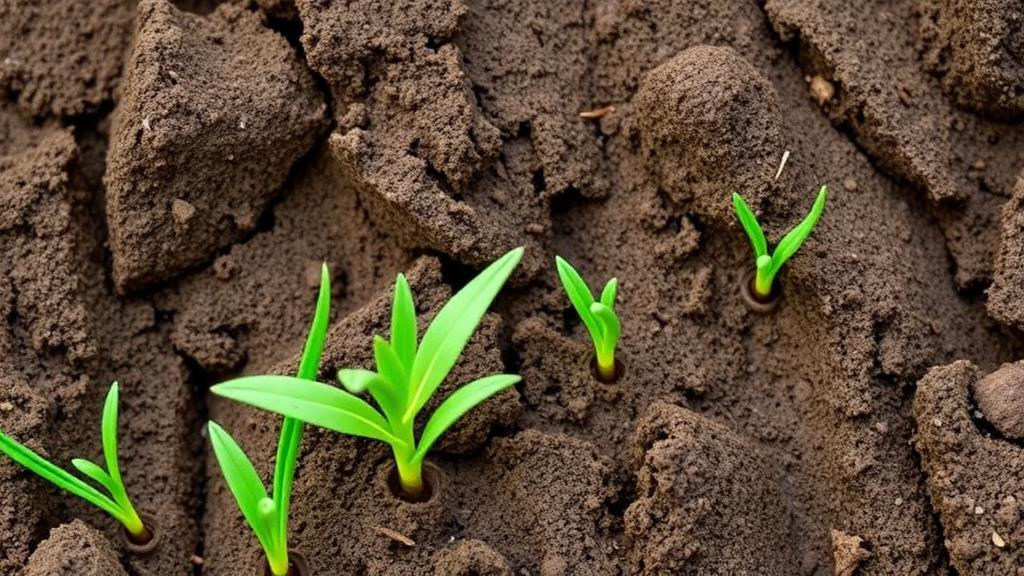
When heavy rain hammers a steep roadside slope, the first line of defense is often nothing more than grass. Engineers have long known that dense, fibrous roots help hold soil together, but the mechanics of how living roots actually change the way compacted soil erodes has remained frustratingly vague. Now a team of researchers from The Hong Kong University of Science and Technology and Jinan University has delivered one of the most detailed experimental dissections of the problem to date, and in doing so has introduced a new, physically grounded number that promises to make vegetation-based erosion control far more predictable. The study, published in the journal Plant and Soil, combined controlled greenhouse cultivation with laboratory flume experiments on compacted sandy soils, testing how particle size, packing density, and plant biology interact to determine whether a soil surface crumbles grain by grain or holds firm under concentrated flow.
The research focused on completely decomposed granite, a sandy, weakly cohesive soil that is ubiquitous in man-made slopes across Hong Kong and much of subtropical Asia. The team sieved the soil into two fractions, one with a maximum particle size of 5 millimeters and one with a maximum of 2 millimeters, and compacted each to relative densities of 90, 80, and 70 percent. That matrix of six bare-soil treatments formed the baseline. For the biological treatments, the researchers used an elegant compartmental design: pots were split by a 38-micrometer mesh, with bahiia grass (Paspalum notatum) grown on one side and only mycorrhizal fungal hyphae, root exudates, and other dissolved biological agents allowed to cross into the neighboring compartment. This meant one side of each pot contained living roots, while the other received the biochemical products of root activity without any physical roots at all, allowing the team to separate the two great reinforcement pathways that roots provide.
Those two pathways are physical binding and biochemical bonding. Physical binding is the intuitive one: fine roots physically enmesh soil aggregates, the way rebar reinforces concrete. Biochemical bonding is subtler and, until now, much harder to quantify. Root exudates, decomposing organic matter, glomalin-related proteins deposited by mycorrhizal fungi, and microbial polysaccharides all act as glues at the microaggregate scale, stabilizing soil structure without any mechanical entanglement. Earlier studies had estimated that physical binding accounted for roughly 70 to 76 percent of the erosion resistance conferred by herbaceous roots, but those estimates typically relied on short-term growth experiments or dead roots, in which biochemical effects could not be fully eliminated. By constructing bonded soils directly, the Hong Kong team could measure each contribution cleanly for the first time in compacted, engineered slope materials.
The erosion measurements themselves were carried out in a custom-built transparent flume nearly four meters long, in which saturated soil cores were scoured under carefully controlled combinations of flow discharge and bed gradient. Nine to eleven shear stress levels were tested for each treatment, spanning the transition from gentle sheet flow to the concentrated rill flows that carve gullies into bare slopes during intense storms. Detachment rates were then fitted to two competing mathematical models. The first, the classic excess shear stress model, assumes a simple linear relationship between detachment rate and the stress exceeding a critical threshold. It is convenient but, as the authors note, its erodibility coefficient lacks any real physical meaning. The second, Wilson’s model, derives from a two-dimensional representation of individual particles interacting with turbulent flow, and its two parameters, b0 and b1, correspond to the rate at which particles exchange with the flow and the probability that drag forces exceed the stabilizing forces holding them in place.
Across the bare soils, the results confirmed textbook expectations with striking clarity. The coarser 5-millimeter soils were consistently harder to erode than the finer 2-millimeter soils, showing lower erodibility coefficients and higher critical shear stresses, with mean critical shear stress of 2.66 pascals versus just 0.94 pascals for the finer material. Compacting the soil to 90 percent relative density amplified this resistance further, though the difference between 80 and 70 percent densities was modest, suggesting that compaction below 80 percent buys engineers surprisingly little erosion protection. The Wilson’s model generally fit the data better than the excess shear stress model, particularly for the looser soils, reinforcing the argument that a physically based framework is worth its extra mathematical complexity when the goal is mechanistic understanding rather than mere curve fitting.
The biological results were more surprising. Roots and bonding agents consistently reduced erodibility coefficients and raised shear thresholds across every particle size and density combination, but the magnitude of the effect depended strongly on soil conditions. The largest benefits appeared in the finer, moderately dense soils: in the 2-millimeter soil compacted to 80 percent relative density, the presence of roots or bonding agents cut the erodibility coefficient by more than fourfold and the Wilson parameter b0 by nearly sixfold. Paradoxically, the densest compaction, which engineers specify precisely to stabilize slopes, worked against biology. At 90 percent relative density, grass roots grew poorly, producing the smallest shoot biomass, root length density, and root surface area of any treatment, and the resulting reinforcement was correspondingly weak. The soil’s fine fraction, it turns out, is the essential substrate on which roots and their biochemical products build cohesion; without it, even abundant roots have little to grip.
The centerpiece of the study is a new dimensionless indicator, Kbio, derived by algebraically manipulating Wilson’s model. The researchers showed that the combined term sqrt(b0 squared times b1) behaves as a soil-specific erodibility constant that is largely independent of the flow conditions during detachment, and that it is governed by the ratio of particle resistance to the exposure resistance of the surrounding finer particles. Because both roots and bonding agents act primarily by adding cohesion, this term shrinks when biology strengthens the soil, and the ratio of its value before and after biological treatment defines Kbio. A value greater than one signals reduced erodibility. When the team computed Kbio for each treatment, the total biological effect ranged from 1.60 in the densest coarse soil to 4.34 in the finer moderately dense soil, while the physical binding component stayed relatively constant, between 1.11 and 1.63, across all conditions. The biochemical bonding component, by contrast, varied widely and dominated the reinforcement in the finer, moderately dense soils.
This finding upends the conventional wisdom that physical binding is the dominant mechanism. In compacted sandy slope soils, the invisible chemistry of root exudates and fungal hyphae appears to do most of the heavy lifting, at least where fine particles are available to be glued together. The authors validated their modified Wilson’s framework against twenty independent datasets, including laboratory flume tests on peanut-farming soils under different management practices and a field test on an unpaved loess road, and the reparameterized model reproduced the original model’s predictions in eighteen of the twenty cases. They are candid about the limits: the indicator has so far been tested only on sandy soils with low cohesion and high permeability, and extreme turbulence conditions, where instantaneous shear stresses spike far above the mean, remain outside the model’s validated domain.
The practical implications reach well beyond the laboratory. Ecological engineering, the use of living plants as construction materials, is increasingly specified for roadside slopes, dikes, and restored terrain worldwide, yet designers currently rely on empirical root indices that are soil-specific and confounded by multiple factors. A dimensionless, physically meaningful indicator like Kbio could let engineers predict, before planting, how much a given grass species will actually reduce erosion on a given compacted soil, and could guide the choice of both plant species and compaction specifications. The study also sends a caution to geotechnical practice: specifying maximum compaction for slope stability may inadvertently suppress the biological reinforcement that protects the same slope from washing away. The authors call for field validation across different rainfall regimes and soil textures, but the conceptual advance is clear. Erosion resistance, long treated as an empirical black box, can now be decomposed into measurable physical and biological parts, and the invisible half of the story, the chemistry flowing from roots into soil, turns out to be the bigger half after all.
Subject of Research: Effects of plant roots and biochemical bonding on the erodibility of compacted sandy soils under rill flow
Article Title: Effects of plant roots on the erodibility of compacted soils can be explained by a biological indicator derived from Wilson’s model
Article References: Li, M., Leung, A. K., & Chen, X. W. (2026). Effects of plant roots on the erodibility of compacted soils can be explained by a biological indicator derived from Wilson’s model. Plant and Soil. https://doi.org/10.1007/s11104-026-09147-6
Image Credits: AI Generated
DOI: 10.1007/s11104-026-09147-6
Keywords: soil erosion, plant roots, soil erodibility, Wilson's model, rill detachment, compacted soils, biochemical bonding, physical binding, mycorrhizal fungi, aggregate stability, flume tests, ecological engineering
News Source: Alan Morgan. (October 4, 2026). Grass Roots Fight Erosion in Compacted Soils, and a New Indicator Shows How. Scienmag.