Deep inside wastewater treatment tanks and laboratory reactors around the world, an extraordinary biological phenomenon is quietly unfolding: living bacteria are generating electricity. A comprehensive new review published in Discover Electrochemistry by Kartikey Mishra, Md. Mirazul Islam, Urvashi Soni and Vandana Vinayak of Dr Harisingh Gour Vishwavidyalaya brings together a century of research on how microbes shuttle electrons to electrodes, the central process that makes microbial fuel cells (MFCs) work. These devices promise a rare double win: cleaning polluted water while simultaneously producing bioelectricity, all with minimal chemical additives and negligible greenhouse gas emissions. Yet the technology’s future hinges on a question that sounds almost philosophical: how does a microscopic organism, sealed inside a nonconductive membrane, hand its electrons to a lump of carbon?
The answer lies in two fundamentally different strategies known as direct electron transfer (DET) and mediated electron transfer (MET). In DET, bacteria physically contact the electrode and pass electrons across through specialized molecular machinery. In MET, microbes release or rely on soluble redox compounds, called mediators or electron shuttles, that ferry electrons from the cell surface to the anode. The review emphasizes that understanding and optimizing both pathways is essential for designing efficient MFC systems, because the effectiveness of these electron transfer processes ultimately determines the net power output and stability of the entire device. Which strategy dominates depends on the microbial species involved, the electrode material, and the chemistry of the wastewater itself.
The star performers of direct electron transfer are the metal-reducing bacteria Geobacter and Shewanella. Geobacter sulfurreducens oxidizes acetate and channels the resulting electrons toward external acceptors through conductive pili, often called microbial nanowires, and through a family of multiheme c-type cytochromes embedded in the outer membrane. These redox proteins, with potentials approaching one volt, form conductive pathways that bridge intracellular electron donors and extracellular acceptors. Research on G. sulfurreducens grown with electrodes as the sole electron acceptor revealed a remarkable 1900-fold increase in transcription of the genes encoding outer-membrane cytochromes, showing that the bacteria actively rewire their molecular machinery when an electrode is the only place to dump electrons. Shewanella oneidensis, by contrast, is a versatile dual player, capable of both direct transfer via outer-membrane cytochromes and mediated transfer using soluble flavins it secretes itself.
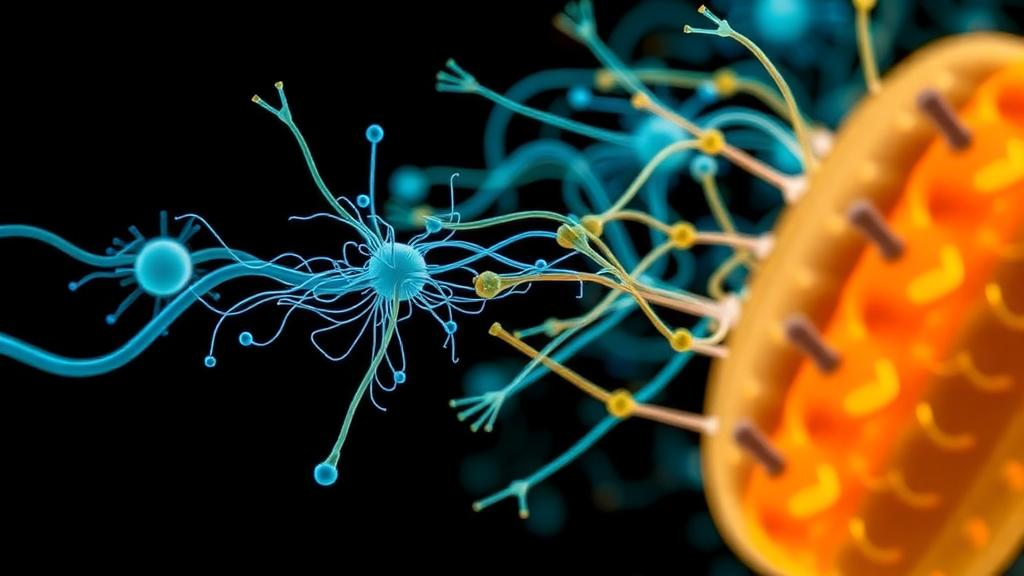
Those nanowires deserve special attention. These filamentous appendages extend from the bacterial cell surface and conduct electrons over micrometer distances, allowing bacteria to link electrically to distant electrodes or even to other cells. The protein OmcS is indispensable to the nanowire structure of Geobacter, while in the archaeon Methanosarcina acetivorans, the c-type cytochrome MmcA serves as an electron transport carrier. Electron microscopy has captured these structures directly: scanning electron micrographs show dense Geobacter biofilms coating electrospun lignin carbon felt anodes, and transmission electron microscopy reveals bacilli, spiral and spherical forms bristling with the filamentous pili essential for direct transfer. Biofilms are not passive passengers either. They dramatically increase the effective surface area of the anode and protect the community from environmental threats, desiccation and antibacterial agents.
Not every microbe can play this game directly. The outer layers of many bacterial species consist of nonconductive lipid membranes, peptidoglycans and lipopolysaccharides that block physical electron transfer, which is precisely where mediators come in. An effective mediator must penetrate the cell membrane easily, react quickly at the electrode, dissolve well in the anolyte, remain nontoxic and nonbiodegradable, and be inexpensive. Endogenous mediators are produced by the microbes themselves: Pseudomonas aeruginosa secretes the phenazine pyocyanin, while S. oneidensis relies on secreted flavins for roughly 80 to 90 percent of its extracellular electron transfer. Exogenous mediators such as methylene blue, neutral red, thionine and anthraquinone-2,6-disulfonate (AQDS) can be added artificially, though their instability and toxicity restrict practical use. Riboflavin and humic acid, both naturally abundant, have proven efficient shuttles; adding just 9.1 millimoles per liter of riboflavin accelerated the reduction of the azo dye Mordant Yellow 10 by 61 percent in anaerobic granular sludge.
Because electron transfer happens at the electrode surface, the material the electrode is made from matters enormously. The review documents a striking range: graphite anodes yield a maximum power density of roughly 0.7 milliwatts per square meter, while magnesium anodes coated with chitin particles reach approximately 1878 milliwatts per square meter, a thousandfold difference. Over the past five years, reported power densities have spanned from 6.12 to 6119 milliwatts per square meter depending on anode modifications. Nanotechnology has driven much of this progress. Nitrogen-doped carbon/iron oxide nanotube composite arrays on carbon cloth achieved a power density of 4.11 milliamperes per square centimeter with 89 percent coulombic efficiency, while titanium nitride nanoarrays on carbon cloth captured 97.2 percent of Geobacter from mixed sludge, ensuring long-term stability. Iron phthalocyanine modification of carbon cloth raised the Geobacter population from 6.97 to 44.83 percent and boosted power density from 560 to 2419 milliwatts per square meter, apparently by mimicking the iron porphyrin active centers of c-type cytochromes and improving their affinity for the surface.
Carbon nanomaterials have emerged as perhaps the most versatile electrode platform. Graphene, reduced graphene oxide and carbon nanotubes combine high conductivity with enormous surface areas, supporting stable biofilm formation. A three-dimensional graphene aerogel anode achieved an output voltage of 0.488 volts and a peak power density of 2381 milliwatts per cubic meter, far exceeding the 708.89 milliwatts per cubic meter of the control. A graphene aerogel scaffold decorated with platinum nanoparticles reached 1460 milliwatts per square meter with Shewanella oneidensis MR-1, 5.3 times better than carbon fabric. Nitrogen-doped multiwalled carbon nanotube/graphene aerogels pushed power density to 2977.8 milliwatts per square meter, and porous iron oxide nanofibers integrated with carbon nanotubes achieved 1959 milliwatts per square meter thanks to their highly porous, three-dimensional interpenetrating network. Even biomass waste is being recruited: tea polyphenol-functionalized reduced graphene oxide on carbon cloth delivered 773.9 milliwatts per square meter while cutting charge transfer resistance to 14.6 ohms.
The microbial side of the equation is equally dynamic. Community analyses reveal no single dominant ‘winner’ on the anode; instead, diverse consortia including Comamonadaceae, Geobacter, Clostridium, Rhodopseudomonas, Bacillus and Shewanella coexist, and even gram-positive species such as Lysinibacillus sphaericus D-8 can perform extracellular electron transfer despite their thick, nonconductive cell walls. Cocultures frequently outperform pure strains: pairing Escherichia coli with P. aeruginosa yielded 190.44 milliwatts per square meter versus 139.24 and 158.76 for the pure cultures alone. Engineered consortia go further. A ternary culture of Cellulomonas Lsc-8, Bacillus subtilis C9 and G. sulfurreducens PCA converted cellulose into electricity at a peak current density of 796 microamperes per square centimeter, with the first two species breaking down cellulose and releasing riboflavin while Geobacter consumed the resulting acetate. Genetic engineering adds another lever: integrating the flavin biosynthesis pathway into S. oneidensis raised power density to 238.7 milliwatts per square meter, and multiplying riboflavin operon copies in Bacillus subtilis RH33 similarly enhanced output.
Photosynthetic microalgae are adding a solar dimension to the field. In photosynthetic microalgal-assisted MFCs, algae at the cathode release oxygen through photosynthesis, providing a free, cost-effective electron acceptor while yielding valuable biomass, lipids, pigments and proteins as byproducts. A system using live Chlorella pyrenoidosa reached a striking 6030 milliwatts per square meter under optimized conditions, and one with Haematococcus lacustris achieved 33.77 milliwatts per square meter alongside astaxanthin production and 46 percent chemical oxygen demand removal. Diatom-based fuel cells reached 12.62 milliwatts per square meter with a 22.95 percent coulombic efficiency while boosting lipid production by 64.28 percent, and diatomite nanocomposites at the anode degraded the dye rhodamine with 88.23 percent efficiency. Wastewater applications are scaling impressively: constructed wetland-MFC hybrids treating real leather tannery wastewater achieved nearly 99.8 percent COD removal, and heat-pretreated sludge eliminated methanogens within four hours while maintaining a power density of 134 milliwatts per square meter.
Commercialization, however, remains the stubborn frontier. The review is candid that large-scale power generation with MFCs is currently impractical: energy output remains insufficient to compete with alternative power technologies, installation and maintenance costs can reach hundreds of thousands of euros per kilowatt, and corrosive wastewater degrades infrastructure over time. There are no certification standards, renewable-energy credits or feed-in tariffs specifically for MFC modules, and reproducibility at commercial scale is still unproven. Yet the authors see a clear roadmap: cheaper biomass-derived electrodes, 3D-printed porous structures, alternative catalysts to replace expensive platinum, better separators such as clayware plates and bipolar membranes, and bioinformatics-driven identification of electroactive species. If those pieces come together, the humble bacteria that have been quietly passing electrons for billions of years may finally power the water infrastructure of the future, turning every treatment plant into a modest power station.
Subject of Research: Electron transfer mechanisms between electroactive bacteria and electrodes in microbial fuel cells
Article Title: Electron transfer mechanism in microbial fuel cells
Article References: Mishra, K., Islam, M. M., Soni, U., & Vinayak, V. (2026). Electron transfer mechanism in microbial fuel cells. Discover Electrochemistry, 3(1), Article 33. https://doi.org/10.1007/s44373-026-00118-1
Image Credits: AI Generated
DOI: 10.1007/s44373-026-00118-1
Keywords: microbial fuel cells, electron transfer, Geobacter, Shewanella, bioelectricity, nanowires, cytochromes, redox mediators, electrode materials, wastewater treatment, microalgae, biofilms
News Source: Victoria Harrison. (October 4, 2026). How Bacteria Wire Themselves to Electrodes: The Electron Transfer Secrets Powering Microbial Fuel Cells. Scienmag.