In the drought-prone districts of southern India, where residents in some parts of Tamil Nadu pay roughly ten rupees per bucket of water and reservoirs dwindle year after year, researchers have been searching for irrigation water in unlikely places. A new study published in BMC Agriculture suggests that one of those places may be the brewery. Scientists at Tamil Nadu Agricultural University, working with effluent from United Breweries in Palakkad, Kerala, have found that treated brewery wastewater can boost maize growth, enrich soil fertility and raise nutrient uptake, even as several of its chemical parameters exceed international irrigation safety limits. The findings, published on 5 March 2025, offer a carefully qualified but potentially significant answer to one of agriculture’s most pressing questions: where will the water come from?
The context is stark. Climate change has disrupted rainfall patterns across India, and the Ministry of Water Resources projects that national water demand will surpass supply by 2050, driven by rising industrial and agricultural needs. In regions such as Palakkad and Coimbatore, the depletion of the Bharathapuzha and Siruvani rivers has already created severe shortages of both drinking and irrigation water. Farmers have been forced to consider brackish groundwater and treated municipal wastewater as alternatives. Against this backdrop, the enormous volumes of effluent generated by breweries, which consume vast quantities of water across malting, mashing, fermentation and clarification, have long looked like a wasted opportunity. Unlike many industrial effluents, brewery wastewater is rich in biodegradable organic compounds such as sugars, starch and ethanol, along with nutrients derived from malt, yeast and processing chemicals.
The research team, led by Senthilraja Kandasamy of Tamil Nadu Agricultural University, began by characterizing the effluent against the irrigation water quality standards of the Food and Agriculture Organization. The picture that emerged was genuinely mixed. On the reassuring side, the wastewater’s pH of 7.85, electrical conductivity of 1.86 decisiemens per meter, suspended solids, calcium, magnesium, sodium and chloride all fell within FAO permissible limits. But several other parameters did not. Total dissolved solids reached 1,320 milligrams per liter, biochemical oxygen demand stood at 22 milligrams per liter, and chemical oxygen demand hit 135 milligrams per liter, more than double the FAO safe limit of 60. Nitrate nitrogen measured 44.5 milligrams per liter, phosphate 6.2, and potassium and bicarbonate also exceeded thresholds. Most concerning for soil structure, the sodium adsorption ratio reached 27.7, well above the value of 18 that signals a sodium hazard, and Kelley’s ratio exceeded 1, indicating water that is formally unsuitable for irrigation without corrective management.
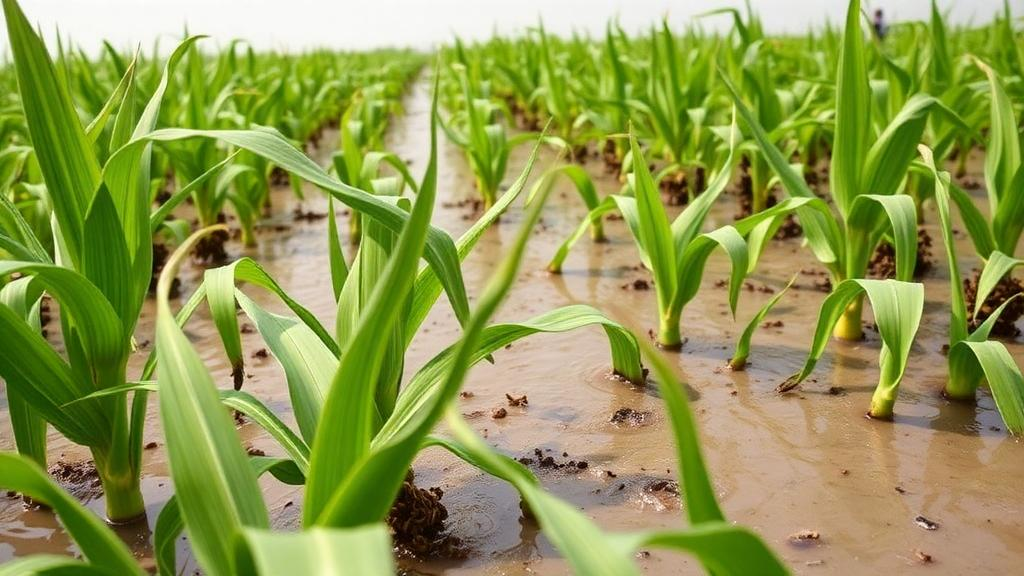
Those caveats matter, but they did not prevent striking results in the greenhouse. The team grew certified maize seedlings in pots filled with garden soil, irrigating them with river water as a control or with brewery wastewater diluted to 25, 50, 75 or 100 percent, in a completely randomized design with five replications. After 45 days, plant height and stem girth showed no statistically significant differences across treatments. But nearly everything else did. Full-strength brewery wastewater significantly increased leaf area, total chlorophyll content, shoot biomass and root biomass compared with river water irrigation. Shoot biomass rose by 12 percent and root biomass by 3 percent under full-strength effluent. Leaf area expanded by roughly 20 percent, and chlorophyll content climbed 16 percent, a change the authors attribute to the wastewater’s abundant magnesium, a central atom in the chlorophyll molecule, and its dual supply of nitrogen as both ammonium and nitrate.
Nutrient uptake told a similar story. Maize leaves under 100 percent brewery wastewater accumulated 28 percent more nitrogen, 15 percent more phosphorus, 19 percent more potassium, 10 percent more calcium, 3 percent more magnesium and 45 percent more sodium than the river-water controls. The researchers note that maize, as a C4 crop with high photosynthetic capacity, is particularly effective at metabolizing nitrogen from wastewater, which may explain why the crop responded so vigorously. One warning sign did emerge: the ratio of sodium to potassium in the seedlings rose steadily as wastewater concentration increased, reaching its highest value under full-strength effluent. Sodium accumulation is a classic precursor of salinity stress, and maize is only moderately tolerant of salty conditions, so this trend will need monitoring in any long-term application.
The soil itself was transformed, in ways that were largely but not entirely positive. After two months of irrigation, soil organic carbon under full-strength effluent reached 0.64 percent, compared with 0.48 percent under river water. Available nitrogen rose by 29 percent on average across wastewater treatments, available phosphorus jumped by nearly 65 percent, and exchangeable calcium, magnesium and sodium all increased significantly. Most strikingly, the soil’s cation exchange capacity, a measure of its ability to hold and exchange nutrients, climbed from 5.27 to 7.94 centimoles of charge per kilogram, an increase of roughly 50 percent. The authors attribute this to the surge in organic matter, whose negatively charged surfaces attract positively charged nutrient ions. Electrical conductivity in the soil also rose sharply, from 0.32 to 1.15 decisiemens per meter, a reminder that dissolved salts accumulate quickly even within a single season.
To make sense of the tangled relationships among 23 soil and plant variables, the team turned to principal component analysis. The first two components captured 75 percent of the variance, and the first alone accounted for nearly 61 percent, loading heavily on organic carbon, available nitrogen, phosphorus and potassium, exchangeable cations and cation exchange capacity. The analysis singled out organic carbon as the property with the most positive influence on both soil quality and plant growth, reinforcing the idea that the effluent’s biodegradable organic load is the engine behind its fertilizing effect. A heatmap of the treatment groups clustered the river-water control apart from the high-concentration wastewater treatments, visually confirming that full and near-full strength effluent produced a distinctly different soil and plant chemistry.
Not everything changed. Microscopic examination of stem and root anatomy revealed that maize plants irrigated with brewery wastewater were structurally indistinguishable from controls. Vascular bundles, sclerenchymatous sheaths, xylem parenchyma, root pith and intercellular spaces all appeared normal, suggesting that at least over a single 45-day growing cycle, the effluent imposed no visible tissue-level stress. That anatomical stability, combined with the biomass and chlorophyll gains, paints a picture of a crop that is not merely tolerating the wastewater but exploiting it, at least in the short term and under controlled conditions.
The authors are careful about what their results do and do not license. This was a pot experiment lasting weeks, not a multi-season field trial, and the wastewater’s elevated chemical oxygen demand, bicarbonate, potassium and sodium adsorption ratio mean that untreated use would carry real risks of soil structural degradation, pore clogging and salinity buildup. They recommend blending brewery effluent with cleaner water, applying calcium-rich amendments such as gypsum or organic manures to displace sodium, monitoring soil salts regularly, and conducting long-term field studies before widespread adoption. They also call for cheaper treatment and filtration technologies tailored to brewery effluent, real-time water quality monitoring, and cost-benefit analyses to make reuse economically viable for farmers. A companion field-level investigation is reportedly underway.
Even with those qualifications, the study fills a genuine gap. Previous work in Ethiopia found brewery effluent to be saline-sodic and harmful to lettuce without gypsum amendments, while earlier research by some of the same Indian authors showed sunflower and sesame thriving on stronger dilutions. The new results extend that evidence to maize, a staple C4 cereal, in one of the world’s most water-stressed agricultural regions. If the sodium hazard can be managed, the arithmetic is compelling: a polluting industrial discharge becomes a nutrient-bearing irrigation source, easing pressure on depleted rivers while cutting the organic load that breweries currently release into waterways. In a state where every bucket of water is rationed and paid for, turning brewery waste into crop water may be one of the more elegant pieces of circular economics to emerge from agricultural science in years, provided the fine print on soil chemistry is respected.
Subject of Research: Use of brewery wastewater as an alternative irrigation source and its effects on soil health and maize nutrient uptake in Tamil Nadu, India
Article Title: Assessment of brewery wastewater as an alternative irrigation source: impacts on soil health and nutrient uptake by maize in Tamil Nadu, India
Article References: Kandasamy, S., Dhandayuthapani, U. N., Subramanian, V., Palanisamy, J., Shanmugam, M. K., Dhakshanamoorthy, D., Subramani, U. K., & Nagappan, S. (2025). Assessment of brewery wastewater as an alternative irrigation source: impacts on soil health and nutrient uptake by maize in Tamil Nadu, India. BMC Agriculture, 1(1), Article 2. https://doi.org/10.1186/s44399-025-00002-0
Image Credits: AI Generated
DOI: 10.1186/s44399-025-00002-0
Keywords: brewery wastewater, irrigation, maize, soil health, nutrient uptake, water scarcity, Tamil Nadu, wastewater reuse, soil fertility, sodium adsorption ratio, organic carbon, sustainable agriculture
News Source: Alan Morgan. (October 4, 2026). Brewery wastewater could irrigate India’s maize fields, study finds. Scienmag.