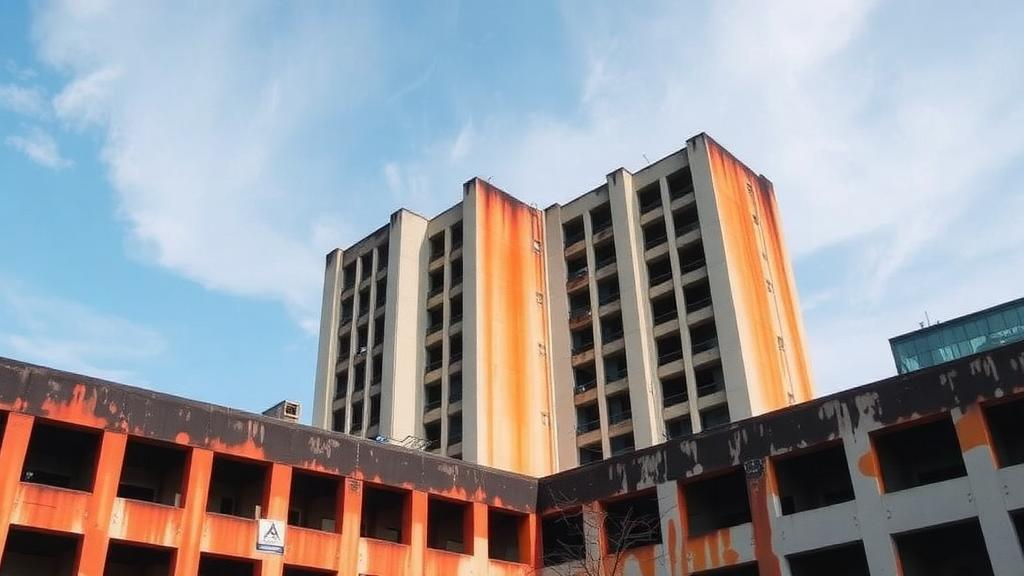
Brazil’s reinforced concrete buildings and bridges may be quietly racing toward failure far faster than their designers ever intended, and the culprit is not an earthquake or a flood but the air itself. A new nationwide study has combined regional climate projections, probabilistic reliability analysis and machine learning to map, for the first time, how carbonation-induced corrosion will threaten concrete structures across every microclimate in Brazil from 1970 to 2100. The findings suggest that structures built under older design codes could face a greater than 50 percent probability of reinforcement depassivation within just 40 years, while even modern buildings face growing risk under high-emission futures.
The science behind the threat begins with chemistry. Steel bars embedded in concrete are protected by a passive oxide film sustained by the high alkalinity of the pore solution. Carbon dioxide from the atmosphere diffuses into the concrete and reacts with the cement matrix, a process called carbonation that lowers the pH and dissolves that protective layer. Once the carbonation front, which advances from the surface inward, reaches the steel, depassivation occurs and active corrosion begins. The corrosion products occupy far more volume than the original steel, generating tensile stresses that crack the concrete cover, degrade the bond between steel and concrete, and ultimately erode the structure’s stiffness and ductility.
How fast this front moves depends on a delicate interplay of material and environmental factors: the concrete’s water-to-cement ratio, its porosity and compressive strength, the ambient temperature, the relative humidity, and the concentration of carbon dioxide in the air. The new research, published in Case Studies in Construction Materials by Chiara Pinheiro Teodoro, Rogério Carrazedo and Emilio Bastidas-Arteaga, adopts a climate-dependent carbonation model in which carbonation depth accelerates with rising temperature and elevated carbon dioxide, but slows when relative humidity exceeds roughly 65 percent. Paradoxically, the most dangerous humidity range sits between about 25 and 65 percent, where pores are moist enough for carbon dioxide to react but dry enough for gas to diffuse rapidly.
That sensitivity is precisely what makes climate change so consequential. Under most future Shared Socioeconomic Pathways, both temperature and atmospheric carbon dioxide are projected to rise throughout Brazil, while relative humidity declines across much of the country, with the strongest reductions expected in the Amazon region. The team used a dataset spanning 1961 to 2100 at a spatial resolution of 0.2 degrees, covering five emission scenarios from the ambitious SSP1-1.9 to the fossil-fueled SSP5-8.5. In many locations, the projected drops in humidity fall squarely into the critical range that accelerates carbonation, compounding the effects of warming and rising carbon dioxide.
To translate these climate signals into engineering risk, the researchers ran Monte Carlo simulations with Latin hypercube sampling, generating 100,000 samples for each combination of location, construction period, climate scenario, exposure condition and aggressiveness class. The limit state function compared the concrete cover depth against the predicted carbonation depth, treating cover, diffusivity, ageing and urban carbon dioxide factors as random variables with realistic variability. The results were striking: for structures built in 2000 under the NB 1:1978 code, the probability of depassivation exceeded 50 percent within 40 years at nearly all of the 500 sampled locations, whereas structures built in 2020 under the stricter NBR 6118:2014 mostly stayed below that threshold over the same service life.
The contrast reveals how much design codes matter. Brazil’s concrete standard has evolved from the permissive NB 1 rules of 1940 through 1978, which prescribed covers as thin as 1.5 centimeters indoors and set no water-to-cement limits, to the current NBR 6118:2023, which mandates covers up to 5 centimeters and water-to-cement ratios as low as 0.45 for the harshest environments. Structures designed under the older codes combine shallow cover with high diffusivity, leaving them doubly exposed as the climate warms. The study found that buildings erected before 2003 systematically show higher depassivation probabilities, and that the differences among future emission scenarios widen over time, meaning long-term durability decisions should never rest on a single climate projection.
Geography matters just as much as construction date. The machine learning analysis, which trained a Random Forest model on simulations from 500 representative locations, showed that inland regions with intermediate humidity and elevated temperatures are the most vulnerable. Manaus, with high temperatures and humidity often between 40 and 70 percent, shows markedly higher depassivation probabilities than Porto Alegre, where cooler temperatures and humidity above 65 percent suppress carbonation. Coastal cities such as Fortaleza and Recife benefit from persistently high humidity, although the authors caution that their results there capture only the carbonation contribution, since chloride-induced corrosion, often more severe near the sea, was outside the scope of the study.
The Random Forest model itself proved remarkably powerful, achieving a coefficient of determination near 0.999 on a random test split and an average of 0.941 in a stricter spatial validation that excluded entire geographic regions from training. It also trained in about 18 minutes, whereas the artificial neural network alternative required more than 24 hours with lower accuracy. This efficiency means engineers can now estimate corrosion initiation probability for virtually any location, construction year, exposure class and climate scenario in seconds, turning what was once a computationally prohibitive reliability analysis into a practical design tool.
The stakes are far from academic. A 2024 investigation following a bridge collapse in northern Brazil reported that at least 736 bridges in the country are in poor or critical condition, and field studies have repeatedly found that actual concrete covers in Brazilian buildings frequently fall short of design specifications, with one survey reporting nearly half of measured covers non-compliant. The new study’s national statistics show a median 50-year depassivation probability of about 2.8 percent for pre-2025 structures, dropping to 1.5 percent for those built under the stricter modern code, but with regional medians reaching 14.2 percent in the South and sharp variability across exposure classes.
The authors argue that Brazil’s current four-class exposure scheme is too coarse to capture the country’s enormous climatic diversity, and that future revisions of the durability provisions should become region-specific and climate-informed. Their framework, which could be extended to include chloride ingress and corrosion propagation, points toward a shift from prescriptive rules to performance-based design, in which cover depths and concrete quality are tailored to local climate futures rather than one-size-fits-all tables. As global emissions continue to climb, the invisible chemistry unfolding inside Brazil’s concrete may become one of the most expensive and overlooked consequences of a changing climate.
Subject of Research: Probabilistic assessment of carbonation-induced reinforcement depassivation in Brazilian reinforced concrete structures under climate change
Article Title: Probabilistic assessment of carbonation-induced depassivation in Brazilian reinforced concrete structures under climate change
Article References: Teodoro, C. P., Carrazedo, R., & Bastidas-Arteaga, E. (2026). Probabilistic assessment of carbonation-induced depassivation in Brazilian reinforced concrete structures under climate change. Case Studies in Construction Materials, 25, Article e06584. https://doi.org/10.1016/j.cscm.2026.e06584
Image Credits: AI Generated
DOI: 10.1016/j.cscm.2026.e06584
Keywords: reinforced concrete, carbonation, corrosion, climate change, Brazil, depassivation, Monte Carlo simulation, machine learning, random forest, durability, design codes, SSP scenarios
News Source: Sloane Callahan. (October 4, 2026). Climate change could silently corrode Brazil’s concrete buildings, study warns. Scienmag.