Kombucha, the tangy fermented tea that has conquered cafe menus and wellness aisles worldwide, may be about to colonize a far older culinary institution: the sourdough loaf. In a study published in Food Science & Nutrition, researchers at the University of Padua report that liquid kombucha can serve as a ready-made microbial starter for sourdough fermentation, cutting the time needed to establish a mature starter from well over a week to just five days, while producing bread that is virtually indistinguishable from the traditional article in every quality parameter that matters to bakers and consumers. The only measurable difference, and it is a striking one, is that the kombucha bread carried significantly higher levels of phenolic compounds and in vitro antioxidant capacity than bread made with a conventional artisanal starter.
The logic behind the experiment rests on the peculiar biology of kombucha itself. The beverage is produced by a symbiotic culture of bacteria and yeasts, universally known by its acronym SCOBY, which ferments sweetened black or green tea under aerobic conditions. Over seven days at 23 degrees Celsius, the Padua team watched the pH of their tea fall from 5.92 to 3.20, driven by an accumulating arsenal of organic acids. Microbiological plate counts revealed that acetic acid bacteria multiplied significantly during fermentation, rising from roughly 3.7 to 4.4 log CFU per milliliter, while yeasts remained dominant throughout at around 6 to 6.7 log CFU per milliliter. The bacterial cellulose pellicle, the rubbery SCOBY disc itself, grew by about 35 percent over the week, a visible testament to the metabolic activity churning inside the jar.
What makes this consortium attractive as a sourdough inoculum is that it arrives pre-activated. Traditional Type I sourdoughs, the living heirlooms passed between bakers for centuries, are built by backslopping, a daily ritual of mixing flour, water, and a portion of the previous dough. Starting from nothing but flour and water, this process typically demands more than a week of repeated refreshments before the microbial ecosystem stabilizes and the dough acquires reliable acidification and leavening power. The Italian researchers hypothesized that pouring live kombucha directly into flour would short-circuit that waiting period by introducing a fully functioning fermentative community from day one.
The protocol was elegantly simple. One hundred grams of strong wheat flour were kneaded with 100 milliliters of kombucha and left at 23 degrees for 24 hours. Over the following days, the dough was refreshed with additional flour and progressively less water, a deliberate reduction in dough yield designed to steer the system from a liquid tea matrix toward the stiffer hydration typical of artisanal sourdough maintenance. By day five, the kombucha sourdough was declared mature. Its pH had dropped roughly 0.4 units to a value comfortably within the optimal sourdough range of 3.4 to 4.9, and the dough visibly leavened, confirming that gas production was underway.
The microbiological comparison with a daily-refreshed traditional sourdough proved the most revealing part of the study. Yeast populations in the kombucha sourdough were statistically indistinguishable from those in the traditional control, at about 8 log CFU per gram, demonstrating that the tea-borne yeasts had successfully adapted to a cereal environment, something earlier studies had failed to achieve. Lactic acid bacteria, meanwhile, increased by a full two logs relative to the traditional sourdough, reaching 8.19 log CFU per gram. Most dramatically, acetic acid bacteria, which were below the detection limit in the traditional starter, flourished in the kombucha version at 8.18 log CFU per gram. The result was a three-way microbial balance, with yeasts, lactic acid bacteria, and acetic acid bacteria all present at the same order of magnitude, a configuration the authors attribute to the flour providing a welcoming substrate for the bacteria introduced with the tea.
That microbial complexity translated into a measurable biochemical dividend. Kombucha sourdough exhibited significantly higher total phenolic content and antioxidant capacity than traditional sourdough across the Folin-Ciocalteu and FRAP assays, with FRAP values of 231 versus 155 milligrams of Trolox equivalents per gram of lyophilized sample and phenolic content of 2.30 versus 1.61 milligrams of gallic acid equivalents per gram. The researchers attribute this enrichment to two converging sources: phenolic compounds carried over from the tea itself, and intensified enzymatic liberation of bound phenolics from the cereal matrix, driven by the synergistic metabolism of the expanded bacterial community. Baking, as expected, degraded some of these compounds through thermal exposure, yet the kombucha bread still retained significantly higher FRAP and total phenolic values than the traditional loaf, at 187 versus 135 and 0.66 versus 0.47 respectively. Notably, the fermentation itself had not altered the antioxidant profile of the tea, since kombucha and plain tea showed equivalent DPPH, FRAP, and phenolic readings before ever touching flour, meaning the advantage stems from the tea matrix rather than novel compounds generated during kombucha fermentation.
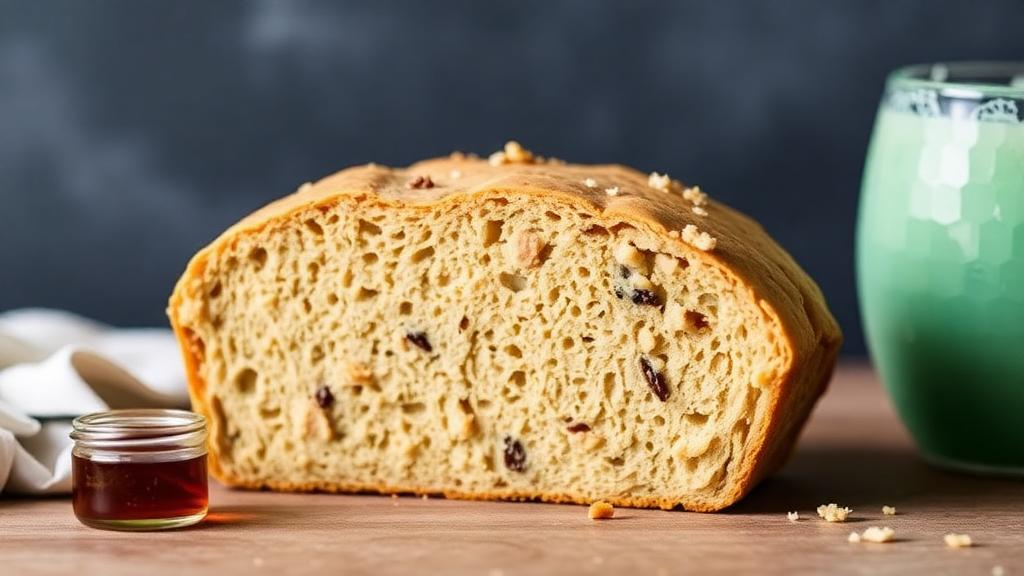
The critical question, of course, was whether this functional bonus came at the cost of bread quality. It did not. Specific volume, the gold standard of loaf performance, measured 2.62 cubic centimeters per gram for kombucha bread against 2.46 for the traditional loaf, a statistically insignificant difference that contradicts earlier reports of dense, compact kombucha breads. Moisture content and water activity of both crumb and crust, tracked over 48 hours of storage, were governed entirely by bread region and time, not by starter type. Instrumental color analysis in the CIE Lab* space found no significant differences in lightness, chroma, or browning index, confirming that Maillard chemistry and caramelization proceeded identically in both loaves.
Digital image analysis of the crumb, using scanned slices processed through Otsu-thresholded binarization in ImageJ, quantified the internal architecture with forensic precision. Pore count, total pore area, average pore size, and porosity fraction were all statistically equivalent between the two breads. Only subtle shape descriptors diverged: kombucha bread pores were slightly more circular and less elongated, with lower maximum and minimum Feret diameters, hinting at marginally different gas cell expansion dynamics without any macroscopic consequence. Texture profile analysis told the same story of equivalence. Both breads hardened dramatically over 48 hours as starch retrogradation ran its course, with hardness climbing from roughly 1,400 grams to nearly 30,000 grams, but the staling trajectories of the two loaves were indistinguishable, as were cohesiveness, springiness, gumminess, chewiness, and resilience.
A panel of 30 untrained tasters, evaluating both breads in a single blinded session, delivered the verdict that matters most to any baker. Of 72 sensory attributes assessed in binary form, 69 showed no significant difference between the loaves. The traditional bread scored higher on fresh-bread odor and a slightly sour taste, while panelists judged the kombucha crumb to be softer, a perception the authors note may reflect saliva interaction and moisture release during chewing rather than the mechanical hardness captured by the texture analyzer. The authors are candid about the limitations of their binary screening approach and of their single-batch traditional control, and they stress that the antioxidant claims rest on spectrophotometric in vitro assays alone; simulated digestion and bioavailability studies will be needed before any health benefit can be claimed with confidence.
Even with those caveats, the implications are considerable. Sourdough’s labor barrier, the week or more of daily attention required to build a starter from scratch, has always limited home bakers and small producers. A commercially available bottle of live kombucha, it turns out, contains everything needed to leapfrog that process in five days, while quietly enriching the resulting loaf with tea-derived phenolics. The Padua team, funded through national and regional fermentation research programs, has effectively demonstrated that one fermented functional food can bootstrap another, and that the ancient alchemy of flour and water is flexible enough to welcome an entirely foreign microbial guild without complaint. Whether kombucha sourdough becomes a fixture of artisan bakeries or a viral home-baking phenomenon, the study establishes a rigorous proof of concept: the SCOBY that revolutionized beverages may now do the same for bread.
Subject of Research: Use of kombucha as a microbial starter culture for sourdough bread fermentation
Article Title: KOMBREAD, Kombucha as a Functional Starter for Sourdough Bread: Physicochemical Properties, Microbiological Characterization, and Quality Evaluation
Article References: Chinello, M., Tawfik, R. N. R., Canazza, E., Nadai, C., de Barros, F. A. R., Lomolino, G., Lante, A., Corich, V., & Giacomini, A. (2026). KOMBREAD, Kombucha as a Functional Starter for Sourdough Bread: Physicochemical Properties, Microbiological Characterization, and Quality Evaluation. Food Science & Nutrition, 14(10), Article e72433. https://doi.org/10.1002/fsn3.72433
Image Credits: AI Generated
DOI: 10.1002/fsn3.72433
Keywords: kombucha, sourdough, SCOBY, fermentation, functional foods, antioxidants, phenolic compounds, lactic acid bacteria, acetic acid bacteria, bread quality, food microbiology, starter cultures
Morgan Morrow. (October 4, 2026). Kombucha Takes On Sourdough: Tea Ferment Slashes Starter Time and Boosts Antioxidants. Scienmag.