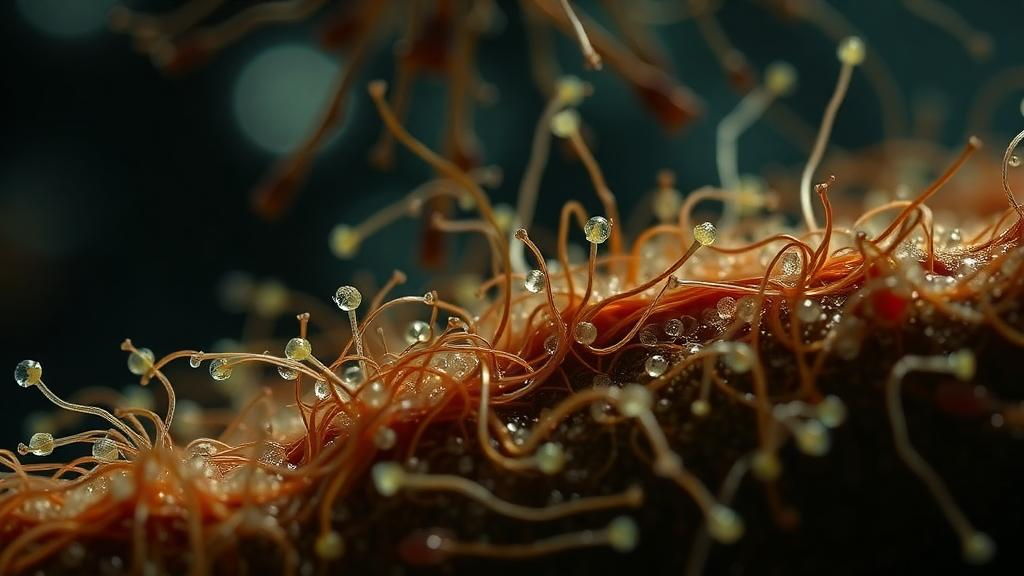
In a laboratory in Vienna, under an oxygen-free microscope chamber, some of the most evolutionarily significant cells ever cultured have been caught doing something no one expected: crawling. Asgard archaea, the microbial group recognized as the closest known living relatives of all complex cells, have now been filmed live for the first time, and the footage reveals a level of dynamism that challenges long-held assumptions about the origins of complex life. The cells extend delicate protrusions, anchor themselves to surfaces, and pull themselves forward in a crawling motion that, until now, had only ever been documented in eukaryotes, the domain that includes animals, plants, fungi and protists.
The study, led by Philipp Radler in the laboratory of Christa Schleper at the University of Vienna and published in the journal Nature, provides the first direct observations of Asgard archaeal motility. These organisms are tiny; each cell has a volume roughly a thousand times smaller than that of a human cell. Yet the recordings show them undergoing dramatic transformations of shape on a minute-by-minute basis, extending thin appendages that can reach up to twenty times the length of the cell body, retracting them again, and using them to actively explore their surroundings. The behavior is strikingly reminiscent of the amoeboid movement seen in far more sophisticated cells, including human immune cells patrolling tissue.
Why does this matter so much? Asgard archaea occupy a central position in current models of eukaryogenesis, the process by which the first complex cells emerged roughly two billion years ago. The prevailing scientific framework holds that a eukaryotic ancestor arose from a symbiotic fusion between a bacterium and an archaeal lineage ancestral to today’s Asgard archaea. In that scenario, the bacterium eventually became the mitochondrion, the energy-producing organelle that powers virtually every complex cell on Earth. Asgard archaea are therefore not merely an interesting branch of the microbial tree; they are the closest available window into the cellular world from which our own lineage was born.
Until very recently, that window was almost entirely opaque. The first Asgard archaea were only brought into culture in 2020 and 2023, one at the JAMSTEC Institute in Japan and another in Schleper’s laboratory in Vienna, and both Japanese teams are co-authors on the new study. Before those milestones, essentially everything scientists knew about the group came from DNA sequencing of environmental samples or from electron microscopy of fixed cells. Those static images were already tantalizing: they showed a round cell body surrounded by a halo of fine, branching projections. But a fixed image cannot reveal whether a cell is extending, retracting, or moving, and so the functional significance of these elaborate shapes remained a matter of speculation.
The Vienna team closed that gap with a technically demanding approach. Asgard archaea are anaerobes, organisms that cannot tolerate oxygen, so the researchers placed the cells in an oxygen-free environment and filmed them alive under the microscope. They worked with two strains: a Lokiarchaeon cultivated in Vienna and a Heimdallarchaeon cultivated in Japan. Both organisms displayed the same remarkable repertoire of behaviors, drastically reshaping themselves every minute and deploying their thin, dynamic appendages to attach to surfaces and probe them. The crawling motion they use had not previously been described in any microbe, and its closest parallels lie in the motility of complex eukaryotic cells.
The mechanistic story behind the movement is equally significant. When the team applied actin inhibitors to the cultures, the dynamic behaviors were suppressed. Actin is one of the fundamental components of the cytoskeleton, the internal scaffolding that gives cells their shape, drives their internal transport, and powers their movement. In eukaryotes, an actin-based cytoskeleton underlies everything from muscle contraction to the crawling of immune cells through tissue. Finding that the motility of Asgard archaea likewise depends on actin suggests that a functional actin cytoskeleton, with clear parallels to the one operating in human cells, was already in place in the archaeal lineage long before the first eukaryote existed.
The international collaboration behind the study included, alongside the Japanese microbiologists, researchers from the Institute of Science and Technology Austria and the Helmholtz Centre for Infection Research in Braunschweig, Germany. Their combined expertise in cultivation, microscopy and cell biology was essential to a result that no single laboratory could have achieved alone. Culturing Asgard archaea remains extraordinarily difficult; the organisms grow slowly, in strict anaerobic conditions, and only a handful of laboratories worldwide have managed it. Every live-cell observation therefore represents years of methodological groundwork.
From an evolutionary standpoint, the discovery opens a genuinely new perspective on the deep history of cellular innovation. Complex cell motility may have far older origins than previously assumed, predating the emergence of eukaryotes themselves. If the ancestor of Asgard archaea already possessed the machinery for shape change, surface attachment and crawling, then some of the cellular capabilities once thought to be eukaryotic inventions may instead have been inherited from their archaeal partner. Such capabilities could even have played a role in the ancient symbiosis from which mitochondria later emerged, potentially facilitating the physical interactions between the archaeal host and its bacterial partner that set complex life in motion.
The findings also carry practical implications that extend well beyond evolutionary theory. Because the actin cytoskeleton governs shape changes and motility in human cells, understanding a simpler, archaeal version of the same machinery offers a comparative framework for dissecting how this fundamental system works. Insights gained from organisms that sit at the evolutionary boundary between prokaryotes and eukaryotes can illuminate which features of the eukaryotic cytoskeleton are ancient inheritances and which are later refinements. In this sense, the humble Asgard archaea, invisible to the naked eye and difficult to culture, may help explain processes that are central to human biology, including immune cell migration and cellular architecture.
Perhaps the most consequential aspect of the study is methodological. Oxygen-free live-cell microscopy of Asgard archaea now makes it possible, for the first time, to test models of the origin of complex life against empirical observation rather than inference from genomes and static images. Hypotheses about how the first eukaryotes moved, attached to surfaces, and interacted with partner cells can now be confronted with real footage of their closest living relatives in action. What has emerged from those first recordings, dynamic protrusions, actin-dependent crawling and a fluidity of form once thought to belong exclusively to complex cells, suggests that the road to eukaryotic life may have been paved with cellular behaviors far older and far more sophisticated than anyone had imagined.
Subject of Research: Crawling motility and actin-based cytoskeleton dynamics in Asgard archaea and their implications for eukaryogenesis
Article Title: Unexpected dynamics of ancient microbes discovered
Article References: Unexpected dynamics of ancient microbes discovered. (n.d.). Original publication
Image Credits: AI Generated
DOI: Not provided
Keywords: Asgard archaea, Lokiarchaeon, Heimdallarchaeon, eukaryogenesis, actin cytoskeleton, cell motility, crawling motility, live-cell microscopy, mitochondria, evolution, University of Vienna, Nature
Drew Townsend. (October 4, 2026). Ancient Microbes Filmed Crawling Reveal Deep Roots of Complex Cell Movement. Scienmag.