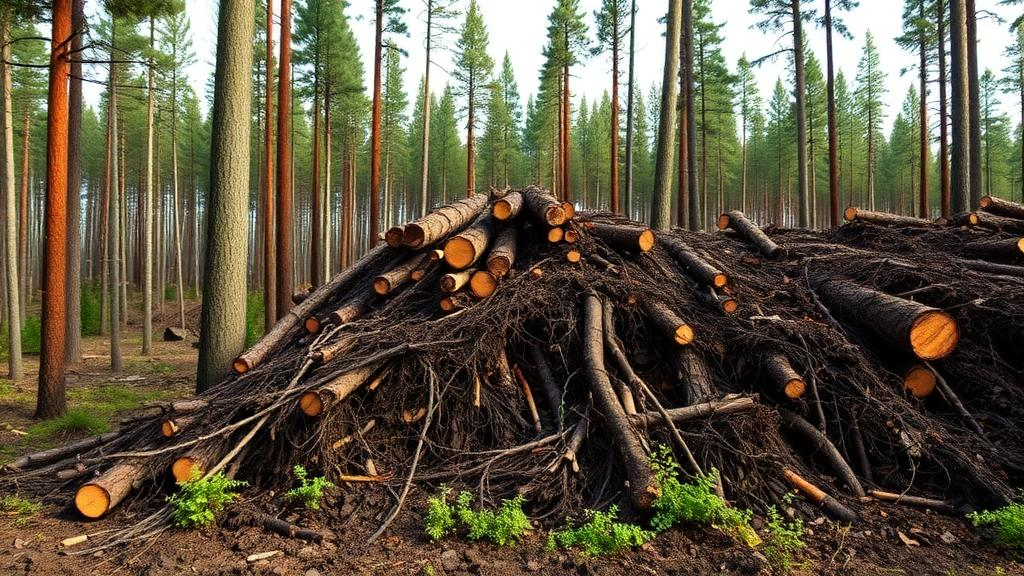
Beneath every mature forest lies a vault that most people never think about: a vast reserve of carbon locked away in the mineral soil, far below the leaf litter and tree roots that dominate our mental image of a forest ecosystem. Soils hold more than three times as much carbon as the atmosphere, and roughly half of that carbon in mineral soils sits deeper than ten to twenty centimeters, where it is thought to be safely bound to iron and aluminum minerals. A new study of harvested red spruce forests in Nova Scotia, Canada, now delivers an unsettling message: the logging practices that reshape the visible forest also reach down into this hidden vault, dissolving the chemical bonds that keep deep soil carbon out of the atmosphere.
The research, published in Discover Soil, examined a chronosequence of temperate red spruce (Picea rubens) stands in the Abraham Lake region of the Liscomb Game Sanctuary in Nova Scotia. The five sites, located within five kilometers of one another on the same parent material, elevation, and topography, differed primarily in the time since harvesting: one year, fifteen years, forty-five years, eighty years, and a reference stand of old-growth forest more than 125 years old, where individual trees exceed two centuries in age. By sampling soils at six depth intervals from the surface down to fifty centimeters at each site, the researchers could reconstruct how the carbon stored in mineral soil changes both with depth and across the decades following a clearcut.
The soils in this region are Podzols, acidic sandy loams shaped by a process called podzolization, in which organic compounds and secondary minerals are leached from the upper profile and re-deposited deeper down. This chemistry makes podzolic soils exceptional carbon storehouses, holding roughly 136 tonnes of carbon per hectare in the top thirty centimeters, and they underpin large areas of the temperate and boreal forests that are actively harvested for timber. In these soils, a large share of the organic carbon is not free-floating debris but is chemically complexed with iron and aluminum, forming organo-metal complexes that have long been considered among the most durable forms of soil carbon storage.
To dissect this storage system, the team used a sequential chemical extraction procedure that peels carbon away from mineral pools of increasing binding strength. Deionized water first removes the water-soluble fraction; sodium pyrophosphate then targets the organo-metal complexes; hydroxylamine-HCl dissolves poorly crystalline minerals such as ferrihydrite and imogolite; and finally sodium dithionite, a strong reducing agent, strips carbon from crystalline iron oxides like goethite and hematite. The result was unambiguous: the organo-metal complexed fraction dominated everywhere, accounting for roughly 59 to 85 percent of all mineral-associated organic carbon across every site and every depth. The other pools were comparatively minor, with water-soluble carbon below about six percent in deep soils and poorly crystalline and crystalline fractions each contributing less than a fifth of the total.
The critical finding emerged when the researchers compared the shallow and deep mineral soil across the chronosequence. In the upper twenty centimeters, carbon concentrations in the mineral-associated pools fluctuated without any clear temporal pattern, likely obscured by the dynamic inputs of fresh organic matter from post-harvest vegetation. But in the deeper soil, between twenty and fifty centimeters, a stark temporal trend appeared. Carbon in the organo-metal fraction was significantly lower at the fifteen-, forty-five-, and eighty-year sites than at the old-growth reference. Total storage in this dominant pool fell from 96 megagrams of carbon per hectare at the 125-plus-year site to just 35 megagrams at the fifteen-year site, a loss of more than sixty percent that had not fully recovered even eight decades after harvest.
The chemistry of the remaining carbon told an equally important story. Using specific ultraviolet absorbance at 254 nanometers (SUVA254), a low-cost spectroscopic proxy for aromatic compounds derived largely from lignin-rich plant material, the researchers tracked the chemical character of the organo-metal carbon through each profile. At every site, aromaticity declined with depth, as expected in a stable soil where microbes progressively process organic matter. Crucially, this depth-related decline was markedly steeper at the fifteen- and forty-five-year sites than at the reference stand, and while the pattern began to recover after fifteen years, the eighty-year-old site had still not returned to the old-growth baseline. In the deep soil, carbon storage and aromaticity rose and fell together, suggesting that as the pool shrank after harvest, its chemical composition shifted toward simpler, less plant-like compounds.
The most compelling evidence came from pairing the spectroscopic data with stable carbon isotope measurements. Across all sites and depths, the researchers found a strikingly tight inverse relationship: as aromaticity decreased, the carbon became enriched in the heavier isotope carbon-13, with a coefficient of determination of 0.84 and a p-value below 0.001. This combination of lower aromaticity and isotopic enrichment is the classic fingerprint of intensified microbial processing, because microbes preferentially consume lighter carbon-12 and break down complex aromatic structures into simpler residues. Previous work at these sites had already ruled out mixing of isotopically distinct carbon sources as the explanation for deep-soil isotopic enrichment, pointing instead to kinetic fractionation during decomposition. The new SUVA data independently corroborate that interpretation.
Together, these lines of evidence support a conceptual model in which clearcut harvesting destabilizes the organo-metal complexes that anchor deep soil carbon. The strong linear relationship between pyrophosphate-extractable carbon and iron in the deep soil indicates that carbon and iron are mobilized together from these associations, consistent with a breakdown of the complexes themselves. If the persistence of soil organic carbon depends largely on whether microbes can physically and chemically access it, then the altered soil conditions following harvest, including changes to podzolization, hydrology, and organic inputs, appear to open the door to microbial attack on carbon that was previously sequestered. Notably, the results suggest that associations with redox-sensitive iron minerals may not confer the protection long attributed to them, since iron cycling itself can participate in carbon destabilization.
The implications extend well beyond a single Nova Scotia forest. Podzolic soils blanket vast stretches of the temperate and boreal zones that supply much of the world’s harvested timber, and mineral soil carbon has generally been treated as a stable, slow-cycling reservoir in forest carbon budgets and climate models. This study shows that the largest mineral-associated pool in these soils, the organo-metal fraction, is also the most vulnerable to harvesting disturbance, with losses persisting on decadal timescales and detectable more than eighty years later. It also offers forest managers and carbon accountants a practical new tool: SUVA analysis is inexpensive compared to isotope measurements, and it can serve as a sensitive indicator of disturbance-driven shifts in soil carbon chemistry. As clearcutting remains routine across North American temperate forests, the hidden carbon beneath the stumps may deserve a far more prominent place in the climate ledger.
Subject of Research: Effects of forest harvesting on mineral-associated soil organic carbon in Podzolic soils
Article Title: Forest harvesting alters the biogeochemical character and protection of mineral associated carbon in a Podzolic soil
Article References: MacIntyre, S., Kellman, L., Gabriel, C. E., & Diochon, A. (2026). Forest harvesting alters the biogeochemical character and protection of mineral associated carbon in a Podzolic soil. Discover Soil, 3(1), Article 118. https://doi.org/10.1007/s44378-026-00261-6
Image Credits: AI Generated
DOI: 10.1007/s44378-026-00261-6
Keywords: soil organic carbon, forest harvesting, Podzolic soils, organo-metal complexes, mineral-associated organic matter, red spruce, SUVA254, carbon-13 isotopes, biogeochemistry, clearcutting, iron oxides, carbon sequestration
Alan Morgan. (October 4, 2026). Clearcut Logging Strips Away the Hidden Carbon Shield Deep in Forest Soils. Scienmag.