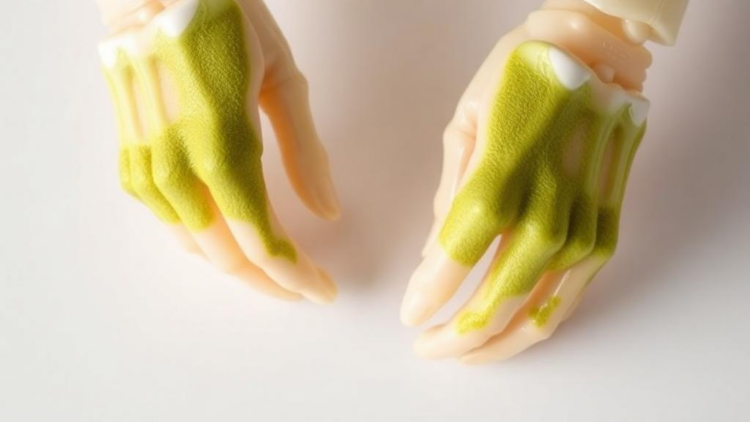
Artificial joints have transformed millions of lives, but they carry a persistent and dangerous vulnerability: bacteria love them. Periprosthetic joint infection, the colonization of an implant by microbes such as Staphylococcus aureus, remains one of the most feared complications of hip and knee replacement surgery. Once bacteria establish a foothold on the implant surface, they can form stubborn biofilms that resist antibiotics and often force patients into revision surgery. Now, a team of researchers in China has developed an elegant two-pronged defense for ultrahigh molecular weight polyethylene, or UHMWPE, the workhorse polymer used in the bearing surfaces of most artificial joints. Their strategy pairs an antibacterial payload derived from green tea with a water-loving polymer coating that both controls how the payload is released and physically blocks bacteria from sticking in the first place.
The study, published in Advanced Composites and Hybrid Materials, was led by Yu Han and Ke Tian of the First Affiliated Hospital of Zhengzhou University together with Jiang-Yu Li, Yue Ren, Chuntai Liu, Changyu Shen and colleagues at Zhengzhou University’s State Key Laboratory of Structural Analysis, Optimization and CAE Software for Industrial Equipment. The core idea is deceptively simple: load the polyethylene with epigallocatechin gallate, or EGCG, a polyphenol extracted from green tea that is well known for its antimicrobial activity, and then wrap the surface in a hydrated biointerface built from hyaluronic acid and the block copolymer Pluronic F127. The result is a surface that fights bacteria actively, through the slow migration of EGCG outward from the polymer matrix, and passively, by making the surface so slippery and protein-repellent that microbes struggle to gain a foothold.
UHMWPE is an obvious target for this kind of engineering. It is tough, wear-resistant and biocompatible, which is why it has dominated joint replacement materials for decades. But it is also chemically inert and hydrophobic, meaning that proteins from joint fluid adsorb readily onto its surface and provide an inviting scaffold for bacterial attachment. Previous attempts to add antibacterial function have often relied on loading the polymer with agents that either leach out too quickly, exhausting their protection in the critical weeks after surgery, or remain trapped so deep in the matrix that they never reach the surface in effective quantities. The Zhengzhou team set out to solve precisely this delivery dilemma.
Their solution centers on a stepwise interfacial immobilization process. First, EGCG is incorporated into the UHMWPE. Then a thin layer of hyaluronic acid, a naturally occurring glycosaminoglycan found in joint fluid and connective tissue, is anchored to the surface, followed by Pluronic F127, a triblock copolymer of polyethylene oxide and polypropylene oxide that is famous for forming hydrated, antifouling brushes in aqueous environments. Together these two components create a hydrated biointerface: a soft, water-rich boundary layer that sits between the implant and its biological surroundings. Hyaluronic acid contributes biocompatibility and lubrication, while the F127 chains extend into the surrounding fluid and sterically repel proteins and bacteria.
What makes the coating genuinely surprising is its effect on drug release. Intuition might suggest that adding a barrier layer on top of the polymer would slow the escape of EGCG from the matrix. The researchers found the opposite. Compared with uncoated EGCG-loaded UHMWPE, the hydrated HA/F127 interface increased the cumulative release of EGCG over the first 24 hours by 52 percent. The team used micro-FTIR depth profiling, a technique that maps chemical composition as a function of depth below the surface, to understand why. The measurements revealed that the coating promotes a redistribution of residual EGCG toward the surface region rather than a broad depletion of the entire matrix. In other words, the hydrated interface appears to draw the polyphenol outward, concentrating the antibacterial agent exactly where it matters most: at the interface with the joint environment.
This surface-biased delivery translated directly into stronger antibacterial performance. In tests against two of the most clinically relevant pathogens, the modified surface achieved inhibition ratios of 95 percent against Staphylococcus aureus and 91 percent against Escherichia coli. These are the bacteria responsible for a large share of periprosthetic joint infections, and S. aureus in particular is notorious for forming biofilms on implant surfaces within hours of contamination. By boosting the flux of EGCG to the surface during the early post-implantation window, when the risk of infection is highest, the coating maximizes the active component of the defense at precisely the right time.
The active killing, however, is only half of the story. The hydrated HA/F127 layer also functions as a passive antifouling shield. The researchers measured significantly reduced protein adsorption and reduced bacterial retention on the coated surface compared with bare polyethylene. This matters because biofilm formation begins with adhesion: bacteria must first attach to a surface, often mediated by adsorbed protein films, before they can multiply and encase themselves in protective extracellular matrix. By denying bacteria that initial foothold, the coating reduces the bacterial load that the EGCG must then deal with. The two mechanisms are complementary, which is why the authors describe the system as providing active-passive antibacterial protection.
Importantly, the design also addresses two other requirements for a joint-bearing material: it must be friendly to the surrounding tissue and it must not degrade the lubricious character of the implant surface. The modified surface maintained good cytocompatibility in the team’s assessments, indicating that it does not harm mammalian cells, and it exhibited a short-term boundary-lubrication effect, meaning the hydrated layer can help reduce friction at the bearing surface, at least in the early period after implantation. Hyaluronic acid is, after all, a natural lubricant of synovial fluid, so its presence at the interface is a sensible choice for a joint material. The authors are careful to characterize the lubrication benefit as short-term, an honest caveat that longer-term wear studies would need to confirm any lasting tribological advantage.
The broader significance of the work lies in its framing of the infection problem as an interface problem. Rather than trying to redesign the entire implant or relying on systemic antibiotics, the researchers engineered a thin, multifunctional boundary layer that simultaneously manages drug transport, surface wettability, protein adsorption and lubrication. This kind of active-release and passive-antifouling strategy could in principle be adapted to other implant materials and other therapeutic payloads, since the underlying logic, using a hydrated polymer interface to bias drug migration toward the surface while blocking fouling, is not specific to EGCG or polyethylene. Given rising rates of joint replacement in aging populations and growing concern about antibiotic resistance, implant surfaces that fight infection without antibiotics carry obvious public health appeal.
There remain, of course, the usual steps between a promising laboratory result and clinical use. The release data cover an initial 24-hour window, and long-term release kinetics, wear performance under millions of loading cycles, and behavior in animal models of joint infection would all need to be established before such a material could reach the operating room. The study was supported by the National Natural Science Foundation of China and several provincial and institutional programs, and it is published open access under a Creative Commons license, making the full technical detail available to other groups who may wish to build on it. Still, the demonstration that a simple hydrated biointerface can boost green tea polyphenol delivery by half while simultaneously repelling the proteins and bacteria that seed infection is a striking piece of materials engineering. It suggests that the next generation of artificial joints may defend themselves not with harsh chemicals or heavy-metal nanoparticles, but with the gentle, water-based chemistry of the body’s own tissues, reinforced by a molecule borrowed from a cup of tea.
Subject of Research: Hydrated HA/F127 biointerface coatings for modulating EGCG release and providing active-passive antibacterial protection on UHMWPE joint implant materials
Article Title: A hydrated HA/F127 biointerface for polyphenol release modulation and active–passive antibacterial protection on EGCG-loaded UHMWPE joint materials
Article References: Han, Y., Li, J.-Y., Pan, S.-M., Yu, P., Jing, M., Wang, Y., Ren, Y., Tian, K., Liu, C., & Shen, C. (2026). A hydrated HA/F127 biointerface for polyphenol release modulation and active–passive antibacterial protection on EGCG-loaded UHMWPE joint materials. Advanced Composites and Hybrid Materials, 9(5), Article 409. https://doi.org/10.1007/s42114-026-02059-0
Image Credits: AI Generated
DOI: 10.1007/s42114-026-02059-0
Keywords: UHMWPE, EGCG, biointerface, polyphenol release, antibacterial, antifouling, hyaluronic acid, Pluronic F127, periprosthetic joint infection, artificial joints, green tea polyphenol, boundary lubrication
Cite Scienmag News
APA MLA Chicago
Neil Sanderson. (October 4, 2026). Green Tea Coating Turns Artificial Joints Into Infection-Fighting Implants. Scienmag. https://scienmag.com/green-tea-coating-turns-artificial-joints-into-infection-fighting-implants/
Neil Sanderson. “Green Tea Coating Turns Artificial Joints Into Infection-Fighting Implants.” Scienmag, 4 October 2026, https://scienmag.com/green-tea-coating-turns-artificial-joints-into-infection-fighting-implants/. Accessed 4 October 2026.
Neil Sanderson. “Green Tea Coating Turns Artificial Joints Into Infection-Fighting Implants.” Scienmag. October 4, 2026. https://scienmag.com/green-tea-coating-turns-artificial-joints-into-infection-fighting-implants/
Copy citation Download RIS
Tags: advanced materials for joint prosthesesantibacterialantifoulingartificial jointsbacteria-resistant hip and knee replacementsbiofilm formation on implantsbiofilm-resistant artificial joint implantsbiointerfaceboundary lubricationEGCGGreen tea antibacterial coatinggreen tea extract in biomedical applicationsgreen tea polyphenolgreen tea-derived antimicrobial agentshyaluronic acidinfection-fighting implants in orthopedic surgeryinnovative drug delivery for joint surgeriesperiprosthetic joint infectionperiprosthetic joint infection preventionPluronic F127polymer coatings for infection controlpolyphenol releaseUHMWPEUHMWPE anti-infection surface modification