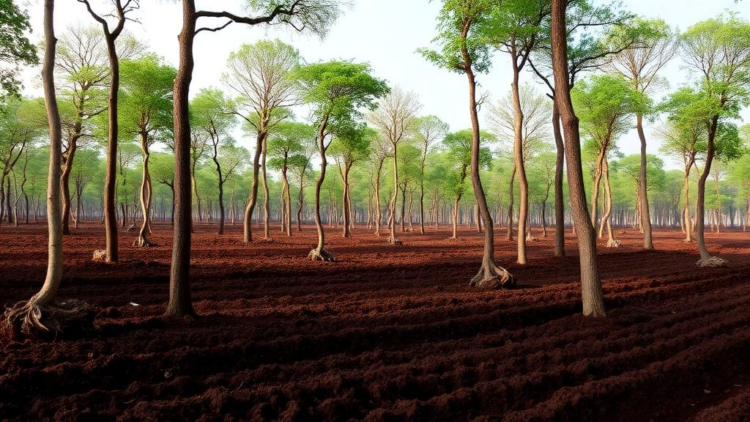
Beneath the scattered forest patches of Punjab and Chandigarh lies a hidden architecture of nutrients that scientists have now mapped for the first time at regional scale. A new study published in Discover Soil analyzed 954 soil samples drawn from 318 locations across 17 forest divisions, spanning three depth intervals from the surface down to 90 centimeters. The findings challenge a long-standing assumption in restoration science: that the visible state of the forest, whether lush or degraded, is the main determinant of what lies in the soil. Instead, the research reveals that the invisible geography of parent material, geomorphology, and pedogenic history exerts a far stronger grip on nutrient distribution than vegetation cover alone.
The research team, led by Vivek Chauhan of the ICFRE-Forest Research Institute in Dehradun, focused on a region that is anything but uniform. Punjab spans roughly 50,362 square kilometers at the interface of the Indo-Gangetic alluvial plains and the Shivalik Himalayan foothills, while the Union Territory of Chandigarh adds a compact 114 square kilometers of comparatively well-forested land. Forest cover in Punjab amounts to just 3.67 percent of its geographical area, yet these tracts harbor species such as Acacia catechu, Dalbergia sissoo, Shorea robusta, and Tectona grandis, and they buffer erosion, regulate water regimes, and sustain biodiversity in one of India’s most intensively cultivated landscapes.
To capture this heterogeneity, the team stratified the landscape using the Forest Survey of India’s 5 by 5 kilometer grid system. Land cover was divided into Non-Degraded Forest, encompassing very dense, moderately dense, open forest, and scrub with crown density of at least 10 percent, and Degraded Forest, defined as land within forest boundaries carrying less than 10 percent crown density. At each location, samples were collected with a stainless-steel auger at three intervals corresponding to the organically active A-horizon, the transitional B-horizon, and the mineral-dominated C-horizon. Twelve physicochemical parameters were measured, including pH, electrical conductivity, organic carbon, nitrogen, phosphorus, potassium, sulphur, and the micronutrients zinc, manganese, iron, copper, and boron.
The analytical centerpiece was linear mixed-effects modelling, a statistical framework that allowed the researchers to simultaneously partition variance among spatial hierarchy, soil depth, and land-cover type. Grid identity nested within forest division was treated as a random effect, absorbing spatial dependence among neighboring observations, while land cover and depth entered as fixed effects. The results were striking. Spatial hierarchy accounted for between 29 and 75 percent of total variance across soil parameters, dwarfing every other source. Soil depth explained up to 15.23 percent of the variance in organic carbon and 7.54 percent in nitrogen, while land cover contributed a mere 0.13 to 2.70 percent depending on the parameter.
The raw measurements themselves tell a vivid regional story. Soil pH ranged from 6.82 in the sub-montane division of Dasuya to 8.76 in Ferozepur, spanning slightly acidic to moderately alkaline conditions. Organic carbon varied from 0.27 percent in Bathinda to 1.11 percent in Dasuya, with the richest soils concentrated in the wetter northern divisions where higher rainfall promotes leaching and organic matter accumulation. Available nitrogen reached 239.90 kilograms per hectare in Chandigarh but fell to 82.53 kilograms per hectare in Pathankot, while potassium ranged from 219.82 kilograms per hectare in Rupnagar to 696.72 kilograms per hectare in Amritsar. Electrical conductivity remained non-saline to marginally saline throughout, peaking at 0.41 decisiemens per meter in Patiala.
Depth emerged as a powerful and ecologically meaningful structuring force. It significantly influenced pH, organic carbon, nitrogen, potassium, and all six measured micronutrients, with organic carbon showing the strongest depth signal at an F-statistic of 123.59. Surface horizons, enriched by litterfall and root turnover, consistently held higher concentrations of carbon, nitrogen, and exchangeable potassium than the layers beneath. Land cover, by contrast, significantly affected only two parameters: pH and copper. The interaction between land cover and depth was significant solely for electrical conductivity, suggesting that vegetated canopies moderate salt distribution differently than exposed degraded sites, but otherwise vertical gradients followed similar trajectories regardless of forest condition.
Perhaps the most compelling patterns emerged from depth-stratified correlation analysis. Across every depth interval and both land-cover categories, pH maintained strong negative relationships with iron and manganese, with correlation coefficients ranging from -0.42 to -0.63 for iron and -0.43 to -0.60 for manganese. This persistent antagonism confirms a well-known geochemical reality of calcareous soils: as alkalinity rises, iron and manganese precipitate as hydroxides and oxides or become adsorbed onto clay minerals, locking them away from plant roots. In the semi-arid southern districts where carbonate accumulation drives pH upward, this immobilization represents a chronic constraint on forest productivity.
The study also documented a progressive decoupling of nutrient relationships with depth. In non-degraded forest surface soils, micronutrients moved together in tight geochemical concert: manganese and iron correlated at 0.44, iron and copper at 0.50, and manganese and copper at 0.34. These couplings, the authors argue, reflect shared redox-sensitive behavior and the stabilizing influence of organic matter, which releases low-molecular-weight organic acids and dissolved organic carbon during decomposition, chelating metals and keeping them mobile even under moderately alkaline conditions. By the 60 to 90 centimeter layer, these correlations had weakened substantially, and in degraded forest subsoils they nearly vanished, with most correlation coefficients falling below 0.2. The subsoil, starved of organic inputs and dominated by mineralogical inheritance, becomes a geochemically fragmented environment.
For forest managers, the implications are concrete. Because surface horizons concentrate both biological activity and management leverage, restoration in these semi-arid alluvial landscapes should prioritize litter retention, assisted natural regeneration, and protection from grazing and soil exposure in the top 30 centimeters. Organic matter enrichment buffers pH-driven micronutrient immobilization, enhances cation exchange capacity, and sustains the nutrient coupling that degraded soils conspicuously lack. Equally important, the authors call for depth-explicit monitoring frameworks: surface-only diagnostics can mask subsurface constraints that limit deep-rooted trees, and stratified sampling to 90 centimeters should be built into forest working plans. The study acknowledges limitations, including the absence of texture, cation exchange, and redox potential measurements, and notes that spatial random effects may have absorbed unmeasured environmental variation. Even so, its central message stands: in the alluvial forests of northwestern India, the landscape writes the nutrient script, and depth determines how the story unfolds, while the label of degraded or non-degraded matters far less than assumed.
Subject of Research: Depth-stratified soil nutrient dynamics in non-degraded and degraded forests of northwestern India
Article Title: Spatial heterogeneity and vertical stratification of soil nutrients in northwestern Indian forests
Article References: Chauhan, V., Kotiyal, P. B., Mishra, S. N., & Panwar, V. P. (2026). Spatial heterogeneity and vertical stratification of soil nutrients in northwestern Indian forests. Discover Soil, 3(1), Article 121. https://doi.org/10.1007/s44378-026-00278-x
Image Credits: AI Generated
DOI: 10.1007/s44378-026-00278-x
Keywords: soil nutrients, soil organic carbon, vertical stratification, linear mixed-effects modelling, variance partitioning, Punjab forests, Chandigarh, alluvial soils, micronutrients, soil pH, forest degradation, Indo-Gangetic plains
Cite Scienmag News
APA
MLA
Chicago
Alan Morgan. (October 4, 2026). Hidden Depth: Why Landscape, Not Forest Cover, Governs Soil Nutrients in Northwest India. Scienmag. https://scienmag.com/hidden-depth-why-landscape-not-forest-cover-governs-soil-nutrients-in-northwest-india/
Alan Morgan. “Hidden Depth: Why Landscape, Not Forest Cover, Governs Soil Nutrients in Northwest India.” Scienmag, 4 October 2026, https://scienmag.com/hidden-depth-why-landscape-not-forest-cover-governs-soil-nutrients-in-northwest-india/. Accessed 4 October 2026.
Alan Morgan. “Hidden Depth: Why Landscape, Not Forest Cover, Governs Soil Nutrients in Northwest India.” Scienmag. October 4, 2026. https://scienmag.com/hidden-depth-why-landscape-not-forest-cover-governs-soil-nutrients-in-northwest-india/
Copy citation
Download RIS
Tags: alluvial soilsChandigarhforest cover versus landscape factorsforest degradationforest patches and soil nutrient dynamicsimpact of geomorphology on soil fertilityIndo-Gangetic plainsinfluence of pedogenic history on soil nutrientslandscape influence on soil nutrientslinear mixed-effects modellingmicronutrientsparent material and soil nutrientsPunjab and Chandigarh soil analysisPunjab forestsregional scale soil nutrient studyregional soil mapping in Northwest Indiarestoration science and soil healthsoil depth and nutrient variationsoil nutrient distributionsoil nutrientssoil organic carbonsoil pHvariance partitioningvertical stratification