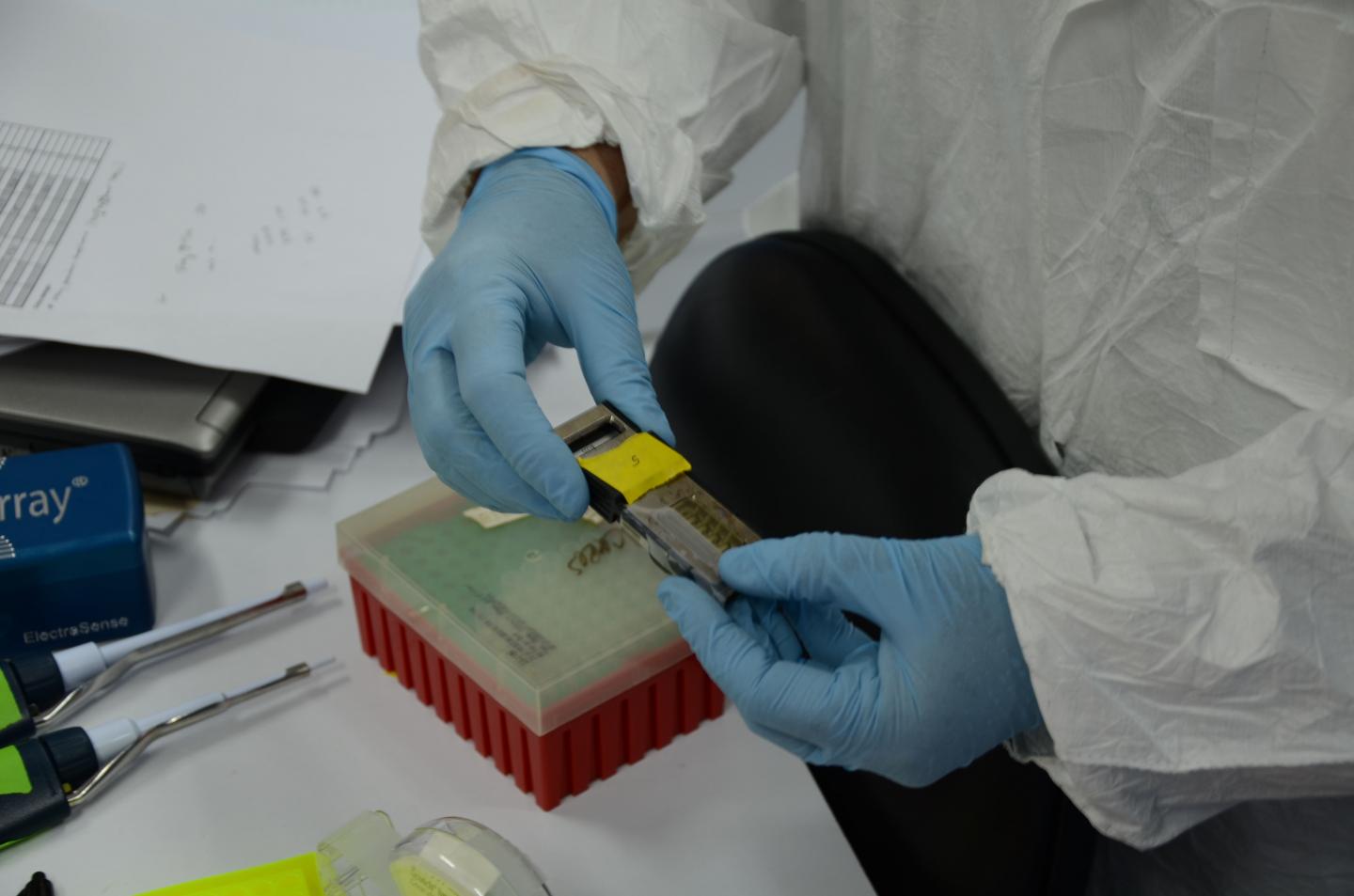
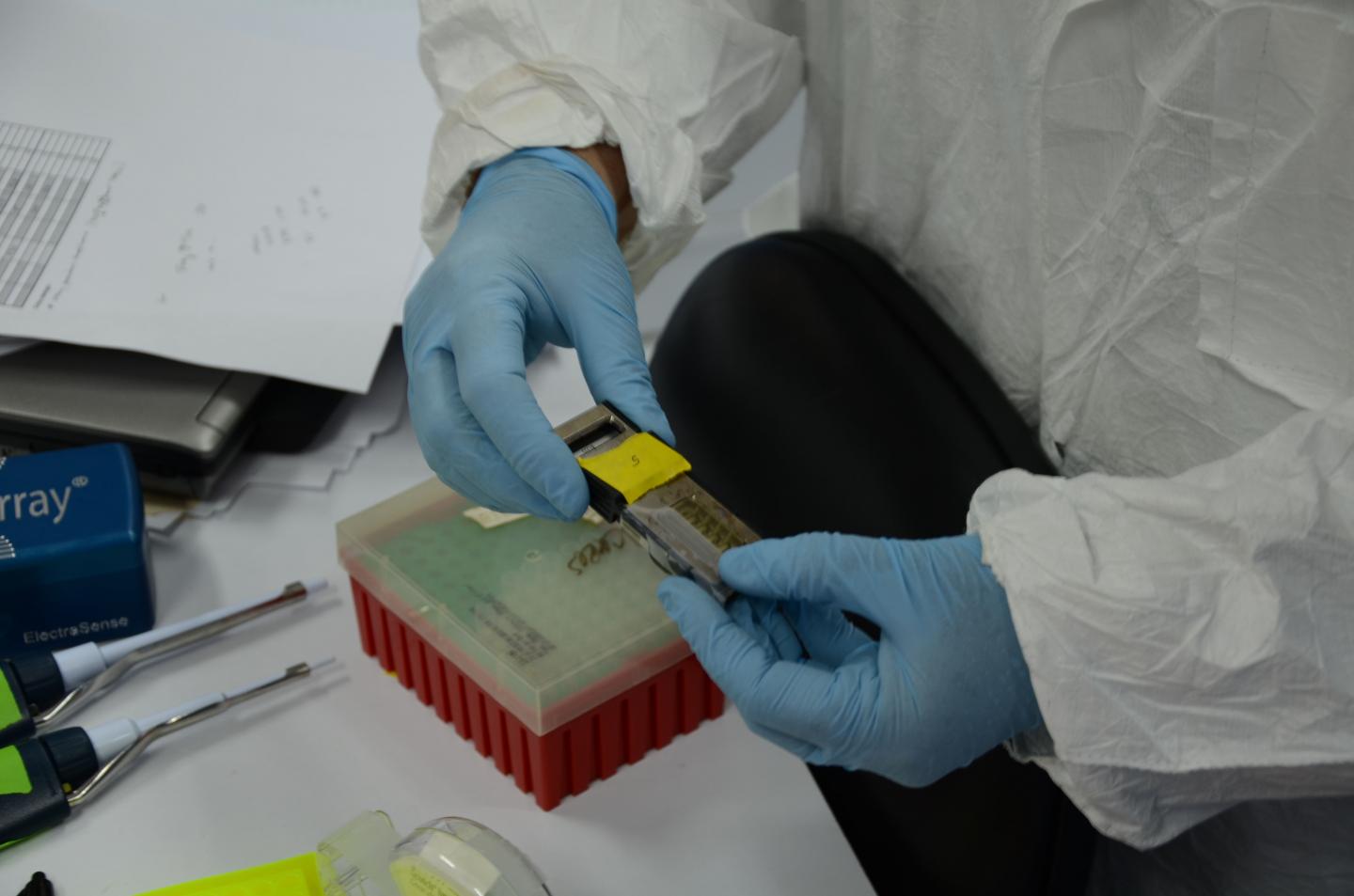
Credit: U.S. Naval Research Laboratory/Lt. Cmdr. Michael Prouty-NAMRU-2 (Released)
WASHINGTON – Antibiotic resistance is one of the most significant global public health problems and is rising in many developing nations due to over-use of antimicrobial agents, widespread availability of counterfeit or substandard medicines and poor infection control measures.
In a joint effort between the U.S. Naval Research Laboratory (NRL), U.S. Army Medical Research Directorate-Kenya (USAMRD-K), Kenya Medical Research Institute (KEMRI), and University of Washington, the research team, using an NRL-developed microarray that detects over 200 different antibiotic resistance genes, tested bacteria from the intestinal tract of healthy individuals and ailing patients in the African country of Kenya, and discovered a high prevalence of bacteria strains resistant to commonly used antibiotics.
"These results suggest that there is selective pressure for the establishment and maintenance of resistant strains," said Dr. Chris Taitt, research biologist, NRL Center for Bio/Molecular Science and Engineering. "This is potentially due to agriculture and prophylactic use of antibiotics and further suggests the need for more effective public health policies and infection control measures than those currently implemented."
Specific to Kenya, widespread use of tetracycline in livestock production, use of trimethoprim/sulfamethoxazole (SXT) and chloramphenicol as first line therapeutics for typhoid, and prophylactic use of SXT in persons exposed to or infected with human immunodeficiency virus (HIV) might have contributed to the high prevalence of resistance.
A total of 90 Klebsiella spp. bacterial strains were isolated from participants ranging in age from 4 months to 54 years. Half of the subjects were diagnosed with acute diarrheal illness, the other half were healthy individuals. Samples were collected from eight Kenyan clinics, including district hospitals of Kisumu, Kisii, Migori, and Homa Bay.
"While important for improvements to global health, an understanding of the types and prevalence of antibiotic resistance in under-characterized regions, such as the Great Horn of Africa, can additionally benefit deployed military personnel in making risk assessment for exposure to, and treatment of, resistant infections," Taitt said.
###
Portions of this work were separately funded by the Office of Naval Research/NRL through internal core funds, the Armed Forces Health Surveillance Branch-Global Emerging Infections Surveillance and Response Systems (AFHSB-GEIS), and the National Institutes of Health. The published findings are made available through PLoS One, under the heading "Antimicrobial resistance of Klebsiella pneumoniae stool isolates circulating in Kenya."
The U.S. Naval Research Laboratory provides the advanced scientific capabilities required to bolster our country's position of global naval leadership. The Laboratory, with a total complement of approximately 2,500 personnel, is located in southwest Washington, D.C., with other major sites at the Stennis Space Center, Miss., and Monterey, Calif. NRL has served the Navy and the nation for over 90 years and continues to advance research further than you can imagine. For more information, visit the NRL website or join the conversation on Twitter, Facebook, and YouTube.
Media Contact
Daniel Parry
[email protected]
202-767-2326
@USNRL
http://www.nrl.navy.mil
Original Source
https://www.nrl.navy.mil/media/news-releases/2017/NRL-Scientists-Find-High-Prevalence-of-Antibiotic-Resistance-in-Kenya http://dx.doi.org/10.1371/journal.pone.0178880