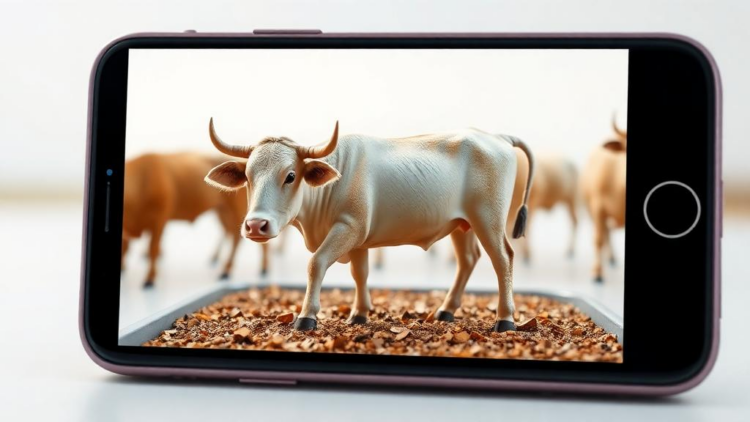
Researchers in Bangladesh have built an artificial intelligence system small enough to weigh a cow from a photograph on an ordinary smartphone, without any internet connection, and then calculate exactly how much herbal supplement that animal should receive. The new model, called HEART-Net, occupies just 0.35 megabytes of memory, roughly one-hundredth the size of a typical photograph, and completes its weight estimate in an average of 51.48 milliseconds. The work, published in Smart Agricultural Technology, was led by Ashif Ahmed Shuvo and colleagues and tested on indigenous Pabna cattle at the Bangladesh Livestock Research Institute.
Body weight is the single most important biometric in livestock management. It determines how much feed an animal needs, whether it is growing healthily, and, critically, how much medicine it should be given. Yet on smallholder farms across much of the developing world, weighing cattle remains a logistical nightmare. Platform scales are expensive and immobile, and herding a 300-kilogram animal onto one is stressful for both beast and farmer. The traditional alternative, estimating weight from a tape measure wrapped around the animal’s heart girth, relies on century-old formulas that carry substantial error.
Computer vision has promised to change this for years, but most existing deep learning models present a paradox. The most accurate networks, such as ResNet50 or VGG16, contain tens of millions of parameters and require more memory and processing power than a low-cost phone can spare. They either run painfully slowly on the device or must ship images to a cloud server, which is useless in rural areas with no reliable connectivity. The team behind HEART-Net set out to break this trade-off, hypothesizing that a carefully designed lightweight network fused with physical measurements could match heavyweight accuracy while fitting under one megabyte and running in under 100 milliseconds.
To build their dataset, the researchers photographed 30 Pabna cattle over multiple days and sessions, capturing 2,000 images per animal under deliberately varied lighting, backgrounds, and postures, for a total of 60,000 frames. Alongside each image they recorded the animal’s true weight on a certified electronic scale, measured before morning feeding to minimize rumen-fill variance, plus three tape-measured biometrics: withers height, body length, and heart girth. Crucially, the data splits were organized by individual animal rather than by image, so the five test cattle had never been seen by the model during training. This prevents the network from cheating by memorizing the coat patterns of animals it has already met.
HEART-Net’s architecture is a study in compression. Its visual backbone uses inverted residual blocks, a narrow-wide-narrow bottleneck design in which cheap depthwise convolutions handle spatial filtering while pointwise convolutions expand and project features. A spatial attention module then generates a mask that highlights anatomically relevant regions, such as the contours of the heart girth, while suppressing background clutter. A stochastic depth regularizer randomly drops entire residual branches during training, discouraging the model from memorizing individual animals. The visual features are ultimately condensed into a compact latent vector through global average pooling.
The most distinctive element is the hybrid fusion layer. Rather than trusting the neural network alone, HEART-Net simultaneously computes a classical weight estimate using Schaeffer’s Livestock Formula, a deterministic equation based on heart girth squared times body length. Two learnable scalar weights, constrained by a softmax function, dynamically balance the neural prediction against this physical anchor. During inference, a dynamic trust factor monitors the variance of the visual features; when the camera image is noisy or ambiguous, the system automatically leans more heavily on the tape-measure physics. A confidence score then grades each estimate as precise, nominal, or requiring human review.
Benchmarked against seven standard backbones on identical data and deployment targets, HEART-Net achieved a mean absolute error of 7.52 kilograms, an R-squared of 0.979, and a concordance correlation coefficient of 0.988 against the electronic scale, with a mean bias of just 0.15 kilograms, the lowest systematic error of any model tested. Cluster bootstrap hypothesis testing with 1,000 resamples showed HEART-Net was statistically indistinguishable in accuracy from EfficientNetB0, EfficientNetV2B0, MobileNetV3-Large, and VGG16, and significantly better than MobileNetV2. Only ResNet50 and MobileNetV3-Small beat it on individual metrics, but ResNet50 required 45 megabytes and 159 milliseconds per inference, failing the edge deployment criteria entirely.
The deployment pipeline is as innovative as the model itself. The team converted the trained network into a Float16-quantized TensorFlow.js artifact and embedded it in a Progressive Web Application called Smart-Herbo, built with React and TypeScript. All inference runs locally in the browser via the WebGL backend, meaning no images ever leave the device, a privacy feature enforced by identifying animals only through local cryptographic hashing. Service workers store the model in device storage for full offline operation. An onboard object detector gates the camera, capturing frames only when a bovine subject is detected with confidence above 0.60, preventing wasted computation on empty paddocks.
The final step turns weight into action. The estimated mass feeds into a dosing module grounded in Kleiber’s Law of metabolic scaling, which holds that metabolic requirements scale with body weight raised to the three-quarters power rather than linearly. The app computes weight-proportional doses of plantain herb, a phytogenic supplement whose iridoid glycosides and acteosides have been shown to improve antioxidant profiles and daily weight gain in ruminants. Linear dosing, the researchers note, systematically under-supplements calves and over-supplements mature animals; allometric scaling corrects this drift automatically.
In a field pilot with 40 stakeholders, including 20 smallholder farmers and 20 agricultural extension workers in the Mymensingh region, the system earned a combined System Usability Scale score of 82.25, well above the industry average of 68 and within the excellent category. Extension workers scored slightly higher than farmers, a gap the authors attribute to greater prior exposure to digital tools rather than any design flaw. The team is careful to frame the work as a lab-to-field proof of concept: with only 30 animals from a single breed at one facility, multi-center validation across breeds and uncontrolled environments remains the essential next step. Future iterations will incorporate depth sensors for automated biometric capture and RFID identification for longitudinal herd management, potentially turning a 0.35-megabyte file into a portable veterinary clinic for the world’s smallholders.
Subject of Research: Ultra-lightweight multimodal deep learning for on-device cattle live-weight estimation and precision phytogenic dosing
Article Title: HEART-Net: An ultra-lightweight multimodal neural network for on-device cattle live-weight estimation and precision phytogenic dosing
Article References: Shuvo, A. A., Hasan, S., Anjum, A., Shahed, A., & Al-Mamun, M. (2026). HEART-Net: An ultra-lightweight multimodal neural network for on-device cattle live-weight estimation and precision phytogenic dosing. Smart Agricultural Technology, 15, Article 102587. https://doi.org/10.1016/j.atech.2026.102587
Image Credits: AI Generated
DOI: 10.1016/j.atech.2026.102587
Keywords: HEART-Net, precision livestock farming, cattle weight estimation, edge AI, multimodal neural network, Kleiber’s Law, phytogenic dosing, TensorFlow.js, Pabna cattle, System Usability Scale, offline inference, spatial attention
Cite Scienmag News
APA
MLA
Chicago
William Thompson. (October 3, 2026). Tiny AI Weighs Cattle on a Phone in Under 52 Milliseconds. Scienmag. https://scienmag.com/tiny-ai-weighs-cattle-on-a-phone-in-under-52-milliseconds/
William Thompson. “Tiny AI Weighs Cattle on a Phone in Under 52 Milliseconds.” Scienmag, 3 October 2026, https://scienmag.com/tiny-ai-weighs-cattle-on-a-phone-in-under-52-milliseconds/. Accessed 3 October 2026.
William Thompson. “Tiny AI Weighs Cattle on a Phone in Under 52 Milliseconds.” Scienmag. October 3, 2026. https://scienmag.com/tiny-ai-weighs-cattle-on-a-phone-in-under-52-milliseconds/
Copy citation
Download RIS
Tags: AI-powered precision farming in developing countriescattle weight estimationcomputer vision for livestock weight measurementedge AIHEART-Netherbal supplement dosage calculation for cattleindigenous cattle weight estimation AIKleiber’s Lawlightweight animal biometric analysisLivestock weight estimation using mobile AImultimodal neural networkoffline inferenceoffline smartphone-based livestock monitoringPabna cattlephytogenic dosingportable livestock management toolsPrecision Livestock Farmingrapid animal biometric assessment mobile applicationsreal-time cattle weighing smartphone technologysmall-footprint AI models for agriculturesmall-scale farm animal health monitoringspatial attentionSystem Usability ScaleTensorFlow.js