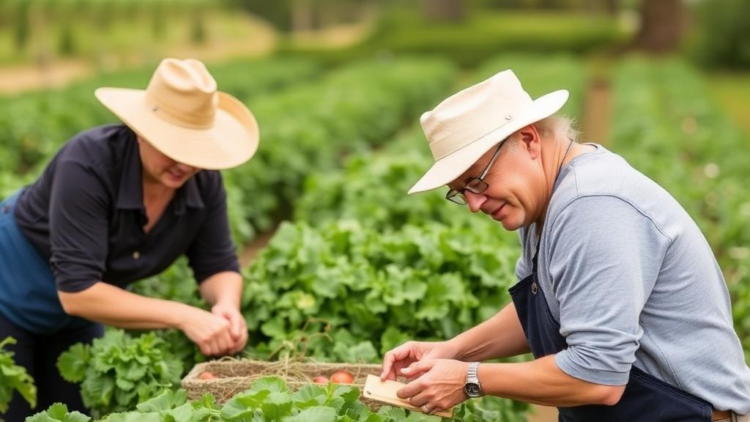
America’s appetite for organic food has long outpaced what its own farmers can supply. For decades, the gap between domestic organic production and consumer demand has widened to the point where billions of dollars flow overseas each year to pay for certified organic imports, even as U.S. producers hesitate to make the leap themselves. The barriers are formidable: the financial risk of a multi-year transition, the technical complexity of organic systems, and the sheer difficulty of learning a fundamentally different way of farming. Now, Arizona State University’s Swette Center for Sustainable Food Systems is betting that structured mentorship can help close that gap. On Oct. 1, the center officially launched Kernel, a nationwide organic mentorship program designed to connect experienced organic producers with farmers, ranchers and food handlers who want to transition their conventional operations to certified organic production.
The timing is not incidental. Kernel builds directly on the legacy of the U.S. Department of Agriculture’s Transition to Organic Partnership Program, known as TOPP, which was discontinued on Sept. 30 after four years of operation. During its run, the $100 million program mobilized organic transition support from more than 200 organizations across the country, providing networking opportunities, technical assistance and, most importantly, facilitated mentorship relationships between seasoned organic producers and newcomers attempting the transition. According to Kathleen Merrigan, executive director of the Swette Center and a former U.S. Deputy Secretary of Agriculture, the mentoring component was the heart of the program’s success. Kernel is designed to carry that legacy forward, ensuring that the network of mentors and mentees built under TOPP does not simply dissolve with the program’s sunset.
The stakes are considerable. As of 2024, roughly $5.7 billion was routed to organic food imports, money that leaves the U.S. economy rather than supporting domestic producers, rural communities and American soil. The Swette Center’s ambition with Kernel is to redirect a meaningful share of that spending back into U.S. pockets by expanding the ranks of certified organic operations nationwide. Beyond the economics, the push aligns with broader national goals of improving soil health and reducing reliance on synthetic pesticides, outcomes that organic management practices are specifically designed to deliver. The program’s leaders argue that every successful transition represents a compound benefit: healthier land, healthier communities and a more resilient domestic food supply.
One of the most persistent misconceptions the program confronts is the idea that organic farming is simply a return to pre-industrial agriculture. Merrigan is emphatic on this point. Organic production, she explained, is a complex systems approach that demands deep ecological knowledge, careful planning and constant problem-solving. It is neither easy nor always intuitive, which is precisely why learning from someone who has already navigated the transition can make the difference between success and failure. For producers new to organic methods, the science of soil biology, pest management without synthetic chemicals, crop rotation design and certification paperwork can feel overwhelming. A mentor who has lived through those challenges provides not just technical answers but the confidence to persist through them.
Mentorship in the Kernel program extends beyond agronomy. Producers new to organic often need guidance on how to enter the organic market itself: which buyers to approach, how certification affects marketing, and what business pitfalls to avoid while their operation is in flux. Growing crops and raising animals according to organic standards is only half the challenge; the other half is building a viable enterprise around them. Experienced mentors can share hard-won lessons about pricing, contracts and market positioning that no manual or extension publication fully captures. This business dimension, program leaders note, is frequently what determines whether a transition sticks once the initial enthusiasm fades.
Even the best mentors cannot smooth out every difficulty in the transition process, and the program’s leaders are candid about the hardest one. Before a producer can be certified organic, there is a mandatory three-year transition period during which chemical inputs must be stopped, in Merrigan’s words, cold turkey, in order to restore soil health. During those three years, the farm cannot market its products as organic or charge the premium prices that organic certification commands. Neither TOPP nor Kernel was designed to fill that financial hole, and it remains one of the structural challenges facing the organic sector. Yet mentors who have endured the transition period insist the wait is worth it, and not only for the eventual price premiums. Farmers who live on or near their land describe tangible improvements in family and community health, farmworker wellbeing and their personal contribution to climate action.
Kernel’s structure reflects lessons learned during the TOPP years. The program’s budget will continue to support the mentorship relationships already established through TOPP, preserving continuity for hundreds of existing pairs. Alongside regional partners including California Certified Organic Farmers, Florida Organic Growers, Oregon Tilth, the Midwest Organic Services Association, the Organic Crop Improvement Association and the Northeast Organic Farming Association Interstate Council, the Swette Center will expand recruitment of both mentors and mentees, bringing more organic hopefuls and experts into the national network. The track record is encouraging: California Certified Organic Farmers reports that the TOPP-era national mentorship program reached more than 600 mentees across the United States, a scale that demonstrates the demand for this kind of peer-to-peer support.
Financial support for Kernel comes through a gift dedicated to advancing Principled Innovation across Arizona State University, a framework the university adopted in 2023 as its ninth design aspiration, embedding character and values into institutional decision-making. Jacqueline Smith, ASU vice president for principled innovation and impact, framed the program as an expression of that commitment, noting that by supporting mentorship for organic farmers, the university is helping strengthen relationships and share the knowledge needed to build more resilient food systems for farmers and consumers alike. Over the next five years, the bulk of Kernel’s budget will go toward compensating mentors, who are eligible to receive $1,000 for each mentee they take on, up to a maximum of $5,000. That funding structure is expected to support approximately 2,000 total mentor and mentee pairings over the program’s life, according to Merrigan.
Money, however, is rarely what draws experienced organic farmers into the mentor’s seat. Among them is George Siemon of Wisconsin, one of the founders of Organic Valley, the multibillion-dollar organic cooperative. As a Kernel mentor, Siemon has traveled to Arizona to support aspiring organic livestock producers, an investment of time that, as Merrigan observed, he hardly needs to make. She described him as representative of a generation of organic industry veterans who see mentorship as a way of investing in the future, not their own future, but that of their grandchildren, and of a food system capable of sustaining the next generation of farm families. That ethos, she suggested, is the program’s real engine.
The program’s name is a deliberate metaphor. The kernel, Merrigan noted, is the part of the seed that represents future growth, and with the average American farmer aging, cultivating that growth has become an urgent national task. Her stated goal is plentiful, homegrown U.S. organic food, with mentorship as one critical piece of a larger puzzle that also includes policy, markets and consumer demand. If Kernel succeeds at its projected scale, thousands of new organic producers could emerge over the next five years, each guided through the technical, financial and psychological challenges of transition by someone who has made the same journey. For a country that currently spends billions importing what it could grow at home, the seed being planted is a modest one, but its ambitions are anything but.
Subject of Research: A national organic farming mentorship program supporting the transition of U.S. producers to certified organic agriculture
Article Title: ASU launches nationwide program to provide organic farming mentorships
Article References: ASU launches nationwide program to provide organic farming mentorships. (n.d.). Original publication
Image Credits: AI Generated
DOI: Not provided
Keywords: organic farming, mentorship, Arizona State University, Swette Center, USDA, TOPP, sustainable agriculture, soil health, organic certification, food systems, agricultural transition, Kernel program
Cite Scienmag News
APA
MLA
Chicago
Alan Morgan. (October 1, 2026). New National Mentorship Network Aims to Bring US Farmers Into Organic. Scienmag. https://scienmag.com/new-national-mentorship-network-aims-to-bring-us-farmers-into-organic/
Alan Morgan. “New National Mentorship Network Aims to Bring US Farmers Into Organic.” Scienmag, 1 October 2026, https://scienmag.com/new-national-mentorship-network-aims-to-bring-us-farmers-into-organic/. Accessed 1 October 2026.
Alan Morgan. “New National Mentorship Network Aims to Bring US Farmers Into Organic.” Scienmag. October 1, 2026. https://scienmag.com/new-national-mentorship-network-aims-to-bring-us-farmers-into-organic/
Copy citation
Download RIS
Tags: agricultural transitionArizona State Universitybarriers to organic transitionfarm transition technical assistancefood systemsfood systems sustainabilityinnovative farming practicesKernel programmentorshipnationwide organic farmer supportorganic agriculture educationorganic certificationorganic certification challengesorganic farmingOrganic farming mentorship programsorganic imports and domestic productionsoil healthsustainable agriculturesustainable agriculture initiativesSwette CenterTOPPU.S. organic food industryUSDAUSDA organic transition support