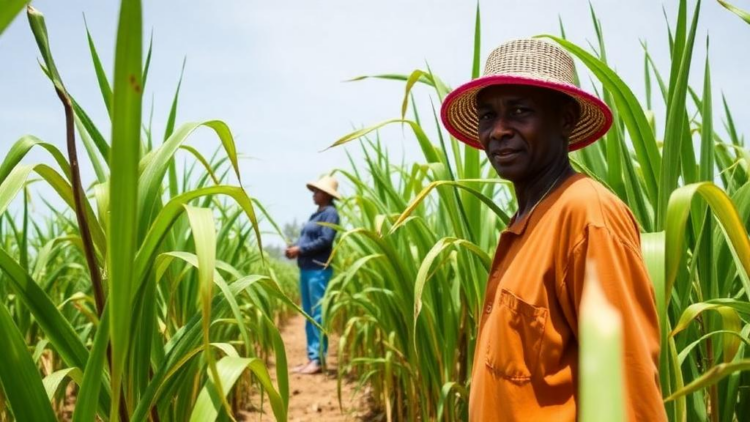
Rwanda’s sugar bowl is leaking. The country produced roughly 130,000 metric tons of sugarcane in 2022, yet national demand for sugar sits between 160,000 and 180,000 metric tons a year, forcing imports to fill a gap of 30,000 to 50,000 metric tons. A new study of smallholder farmers along the Nyabarongo River suggests that a large share of that shortfall could be closed not by planting more land or buying more fertilizer, but simply by using what farmers already have more effectively. The research, published in BMC Agriculture, applied stochastic frontier analysis to 202 sugarcane producers in Kigali City and the Eastern Province and found an average technical efficiency of 80.58 percent. In plain terms, the same fields, the same labor and the same inputs could yield nearly 20 percent more cane if management inefficiencies were ironed out.
Technical efficiency is a deceptively simple idea with powerful implications. It measures the ratio of what a farmer actually produces to the maximum that could be produced with the identical bundle of inputs, a concept that traces back to Farrell’s foundational 1957 work on productive efficiency. A farmer operating at 80 percent efficiency is leaving a fifth of potential output on the table, not because of bad luck or poor soil, but because of sub-optimal decisions about how much labor to hire, how densely to plant and how to allocate scarce resources. The Rwandan study, led by Jean Marie Ntakirutimana of Kabuye Sugar Works together with researchers at Jomo Kenyatta University of Agriculture and Technology and Machakos University, quantified exactly that gap for the first time in this crop and region, where empirical evidence on the causes of low sugarcane productivity had been almost entirely absent.
The methodology is worth understanding, because it is what separates this finding from anecdote. The team used stratified random sampling across the two ecological zones suitable for sugarcane along the Nyabarongo River, drawing 202 farmers from three cooperative societies using Slovin’s formula at a 95 percent confidence level. They then estimated a Cobb-Douglas stochastic production frontier with maximum likelihood methods, a technique that splits the deviation between observed and frontier output into two components: random statistical noise, and a one-sided inefficiency term that captures genuine management shortfalls. This is a crucial advantage over non-parametric approaches like data envelopment analysis, which attribute every deviation to inefficiency and cannot easily be tested statistically. The estimated gamma parameter of 0.6297 told the researchers that roughly 63 percent of the variation in output among these farmers stemmed from differences in technical inefficiency rather than random shocks, a moderate but actionable level of controllable waste.
The input-level results contain some genuine surprises. Pesticide use emerged as the star performer: each additional unit of pesticide was associated with a 21.5 percent increase in sugarcane output, a highly significant effect attributed to effective control of pests and diseases, with chlorpyrifos and mancozeb the most commonly applied products. But three other inputs worked against the farmers. Organic compost reduced output by nearly 10 percentage points on average, likely because it releases nutrients slowly while farmers divert their best compost to vegetable crops. Labor told a similar story, with each additional man-day cutting output by about 12 percent, a pattern the authors link to an aging, inadequately trained agricultural workforce, echoing evidence from China that a graying rural labor force drags down crop productivity. Most strikingly, planting more seed cane reduced output by 7.8 percentage points, pointing to overcrowded fields where stalks compete for light, water and nutrients and end up thinner and shorter.
The socioeconomic and institutional findings are even more provocative, because several of them invert conventional development wisdom. Older farmers were more efficient, with each additional year of age reducing technical inefficiency, plausibly because age proxies decades of accumulated knowledge about local agro-ecological conditions, input timing and irrigation. Access to bank credit also cut inefficiency sharply, with a coefficient of minus 1.6433, consistent with evidence from India, Indonesia and elsewhere that timely financing lets farmers buy quality seed setts, fertilizer and irrigation equipment when they actually need them. Only 16.8 percent of the surveyed farmers had access to credit, so this lever remains largely unused. Gender, education level, household size, marital status and market distance, meanwhile, showed no significant effect at all.
Then come the counterintuitive results that should make policymakers sit up. Farmers who received extension services were less efficient than those who did not. Cooperative members were less efficient than non-members. Trained farmers were less efficient than untrained ones. Larger landholdings were associated with more inefficiency, not less. The authors do not dismiss these institutions; they diagnose them. Rwanda’s extension system, they argue, tends toward a standardized, one-size-fits-all advisory model that disseminates uniform messages poorly matched to the specific agronomy of sugarcane, a crop with a long growth cycle and complex management demands. Cooperatives can suffer from weak governance, delayed input delivery and over-reliance on collective decisions that stifle individual initiative. Training sessions and meetings often collide with critical field preparation windows, pulling farmers away from their fields at exactly the wrong moments. And beyond a certain scale, larger plots may simply exceed a household’s management capacity.
Placed in global context, Rwanda’s numbers look respectable but reveal a clear ceiling. Mean technical efficiency of 80.58 percent sits comfortably within the 70 to 85 percent range reported for sugarcane producers in Brazil and Kenya, and well above India’s national figure of 66 percent or Ethiopia’s 60 to 70 percent. Pakistan’s Faisalabad smallholders exceed 90 percent on technical efficiency but collapse to 28 percent on allocative efficiency, hampered by irrigation costs and saline groundwater. Brazil, the global benchmark, reaches 85 to 90 percent thanks to mechanization, advanced agronomy and strong extension systems, while Thailand’s roughly 85 percent reflects government-backed technology adoption and widespread integrated pest management. Rwanda applies moderate pesticide levels but lacks structured IPM, and its reliance on manual labor and organic composting, however sustainable in intent, contrasts sharply with the mechanized systems of the most efficient producers.
The regional breakdown adds another layer of insight. Farmers in the Eastern Province achieved a mean efficiency of 83.16 percent, while those in Kigali City averaged just 78.00 percent, a gap the authors attribute to differences in resource access, infrastructure and the effectiveness of support services. Across the pooled sample, nearly 60 percent of farmers operated in the 81 to 90 percent efficiency band and another 35 percent in the 71 to 80 percent band, with no farmer below 42 percent. The inefficiency gap of 19.42 percent overall, 22 percent in Kigali City and 16.84 percent in the Eastern Province represents the concrete productivity prize on offer. The surveyed farmers averaged 6,261.9 kilograms of cane on plots averaging just 1.22 hectares, confirming that this is an overwhelmingly smallholder system where marginal gains per farm translate into meaningful national totals.
The policy prescriptions that flow from this analysis are refreshingly specific. Rather than simply pumping more money into extension or cooperatives, the authors argue for improving the quality and crop-specificity of advisory services, strengthening cooperative governance, pairing credit expansion with financial literacy training, and promoting optimal planting densities so that farmers stop treating seed cane quantity as a proxy for ambition. They also call for encouraging innovation and youth participation in a sector where the average farmer is 55 years old with fewer than seven years of sugarcane experience. Given that Africa’s sugar output is projected to grow 36 percent by 2030 and developing countries will account for 79 percent of global growth, Rwanda has a genuine opportunity to convert efficiency gains into import substitution and rural income growth. The study’s core message is quietly radical: before Rwanda plants another hectare, it should fix the fifth of its existing harvest that poor management is quietly throwing away.
Subject of Research: Technical efficiency and its determinants in smallholder sugarcane production in Rwanda
Article Title: Optimizing sugarcane production in Rwanda: a stochastic frontier analysis of smallholder farmers
Article References: Ntakirutimana, J. M., Otieno, G. O., Ngigi, M., & Majiwa, E. (2025). Optimizing sugarcane production in Rwanda: a stochastic frontier analysis of smallholder farmers. BMC Agriculture, 1(1), Article 22. https://doi.org/10.1186/s44399-025-00021-x
Image Credits: AI Generated
DOI: 10.1186/s44399-025-00021-x
Keywords: sugarcane, Rwanda, technical efficiency, stochastic frontier analysis, smallholder farmers, agricultural productivity, extension services, cooperatives, agricultural credit, pesticide use, organic compost, sugar imports
Cite Scienmag News
APA
MLA
Chicago
Alan Morgan. (October 1, 2026). Rwandan Sugarcane Farmers Could Boost Yields Nearly 20 Percent Without Extra Inputs, Study Finds. Scienmag. https://scienmag.com/rwandan-sugarcane-farmers-could-boost-yields-nearly-20-percent-without-extra-inputs-study-finds/
Alan Morgan. “Rwandan Sugarcane Farmers Could Boost Yields Nearly 20 Percent Without Extra Inputs, Study Finds.” Scienmag, 1 October 2026, https://scienmag.com/rwandan-sugarcane-farmers-could-boost-yields-nearly-20-percent-without-extra-inputs-study-finds/. Accessed 1 October 2026.
Alan Morgan. “Rwandan Sugarcane Farmers Could Boost Yields Nearly 20 Percent Without Extra Inputs, Study Finds.” Scienmag. October 1, 2026. https://scienmag.com/rwandan-sugarcane-farmers-could-boost-yields-nearly-20-percent-without-extra-inputs-study-finds/
Copy citation
Download RIS
Tags: addressing sugar demand through efficiency improvementsagricultural creditagricultural productivityagricultural productivity studies in East Africaagricultural research on technical efficiencycooperativesextension servicesimproving crop yields without additional inputsmanaging farm productivity inefficienciesmaximizing existing farming resourcesorganic compostpesticide useRwandaRwanda sugar import gap reduction strategiesRwandan sugarcane production increasesmallholder farmerssmallholder farmers agricultural efficiencystochastic frontier analysisstochastic frontier analysis in agriculturesugar importssugarcanesugarcane farming management practicestechnical efficiencyyield optimization for small-scale farmers