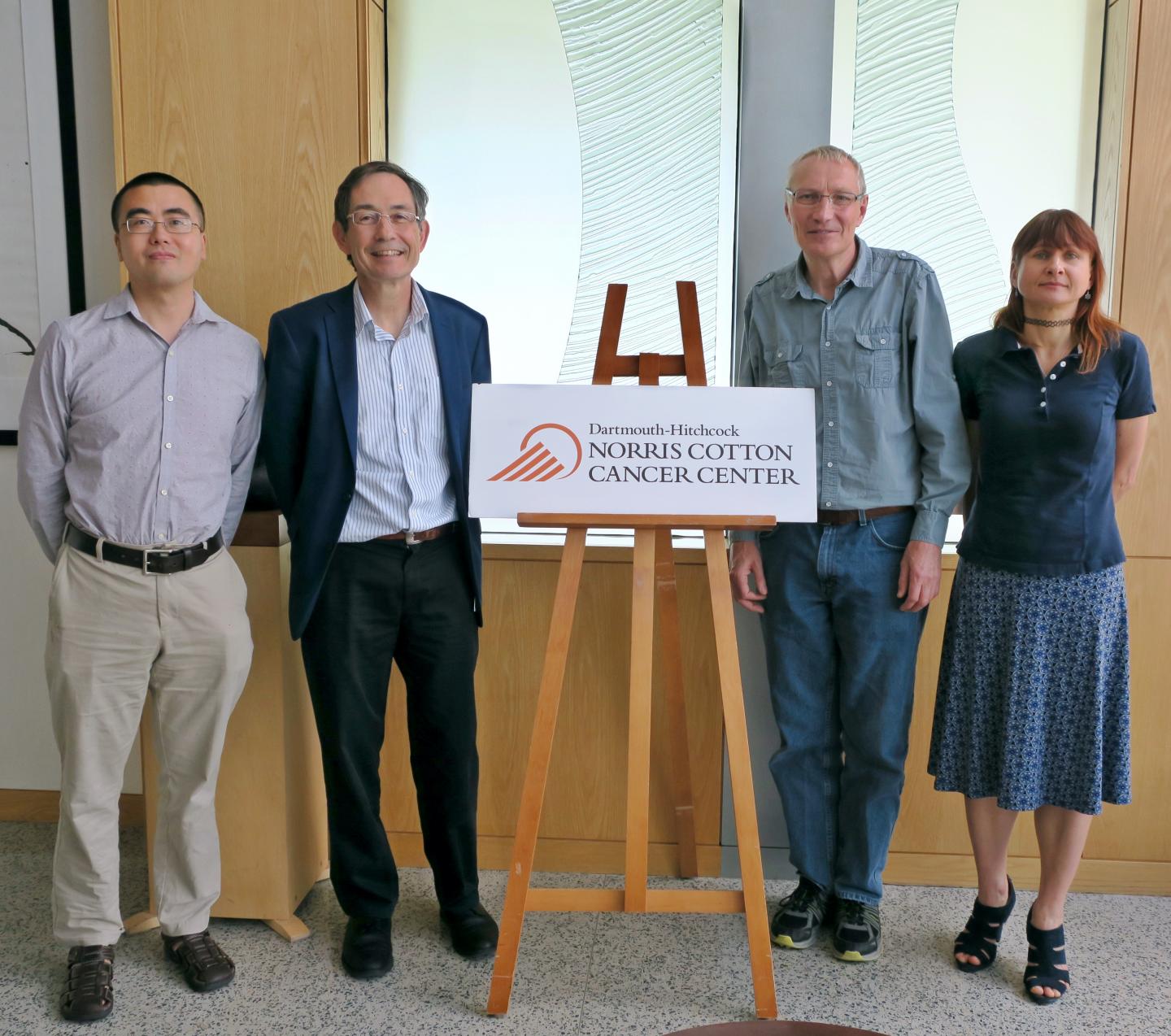
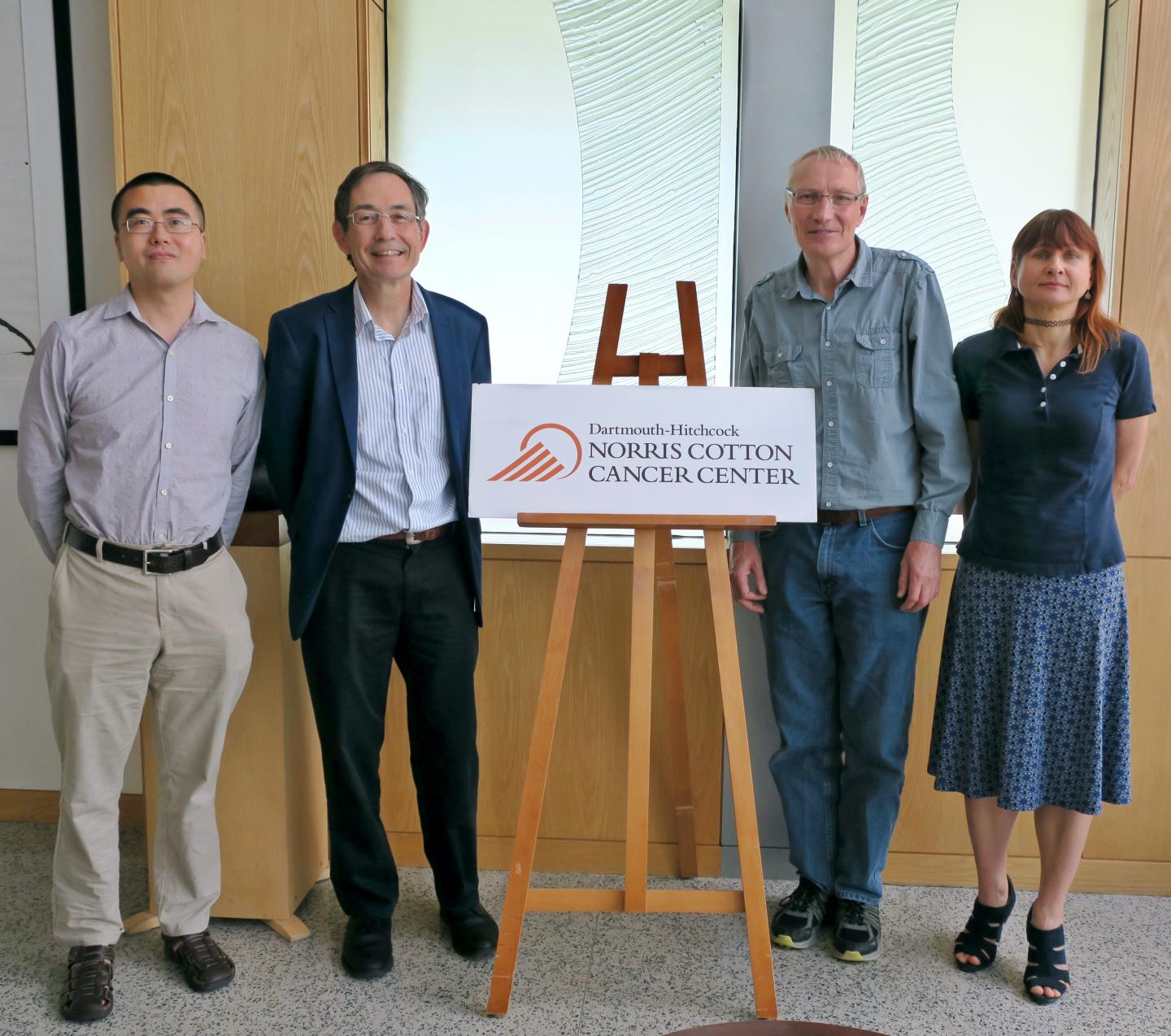
Credit: Norris Cotton Cancer Center
LEBANON, NH – Significant research funding in the form of a five-year, $12.1 million U19 Grant from the National Institutes of Health (NIH) has been awarded to a collaboration of research teams co-led by Dartmouth's Christopher Amos, PhD, to study and improve precision of lung cancer risk and screening.
The title of this multiple-PI grant is "Integrative analysis of lung cancer etiology and risk" and the total award over five years totals $12,177,381. "The goal is to enhance our understanding of gene-environment interactions in lung cancer etiology and to move the observations about risk for lung cancer towards translation" said Amos. For more than 30 years lung cancer has remained the most common cancer, and carries with it the highest cancer mortality rate worldwide, largely due to late-stage diagnosis. With this grant funding, the team particularly aims to more precisely target lung cancer screening to reduce its burden and improve the yield of detection for early lung cancer.
This research funding relates to and greatly extends the team's recently published Nature Genetics paper, "Large-scale association analysis identifies new lung cancer susceptibility loci and heterogeneity in genetic susceptibility across histological subtypes." The paper details the results of a huge study that identified several new variants for lung cancer risk that will translate into improved understanding of the mechanisms involved in lung cancer risk. Using the OncoArray genotyping platform developed by multiple cancer consortia, the genomewide association study identifies new susceptibility loci for lung cancer. Although tobacco smoking is the main risk factor, past studies have also shown heritability of lung cancer as a concern, though much of it remains unexplained.
The cooperative grant study will be arranged into three complementary projects working towards a unifying goal. Project 1, Genomic Predictors of Smoking Lung Cancer Risk, studies large samples to identify variants that affect risk through genetic factors and environmental exposures. Project 2, Biomarkers of Lung Cancer Risk evaluates a wide range of risk biomarkers that have been implicated as promising lung cancer risk biomarkers and will identify validated risk biomarkers for use in risk prediction models. Project 3, Translating Molecular and Clinical Data to Population Lung Cancer Risk Assessment establishes an integrated risk prediction model based on lung cancer CT screening populations in the United States, Canada and Europe. It combines personal health and exposure history with targeted molecular and genomic profiles and lung function data, and establishes nodule assessment models for individuals qualified by the probability models. "We believe that this level of integration will yield novel observations about lung cancer development and provide unique translational opportunities to refine screening eligibility criteria" said Amos. "Ultimately, it will help improve screening efficiency and further reduce lung cancer mortality."
Christopher Amos is Chair of the Department of Biomedical Data Science, Head of the Center for Genomic Medicine, Interim Director of Norris Cotton Cancer Center, and Associate Director for Population Sciences Geisel School of Medicine at Dartmouth. He serves as the communicating PI, the PI of the administrative core and the PI of Project 1. Other Dartmouth investigators include Ivan Gorlov, PhD, Olga Gorlova, PhD, and Jiang Gui, PhD. Paul Brennan, PhD from the International Agency for Research in Cancer, part of the World Health Organization in Lyon, France is the Project 2 leader, focusing on identifying and validating biomarkers of early lung cancer. Rayjean Hung, PhD, at the University of Toronto is the PI of project 3 focusing on applying these biomarkers in all the world's largest screening cohorts. Xihong Lin, PhD, at the Chan Harvard School of Public Health is the PI of the biostatistics core.
###
About Norris Cotton Cancer Center at Dartmouth-Hitchcock:
Norris Cotton Cancer Center combines advanced cancer research at Dartmouth's Geisel School of Medicine with patient-centered cancer care provided at Dartmouth-Hitchcock Medical Center in Lebanon, NH, at Dartmouth-Hitchcock regional locations in Manchester, Nashua and Keene, NH, and St. Johnsbury, VT, and at partner hospitals throughout New Hampshire and Vermont. It is one of 48 centers nationwide to earn the National Cancer Institute's "Comprehensive Cancer Center" designation. Learn more about Norris Cotton Cancer Center research, programs, and clinical trials online at cancer.dartmouth.edu.
Media Contact
Jaime Peyton
[email protected]
603-653-3615
http://www.dhmc.org/webpage.cfm?org_id=796