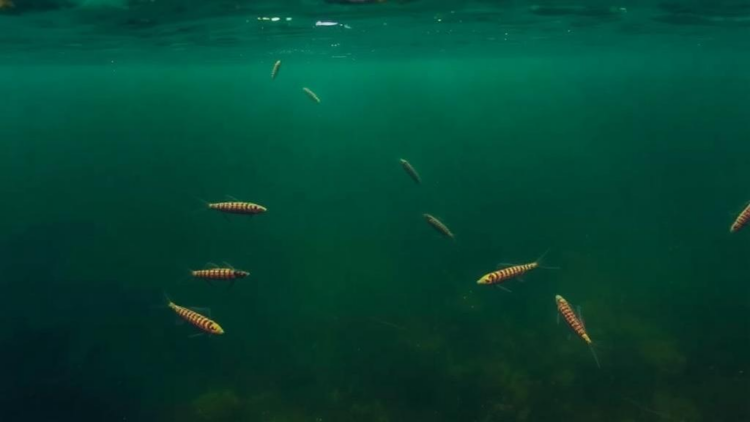
Deep in the Tocantins River, near the city of Imperatriz in the Brazilian state of Maranhão, two small silver fish are quietly telling scientists a great deal about how ecosystems respond to human pressure. Triportheus albus and Triportheus trifurcatus, schooling characiform fish that dart through the river’s channels in large groups, carry on their gills a community of microscopic flatworm parasites known as Monopisthocotyla. A new open-access study published in Acta Parasitologica has now provided the most detailed portrait yet of these parasite communities in the Tocantins-Araguaia basin, the second largest river system lying entirely within Brazil. By examining 262 fish across multiple years and seasons, researchers led by Dennisiane de Jesus Saraiva of the Oswaldo Cruz Foundation and the State University of Maranhão have uncovered patterns that could reshape how scientists monitor the health of one of South America’s most heavily engineered river basins.
The scale of the survey is one of its strengths. Between 2019 and 2024, the team collected fish at two sampling points along the Tocantins River, one near the riverbank close to domestic effluent discharges and another closer to the main channel where the current runs stronger. Of the 262 hosts examined, 69 were Triportheus albus and 193 were Triportheus trifurcatus. The fish were caught with casting nets, transported to the Laboratory of Ecology and Limnology at the State University of the Tocantina Region of Maranhão, and necropsied so that their gills could be carefully removed. Parasites were dislodged using heated distilled water at approximately 65 degrees Celsius, fixed in 70 percent ethanol, and later mounted in Hoyer’s medium for microscopic examination of their sclerotized attachment structures, the hardened hooks and bars that taxonomists use to distinguish species.
What emerged from the gills was a strikingly diverse parasitic fauna. Nine species of Monopisthocotyla were recorded on Triportheus albus and thirteen on Triportheus trifurcatus, all belonging to the genera Anacanthorus, Ancistrohaptor, and Jainus, a group of dactylogyrid flatworms that cling to gill filaments with remarkable host specificity. Overall, 71.01 percent of T. albus and 76.17 percent of T. trifurcatus were parasitized, with mean intensities of 8.04 and 7.05 parasites per infected fish respectively. One genus stood out above all others: Jainus spp. showed the highest prevalence and mean abundance in both hosts, infecting 57.14 percent of T. albus and 62.89 percent of T. trifurcatus. This dominance of a single taxon would prove central to understanding how the two parasite communities differ in their internal organization.
That difference became clear when the researchers applied a battery of community ecology indices. Triportheus trifurcatus hosted the richer and more balanced community, with a Shannon-Wiener diversity index of 1.642, Pielou’s evenness of 0.640, and Simpson’s diversity of 0.743. Triportheus albus, by contrast, showed lower values on all three measures, and correspondingly higher dominance: its Simpson’s dominance index reached 0.443 and its Berger-Parker index, which measures the proportional abundance of the single most common species, hit 0.622, compared with just 0.427 in T. trifurcatus. In plain terms, the parasite community on T. albus is a lopsided affair in which Jainus spp. calls the shots, while T. trifurcatus supports a more democratic distribution of parasite species. The lesson, the authors argue, is that communities with similar total parasite loads can be organized in fundamentally different ways depending on how individuals are apportioned among taxa.
Species sharing between the two hosts added another layer of intrigue. Four parasite species were recorded on both fish, two occurred exclusively on T. albus, and six were found only on T. trifurcatus. Among the shared species, Anacanthorus chaunophallus and Ancistrohaptor spp. showed significantly higher prevalence in T. trifurcatus, with chi-square tests yielding p-values of 0.008 and below 0.001 respectively. This pattern of partial host specificity, in which closely related fish carry overlapping but distinct parasite faunas, is a hallmark of dactylogyrid flatworms in the Neotropics and suggests that even subtle differences in host biology, gill architecture, or ecology can shape which parasites establish persistent populations.
Perhaps the most consistent finding of the entire study was the aggregated distribution of nearly every parasite population. Seven of the nine species recorded on T. albus and nine of the thirteen on T. trifurcatus showed statistically significant aggregation, meaning that most parasites were concentrated in a minority of host individuals rather than spread evenly through the fish population. Jainus spp. displayed the strongest clustering of all, with a dispersion index of 8.91 in T. albus and 4.65 in T. trifurcatus. Aggregation is one of the most universal patterns in parasite ecology, generally attributed to variation in host susceptibility, differences in exposure, or localized environmental conditions that favor transmission. For schooling fish like Triportheus, dense aggregations of hosts moving together likely amplify these effects, allowing the free-swimming larval stage, called an oncomiracidium, to encounter gills with high efficiency.
What the study did not find is equally telling. Neither host sex nor hydrological season nor sampling site had a significant effect on parasite abundance or richness. Prevalence in T. albus rose from 71.21 percent in the dry season to 100 percent in the rainy season, and mean abundance climbed from 5.88 to 8.00, yet the difference was not statistically significant. The same held for T. trifurcatus, whose mean abundance rose from 9.56 to 11.30 between seasons without reaching significance. Host sex showed no effect at all, with p-values ranging from 0.695 to 0.795 across tests. The only biometric signal was a weak but significant positive correlation between standard length and parasite richness in T. trifurcatus, a Spearman coefficient of 0.148 with p equal to 0.039, hinting that larger fish, with more gill surface area and longer cumulative exposure, accumulate slightly more parasite species over time.
The authors interpret this seasonal stability with a provocative hypothesis: the cascade of hydroelectric dams that now regulates the Tocantins River may be flattening the natural pulse of the river, and with it the seasonal dynamics of its parasites. In a free-flowing river, seasonal floods would dilute infective larvae and disperse host schools, creating predictable peaks and troughs in transmission. By damping those peaks, dam regulation could stabilize parasite-host interactions year-round, allowing continuous reproduction of Monopisthocotyla and constant levels of infestation. The researchers caution that absence of statistical significance does not prove absence of ecological effect, and they acknowledge a key limitation: only three T. albus individuals were collected during the rainy season, which sharply reduced the statistical power of the seasonal comparison for that species. Still, the idea that artificial flow regimes can restructure parasite communities is consistent with growing evidence from other impacted rivers and adds a new dimension to debates over the ecological costs of large dams in Amazonia.
Beyond their theoretical interest, these parasites may serve as sentinels of ecosystem health. Monopisthocotyla are ectoparasites with direct life cycles, no intermediate host, and intimate dependence on water quality, which makes their abundance and community structure sensitive to pollution, eutrophication, and hydrological change. The consistently high prevalence observed near Imperatriz, in a stretch of river receiving domestic effluents and subject to upstream dam regulation, may itself reflect chronic environmental stress. Because the Tocantins-Araguaia basin has been far less studied than the Amazon or Paraná systems, this work establishes a crucial ecological baseline against which future changes, whether from new dams, expanding agriculture, or climate shifts, can be measured. The study also underscores the value of combining population-level descriptors such as prevalence, intensity, and aggregation with community-level indices such as diversity, evenness, and dominance, since each scale reveals different aspects of how parasite assemblages are organized.
For a basin under intensifying anthropogenic pressure, where hydroelectric construction and altered flow regimes have already reshaped fish migrations and habitats, the humble gill worms of Triportheus offer something rare: a quantifiable, repeatable, and rapidly responding biological indicator. As the authors note, future studies with broader spatial coverage, deeper taxonomic resolution, and molecular tools such as DNA barcoding could refine these basins and resolve the species-level identities of taxa currently known only by genus. In the meantime, the message from the Tocantins is clear: to understand the health of a great river, sometimes the best instruments are the parasites riding on the gills of its smallest fish.
Subject of Research: Population and community ecology of Monopisthocotyla gill parasites infecting Triportheus fish in the Tocantins-Araguaia River basin, Brazil
Article Title: Population and Component Community Descriptors of Monopisthocotyla Parasitizing Triportheus spp. (Actinopterygii: Triportheidae) in the Tocantins-Araguaia River Basin, Brazil
Article References: Saraiva, D. D. J., da Costa, A. P., Viana, D. C., Nogueira, R. D. M. S., & Cohen, S. C. (2026). Population and Component Community Descriptors of Monopisthocotyla Parasitizing Triportheus spp. (Actinopterygii: Triportheidae) in the Tocantins-Araguaia River Basin, Brazil. Acta Parasitologica, 71(5), Article 208. https://doi.org/10.1007/s11686-026-01372-4
Image Credits: AI Generated
DOI: 10.1007/s11686-026-01372-4
Keywords: Monopisthocotyla, Triportheus, Tocantins-Araguaia basin, fish parasites, Dactylogyridae, parasite ecology, community structure, bioindicators, Neotropical fish, dams, Brazil, gill parasites
Cite Scienmag News
APA MLA Chicago
Gavin Prescott. (October 1, 2026). Gill Parasites Reveal Hidden Ecological Rules in a Dammed Amazonian River. Scienmag. https://scienmag.com/gill-parasites-reveal-hidden-ecological-rules-in-a-dammed-amazonian-river/
Gavin Prescott. “Gill Parasites Reveal Hidden Ecological Rules in a Dammed Amazonian River.” Scienmag, 1 October 2026, https://scienmag.com/gill-parasites-reveal-hidden-ecological-rules-in-a-dammed-amazonian-river/. Accessed 1 October 2026.
Gavin Prescott. “Gill Parasites Reveal Hidden Ecological Rules in a Dammed Amazonian River.” Scienmag. October 1, 2026. https://scienmag.com/gill-parasites-reveal-hidden-ecological-rules-in-a-dammed-amazonian-river/
Copy citation Download RIS
Tags: Amazonian dam impactbiodiversity of parasitic flatwormsbioindicatorsBrazilcommunity structureDactylogyridaedamsecological indicators in tropical riverseffects of damming on aquatic lifefish host-parasite relationshipsfish parasitesfish-gill flatworm parasitesfreshwater parasite community patternsgill parasiteshuman influence on river ecosystemsmonitoring river system healthMonopisthocotylaNeotropical fishparasite ecologyRiver parasite ecologyseasonal variation in parasite prevalenceTocantins River ecosystem healthTocantins-Araguaia basinTriportheus