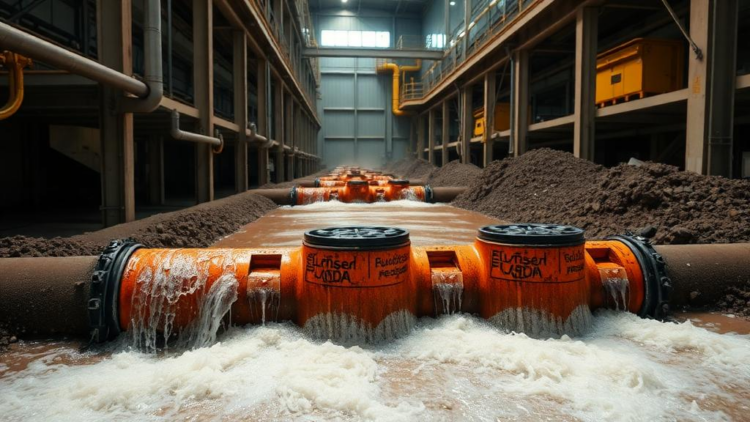
Tannery wastewater is one of the most stubborn pollution problems in industrializing regions, and a new study from researchers in India offers a strikingly effective answer. In work published in Discover Green Chemistry, Rakesh Kumar and Mukul Bajpai report that an optimized electrochemical-Fenton (ECF) process removed 91.25 percent of hexavalent chromium and 96.2 percent of the chemical oxygen demand from real tannery effluent, not the synthetic wastewater that dominates much of the laboratory literature. The effluent they treated was genuinely nasty: chemical oxygen demand of roughly 4,200 milligrams per liter, hexavalent chromium around 170 milligrams per liter, and total dissolved solids near 8,000 milligrams per liter. After an hour of treatment under the right conditions, chromium fell to about 15 milligrams per liter and COD to roughly 160 milligrams per liter, values that closely matched the predictions of their statistical model.
The stakes could hardly be higher. Nearly 90 percent of tanneries rely on chromium sulfate as their principal tanning agent, and around 35 percent of the chromium used in the process ends up in the effluent, either as hexavalent or trivalent chromium. Hexavalent chromium, Cr(VI), is the form that keeps toxicologists awake: it is roughly 100 times more toxic than Cr(III), it is highly mobile in water because of its hydrophilic character, and chronic exposure is linked to hemorrhaging, ulceration, severe skin irritation, chest pain, and lung cancer. The World Health Organization’s permissible limits are routinely exceeded in untreated discharges, and the study’s sampling region, Jajmau in Kanpur district, Uttar Pradesh, is home to dozens of tanneries whose untreated effluents have long been implicated in the pollution of the Ganges River.
The technology at the heart of the paper is a hybrid of two well-known ideas. In conventional electrocoagulation, a sacrificial iron anode dissolves under an applied current, releasing ferrous ions that act as in-situ coagulants, sweeping pollutants into settleable flocs. The Fenton reaction, meanwhile, uses ferrous ions to activate hydrogen peroxide, producing hydroxyl radicals, which are among the most aggressive oxidants known, capable of shredding organic molecules that resist biological treatment. The electrochemical-Fenton process merges the two: the iron electrodes generate Fe2+ electrochemically, and added hydrogen peroxide reacts with it inside the cell to produce hydroxyl radicals continuously. Because the coagulant and the oxidant are both generated in situ, the process avoids the dosing uncertainties and secondary pollution risks that plague conventional Fenton chemistry, where excess chemicals must be neutralized after treatment.
The chemistry unfolds in a coordinated sequence. At the anode, iron is oxidized to ferrous ions; the ferrous ions then react with hydrogen peroxide to yield ferric ions, hydroxyl radicals, and hydroxide. The radicals oxidize the organic load, driving down COD. Simultaneously, the hexavalent chromium is electrochemically reduced to the trivalent form, a reaction that consumes protons and electrons at the electrode surface. The newly formed Cr(III) then precipitates as insoluble chromium hydroxide, locking the metal into a solid phase that can be separated from the water. Acidic conditions favor every step of this cascade, which is why pH emerged as a decisive variable in the optimization.
To find those conditions, the researchers turned to response surface methodology, a statistical framework that maps how multiple operating variables interact, rather than testing them one at a time. Using a Box-Behnken design, they ran 30 experimental combinations spanning four factors: pH from 3 to 7, electrolysis time from 20 to 60 minutes, current density from 5 to 15 milliamperes per square centimeter, and hydrogen peroxide concentration from 200 to 800 milligrams per liter. The resulting quadratic models were exceptionally strong. The F-values of 274.22 for chromium removal and 299.81 for COD removal indicated models far too good to be explained by random noise, with a probability of chance below 0.01 percent. Predicted R-squared values of 0.9875 and 0.9821 tracked their adjusted counterparts within 0.02, and adequate precision ratios of 55.09 and 67.73 signaled robust signal-to-noise performance.
The parameter sweep revealed clear patterns. Removal efficiency for both pollutants rose from pH 3 to pH 5 and then declined toward pH 7, with the optimum at pH 5 delivering 93.78 percent chromium removal and 97.2 percent COD removal after 60 minutes of electrolysis. Below the optimum, insufficient hydroxide limits the precipitation of Cr(III); above it, ferric sludge formation and radical scavenging interfere with the Fenton cycle. Increasing hydrogen peroxide from 200 to 800 milligrams per lifted chromium removal from 73.58 to 93.78 percent and COD removal from 75 to 87.6 percent, because more peroxide means more hydroxyl radicals. Raising the current density to 5 milliamperes per square centimeter lifted chromium removal from 79.46 to 90.45 percent, driven by faster dissolution of ferrous ions from the anode. Longer electrolysis times helped steadily: extending treatment from 20 to 60 minutes at fixed conditions raised chromium removal from 53.4 to 81.25 percent and COD removal from 46.5 to 71.6 percent. Interestingly, current density variations within the tested range had less influence than time and peroxide dose.
The team also probed the mechanism by which chromium leaves the solution, fitting their kinetic data to adsorption models. The uptake of Cr(VI) onto the metal flocs followed pseudo-second-order kinetics, with an R-squared of 0.995, and the experimentally observed equilibrium capacity of 20.267 milligrams per gram matched the pseudo-second-order prediction of 18.145 milligrams per gram far better than the pseudo-first-order estimate of 4.228. Among the isotherms, the Langmuir model fit best, with an R-squared of 0.99 against 0.86 for the Freundlich model, indicating that chromium adsorbs as a monolayer on the floc surfaces with a maximum capacity of 25.39 milligrams per gram. The Langmuir constant of 0.34 liters per milligram and a favorable adsorption intensity of 0.36 pointed to strong binding between chromium species and the iron-based flocs, which is precisely what a treatment process needs to prevent re-release of the metal.
Under the globally optimal conditions identified by the model, pH 5, an electrode gap of 2 centimeters, one hour of electrolysis, a current density of 15 milliamperes per square centimeter, and 500 milligrams per liter of hydrogen peroxide, the predicted chromium removal of 92.06 percent was confirmed experimentally at 91.25 percent, and the predicted COD removal of 97.5 percent was matched by an actual value of 96.2 percent, with a model desirability of 1.0. Against India’s Central Pollution Control Board discharge standards, which cap hexavalent chromium at 0.1 milligrams per liter, total chromium at 2 milligrams per liter, and COD at 250 milligrams per liter, the treated effluent comfortably meets the COD requirement. The chromium concentrations, while slashed by more than an order of magnitude, remain above the stringent Cr(VI) limit, so the authors are candid that a secondary polishing step would be needed for full regulatory compliance. They position ECF as a powerful primary treatment that does the heavy lifting before final polishing.
How does the result stack up against the wider literature? Comparable electrochemical approaches have delivered 87 percent chromium removal from real tannery effluent via electrochemical peroxidation, roughly 90 percent removal from chromium-EDTA complexes using electro-peroxone, and near-complete removal in electrocoagulation of electroplating wastewater and electroprecipitation of real tannery effluent. A heterogeneous electro-Fenton cathode system achieved almost complete Cr(VI) removal within 30 minutes, while electro-Fenton followed by precipitation and titanium-anode indirect reduction reached above 95 percent and around 80 percent, respectively. The present work sits squarely within this competitive field, and its distinguishing strength is that it achieved 91.25 percent removal from genuine tannery wastewater under moderate operating parameters, with a validated statistical model rather than one-variable-at-a-time tuning.
The authors are appropriately measured about the road ahead. The study was conducted at laboratory scale, and real industrial effluents vary in composition from batch to batch, which could shift the optimum. Long-term electrode stability, energy consumption, and operational costs were not comprehensively evaluated, and these factors will determine whether the economics work at full scale. They call for pilot-scale validation, long-term performance assessment, and techno-economic analysis, along with integration of the ECF process with complementary technologies and exploration of renewable-energy-driven or green-oxidant variants. Even with those caveats, the message is compelling: a simple beaker-scale cell with iron plates, hydrogen peroxide, and a well-chosen set of operating conditions can strip the great majority of hexavalent chromium and organic load from some of the dirtiest industrial water in the world, using chemistry that generates its own reagents and leaves behind a separable solid. For the tannery clusters lining rivers like the Ganges, that combination of simplicity, scalability, and verified performance is exactly what a practical cleanup demands.
Subject of Research: Optimization of the electrochemical-Fenton process for removing hexavalent chromium and organic pollutants from real tannery wastewater
Article Title: Optimization of the electrochemical Fenton process for hexavalent chromium removal from tannery wastewater
Article References: Kumar, R., & Bajpai, M. (2026). Optimization of the electrochemical Fenton process for hexavalent chromium removal from tannery wastewater. Discover Green Chemistry, 1(1), Article 9. https://doi.org/10.1007/s44509-026-00012-4
Image Credits: AI Generated
DOI: 10.1007/s44509-026-00012-4
Keywords: hexavalent chromium, tannery wastewater, electrochemical-Fenton, advanced oxidation, hydrogen peroxide, response surface methodology, COD removal, adsorption kinetics, Langmuir isotherm, water treatment, green chemistry, industrial pollution
Cite Scienmag News
APA MLA Chicago
Bethany Barker. (September 30, 2026). Electro-Fenton Process Strips Toxic Chromium From Real Tannery Wastewater. Scienmag. https://scienmag.com/electro-fenton-process-strips-toxic-chromium-from-real-tannery-wastewater/
Bethany Barker. “Electro-Fenton Process Strips Toxic Chromium From Real Tannery Wastewater.” Scienmag, 30 September 2026, https://scienmag.com/electro-fenton-process-strips-toxic-chromium-from-real-tannery-wastewater/. Accessed 30 September 2026.
Bethany Barker. “Electro-Fenton Process Strips Toxic Chromium From Real Tannery Wastewater.” Scienmag. September 30, 2026. https://scienmag.com/electro-fenton-process-strips-toxic-chromium-from-real-tannery-wastewater/
Copy citation Download RIS
Tags: adsorption kineticsAdvanced oxidationadvanced oxidation processes for pollutant removalchemical oxygen demand reduction in wastewater treatmentchromium removal from industrial effluentsCOD removalElectro-Fenton process for heavy metal removal from tannery wastewaterelectrochemicalelectrochemical-Fentonenvironmental impact of tannery wastegreen chemistryhexavalent chromiumhydrogen peroxideindustrial pollutionLangmuir isothermremoval of hexavalent chromium from industrial effluentsresponse surface methodologystatistical modeling of wastewater treatment efficiencysustainable tannery wastewater managementtannery wastewatertoxicity reduction of chromium in industrial effluentstreatment of real tannery wastewater using electrochemical methodswastewater treatment for tanneriesWater treatment