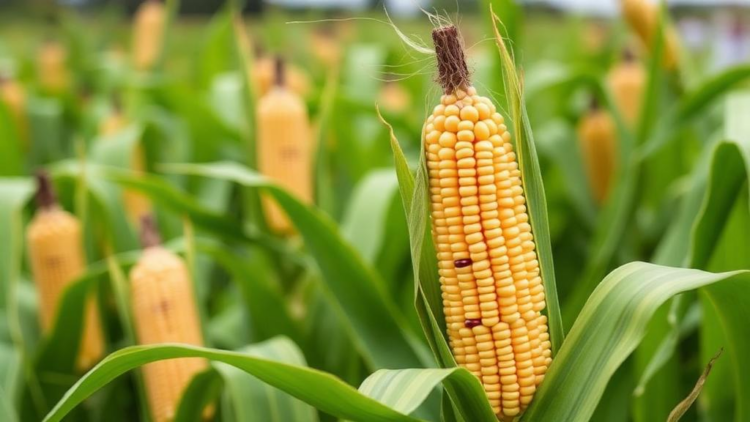
In a development that could reshape how breeders approach one of the world’s most important cereal crops, researchers at the ICAR-Indian Agricultural Research Institute in New Delhi, working with colleagues at the Bhabha Atomic Research Centre in Mumbai and the ICAR-National Institute for Plant Biotechnology, have demonstrated that high energy pulse electron beam irradiation can generate substantial, heritable variation in the yield component traits of field corn. The study, published in the Indian Journal of Genetics and Plant Breeding, represents one of the most detailed combined phenotypic and molecular assessments of electron beam-derived mutants in maize to date, and it arrives at a moment when the pressure to squeeze more grain from every hectare has never been greater.
Maize, or Zea mays L., is a global staple whose productivity depends on a suite of architectural characteristics of the ear, the female inflorescence that carries the kernels. Breeders track four traits with particular care: cob length, cob girth, kernel row number, and kernel number per row. Together these characters largely determine how many kernels a plant can fill, and therefore how much grain it produces. Although maize populations naturally harbor considerable morphological diversity, the researchers argue that creating fresh, heritable variation specifically for these yield component traits is essential if breeders are to assemble genuinely improved plant ideotypes rather than simply reshuffling existing genetic combinations.
The team’s tool of choice was the high energy pulse electron beam, or HEPE beam, a form of induced mutagenesis that differs fundamentally from conventional approaches. While chemical mutagens such as ethyl methane sulfonate and physical agents such as gamma rays have long histories in mutation breeding, electron beam irradiation delivers dense ionization energy in short pulses, producing DNA damage that can generate novel allelic variation at a comparatively high efficiency. Previous work by some of the same authors, and by other groups studying mungbean, cowpea, rice, and groundnut, has suggested that electron beams can be both effective and efficient at inducing useful mutations, sometimes outperforming gamma rays in the balance between mutation frequency and biological damage.
In the new study, the researchers irradiated an elite field corn inbred line and advanced the progeny to produce a mutant population of 213 lines. Each of these mutants was subjected to careful phenotypic characterization for the four key ear traits: cob length, cob girth, kernel row number, and kernel number per row. In parallel, the entire mutant set was genotyped with 50 simple sequence repeat markers, a class of molecular markers that detects variation in short tandem repeats scattered throughout the maize genome. This dual approach allowed the team to ask two complementary questions: whether the electron beam had created measurable variation in the traits that matter for yield, and whether that variation was reflected in the mutants’ DNA profiles.
The statistical answer to the first question was emphatic. Analysis of variance revealed that the electron beam-derived mutants differed significantly from one another for the yield component traits, and estimates of the genetic components of variation indicated that these differences were under genetic control rather than being artifacts of environment or measurement noise. In practical terms, this means the variation the beam created is real, heritable material that breeders can select upon. The team also reported high heritability estimates at both the phenotypic and genotypic levels, a combination that signals the traits respond reliably to selection and that the mutants carry stable genetic differences rather than transient physiological fluctuations induced by the irradiation itself.
Perhaps the most intriguing finding concerns trait associations. In unmodified maize germplasm, yield component traits often show negative correlations with one another: plants that pack more rows onto a cob may compensate with fewer kernels per row, or longer cobs may come at the expense of girth. These trade-offs constrain the breeder’s ability to improve all components simultaneously. When the researchers performed association analysis among the mutants, however, they found evidence that the electron beam had played a distinct role in breaking these negative associations. In other words, the mutagenic process appears to have loosened the genetic linkages and pleiotropic relationships that normally force breeders into compromises, opening the possibility of combining favorable values of multiple yield components within a single line.
The molecular marker analysis reinforced this picture from the other direction. Genotyping with the 50 SSR markers showed that the mutants were clearly distinct from the wild-type parent, confirming that the irradiation had left detectable signatures across the genome. More notably, the team found indications of new alleles present at low frequencies in the tested population, specifically associated with kernel and cob related traits. Novel alleles arising at low frequency are precisely the raw material of mutation breeding: rare variants that would not exist in the natural gene pool but that can be fixed through selection and deployed in hybrid development. The presence of such alleles suggests the electron beam did not merely shuffle existing variation but genuinely expanded it.
From the 213 mutants, the researchers selected the ten best performers based on their trait means, and one line emerged as particularly valuable. Designated EB24010202, this mutant combines a cob girth of 4.7 centimeters, a cob length of 17 centimeters, 18 kernel rows, and 28 kernels per row, a combination of desirable values across all four yield components that is rarely achieved simultaneously. Because the study’s association analysis indicated that the usual negative trade-offs had been weakened in the mutant population, a line like EB24010202 is not simply an outlier but potentially a donor of a favorable trait package that can be crossed into elite breeding material.
The implications extend beyond a single experiment. Maize productivity in India, as the authors and cited reports note, lags behind the global average, and closing that gap will require both improved management and improved genetics. Induced mutagenesis offers a way to widen the genetic base of elite inbred lines without the linkage drag that accompanies wide crosses, and electron beam irradiation appears to be an especially promising variant of the technique given its reported efficiency relative to gamma rays and chemical mutagens in several crop species. The mutants generated in this study, the authors conclude, will be of considerable importance in future field corn improvement programs, serving as donors for yield component traits and as material for mapping the genes underlying the new variation.
The work also illustrates a broader trend in modern mutation breeding: the pairing of classical biometrical genetics with molecular marker technology. By combining analysis of variance, genetic component estimation, correlation and association analysis, and SSR-based diversity profiling, the researchers were able to verify at both the phenotype and the genotype levels that their mutagenic treatment had succeeded. As sequencing and marker technologies become cheaper, this kind of two-pronged validation is likely to become the standard for mutation breeding programs worldwide, ensuring that the variation breeders chase in the field is genuinely written into the genome. For now, the message from New Delhi and Mumbai is clear: a pulsed beam of high energy electrons can crack open the genetic constraints on maize yield architecture, and the mutants it leaves behind may help feed a growing population.
Subject of Research: Electron beam-induced mutagenesis for yield component trait variation in field corn
Article Title: Assessment of Phenotypic Variability and Molecular Diversity Induced by High Energy Pulse Electron Beam for Yield Component Traits in Field Corn (Zea mays L.)
Article References: Hadiya, M. S., Mukri, G., Mondal, S., Bhat, J. S., Baliyan, S., Mallikarjuna, M. G., Singh, C., & Gupta, N. C. (2026). Assessment of Phenotypic Variability and Molecular Diversity Induced by High Energy Pulse Electron Beam for Yield Component Traits in Field Corn (Zea mays L.). Indian Journal of Genetics and Plant Breeding, 86(2), 139-146. https://doi.org/10.1007/s44489-026-00020-5
Image Credits: AI Generated
DOI: 10.1007/s44489-026-00020-5
Keywords: maize, electron beam, mutagenesis, plant breeding, genetic variability, SSR markers, yield components, Zea mays, heritability, mutation breeding, field corn, molecular diversity
Cite Scienmag News
APA
MLA
Chicago
Alan Morgan. (September 30, 2026). Electron Beam Mutagenesis Unlocks New Yield Potential in Field Corn. Scienmag. https://scienmag.com/electron-beam-mutagenesis-unlocks-new-yield-potential-in-field-corn/
Alan Morgan. “Electron Beam Mutagenesis Unlocks New Yield Potential in Field Corn.” Scienmag, 30 September 2026, https://scienmag.com/electron-beam-mutagenesis-unlocks-new-yield-potential-in-field-corn/. Accessed 30 September 2026.
Alan Morgan. “Electron Beam Mutagenesis Unlocks New Yield Potential in Field Corn.” Scienmag. September 30, 2026. https://scienmag.com/electron-beam-mutagenesis-unlocks-new-yield-potential-in-field-corn/
Copy citation
Download RIS
Tags: advanced mutagenesis techniques in cereal crop developmentbreeding for increased kernel number and cob sizeelectron beamelectron beam mutagenesis in crop breedingfield corngenetic diversity generation in maize using irradiationgenetic enhancement of field corngenetic variabilityheritabilityheritable trait variation in maizehigh energy pulse electron beam irradiation in plant geneticsimpact of electron beam mutagenesis on maize architectureimproving crop productivity with novel mutagenesis methodsmaizemaize yield improvement through mutagenesismolecular assessment of mutant maize linesMolecular Diversitymutagenesismutation breedingplant breedingrole of electron beam technologySSR markersyield componentsZea mays