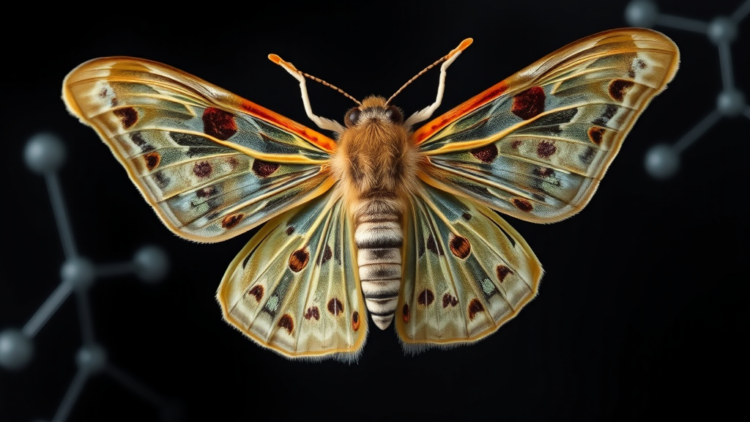
For more than half a century, one of the most powerful tools in environmentally friendly pest management has rested on a deceptively simple biological fact: many insects find their mates by following trails of scent. These chemical messengers, known as pheromones, are released by one sex and detected at astonishing sensitivity by the other, often across considerable distances. Because each species tends to use its own characteristic blend of molecules, pheromones offer a way to intervene in insect reproduction with a precision that broad-spectrum insecticides cannot match. Now, a team of researchers at the French National Research Institute for Agriculture, Food and Environment (INRAE) has demonstrated a fundamentally new way to unlock this chemical language, one that begins not with the insect itself but with the molecular machinery it uses to smell. The work, published in BMC Biology, provides proof of concept that the sex pheromone of a moth can be predicted from the structures of its olfactory receptors, opening a path to faster identification of pheromones for species that have never been chemically characterised.
The traditional route to identifying a sex pheromone has always been laborious. Researchers must typically maintain live colonies of the target insect, collect and extract the chemicals emitted by females, and then sift through a complex mixture of dozens or even hundreds of volatile compounds to determine which ones actually attract males. The timing of pheromone production matters enormously, since many species release their signals only during narrow windows of the day or night, and missing that window can mean missing the signal entirely. Once candidate compounds are isolated, each must be tested for behavioural activity, often through wind-tunnel experiments or field trials, before the true pheromone can be confirmed. For rare species, invasive pests that have just appeared in a new region, or insects that are difficult to rear in captivity, this process can stall for years, leaving pest managers without the species-specific tools that pheromone-based control depends on.
The INRAE team, working within the EXPLOR’AE Programme funded through the project known as Invoria, chose to invert this logic entirely. Rather than starting with the emitter of the chemical signal, they started with the receiver: the male moth, and more specifically, the olfactory receptors housed in his antennae that are tuned to detect the female’s scent. Their study species was the lily moth, Spodoptera picta, a strikingly coloured insect whose sexual communication had never been described. The lily moth is what biologists call a non-model organism: it is not a standard laboratory species with a rich history of prior research, and this was precisely the point. If the method could work on a poorly studied insect with no established toolkit, the researchers reasoned, it could likely be extended to many other species that currently resist conventional analysis.
The first step of the reverse approach relied on genomics. By analysing the genes of the lily moth and comparing them with those of related species, the researchers narrowed down a catalogue of candidate olfactory receptors to two promising candidates. This comparative step matters because receptor genes evolve alongside the chemicals they detect; receptors in closely related species that respond to similar pheromones often share detectable similarities in their sequences. From this genetic starting material, the team turned to artificial intelligence. Machine-learning tools were used to predict the three-dimensional structures of the two candidate receptors, generating models of the protein shapes that sit in the membranes of sensory neurons and cradle odorant molecules as they arrive from the air.
With structural models in hand, the researchers applied molecular docking, a computational technique widely used in drug discovery, to predict which volatile molecules would fit and bind within the receptors’ binding pockets. Docking simulations evaluate how two molecules can interact spatially and energetically, scoring the likelihood that a given compound will make stable contact with a target protein. By screening a library of volatile compounds against the modelled receptors, the computational pipeline identified a specific molecule predicted to interact strongly with both candidate receptors: (Z,E)-9,11-tetradecadienyl acetate. In effect, the algorithm had proposed an answer to a question the insects had never been asked in the laboratory: what chemical does the female of this species use to signal her availability?
Prediction alone, however, is never sufficient in biology, and the team followed the computational phase with a rigorous sequence of experimental validation. First, the selected olfactory receptors were tested directly against the predicted volatile molecules using electrophysiological methods, which measure the electrical responses of sensory cells or expressed receptor proteins when exposed to chemical stimuli. The receptors responded, confirming computationally predicted interactions with real physiological activity. Next, the researchers combined physicochemical analysis with electrophysiology to verify two crucial facts: that female lily moths actually secrete the predicted compound as their sex pheromone, and that male moths can detect the volatile molecule in the air. These analytical steps confirmed that the AI-guided prediction matched what the insects themselves were doing.
The final and most demanding test was behavioural. A molecule may be detected by an antenna, but detection does not guarantee attraction; only a behavioural response demonstrates that the compound functions as a genuine pheromone in the life of the animal. In behavioural assays, the identified compound attracted male lily moths and elicited sexual behaviour, completing the chain of evidence from gene to receptor to molecule to mating behaviour. Taken together, the results show that an unknown pheromone of a non-model species could be identified through a pipeline that begins with sequencing, passes through AI-predicted receptor structures and molecular docking, and ends with classical electrophysiology and behavioural experiments. Each stage filtered and focused the search, dramatically reducing the number of candidate chemicals that needed laboratory testing.
The significance of this proof of concept extends well beyond a single moth species. Current, emerging and invasive crop pests are precisely the organisms for which pheromone identification is most urgently needed and most often missing, because invasive populations can spread faster than conventional chemical ecology can characterise them. Once a species’ sex pheromone is known, two well-established biocontrol strategies become available. Mating disruption involves flooding an area, such as a crop field or orchard, with synthetic pheromone so that males become unable to locate females, crashing reproduction without any toxic chemical. Alternatively, pheromone-baited traps can be used to estimate population density, monitor invasions, or suppress populations through mass trapping. Both approaches are highly species-specific, sparing beneficial insects such as pollinators and natural enemies of pests, and both are compatible with the increasingly strict regulations governing pesticide use in gardens, parks and botanical collections.
The lily moth itself illustrates why such tools matter. The species is not found in mainland France and is therefore not considered a pest of concern there, which made it an ethically convenient and scientifically demanding test case. Yet elsewhere in the world, Spodoptera picta is a significant pest, particularly in private gardens, public parks and botanical gardens, settings where the use of conventional pest-control products is often tightly restricted and where ornamental plants suffer real damage. A validated pheromone-based method could give managers in those regions a targeted, low-toxicity option, and the study’s authors note that this work opens up the possibility of using pheromone-based methods to control the moth. In this sense, the research delivers both a general technique and a concrete practical outcome for a real agricultural problem.
There is also a deeper scientific payoff. Pheromones function as chemical signatures of species, and the molecules a species uses to communicate sexually contribute to reproductive isolation, helping to keep related species distinct. As a result, identifying the compounds that make up the pheromones of moths and other insects offers new insights into the evolutionary history of these lineages, revealing how chemical communication has diverged and shaped speciation. By making pheromone identification faster and less dependent on scarce live insects, the reverse chemical ecology approach demonstrated here could populate the field with many more of these chemical signatures, allowing biologists to reconstruct communication systems across entire groups of species. What began as a pest-management problem thus ends as a window onto evolution, powered by artificial intelligence, and a demonstration that sometimes the fastest way to understand a signal is to study the ear rather than the voice.
Subject of Research: AI-guided prediction of insect olfactory receptors to identify moth sex pheromones for crop protection
Article Title: Crop protection: a new method for understanding insect sexual communication
Article References: Crop protection: a new method for understanding insect sexual communication. (n.d.). Original publication
Image Credits: AI Generated
DOI: Not provided
Keywords: pheromones, chemical ecology, olfactory receptors, Spodoptera picta, biocontrol, mating disruption, molecular docking, artificial intelligence, INRAE, BMC Biology, invasive pests, lily moth
Cite Scienmag News
APA
MLA
Chicago
Gavin Prescott. (September 27, 2026). Scientists Reverse-Engineer Insect Smell Receptors to Identify Moth Sex Pheromones. Scienmag. https://scienmag.com/scientists-reverse-engineer-insect-smell-receptors-to-identify-moth-sex-pheromones/
Gavin Prescott. “Scientists Reverse-Engineer Insect Smell Receptors to Identify Moth Sex Pheromones.” Scienmag, 27 September 2026, https://scienmag.com/scientists-reverse-engineer-insect-smell-receptors-to-identify-moth-sex-pheromones/. Accessed 27 September 2026.
Gavin Prescott. “Scientists Reverse-Engineer Insect Smell Receptors to Identify Moth Sex Pheromones.” Scienmag. September 27, 2026. https://scienmag.com/scientists-reverse-engineer-insect-smell-receptors-to-identify-moth-sex-pheromones/
Copy citation
Download RIS
Tags: Artificial IntelligencebiocontrolBMC Biologychemical ecologyenvironmentally friendly pest managementinnovative methods in insect chemical ecologyINRAEInsect olfactory receptorsInsect pheromone detectioninsect reproductive behavior and chemical signalinginvasive pestslily mothmating disruptionmolecular dockingmolecular mechanisms of insect smellmolecular prediction of insect sex signalsmoth sex pheromone identificationolfactory receptorspheromone-based pest control strategiespheromonesreverse-engineering insect scent receptorsspecies-specific chemical communicationSpodoptera pictatargeted pest control using pheromones