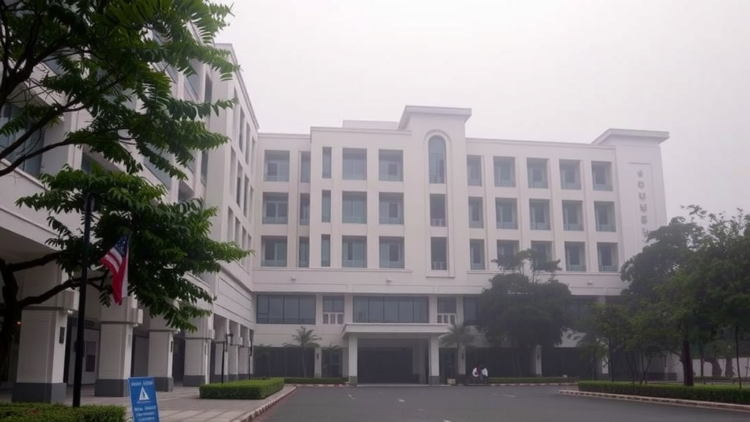
Fine particulate matter is one of the most insidious pollutants in modern cities, small enough to slip past the body’s natural defenses and lodge deep in the lungs. While most people assume that stepping indoors offers an escape from urban smog, a new three-year study from Chulalongkorn University in Bangkok shows that the boundary between outdoor and indoor air is far more porous than many would like to believe. By continuously monitoring particulate matter inside and outside four campus buildings between August 2022 and July 2025, researchers have produced one of the longest paired indoor-outdoor air quality records ever assembled for a tropical university environment, and the results carry a warning for anyone who lives or works in a rapidly urbanizing megacity.
The research team, led by Mushtaq Ahmad and Sirima Panyametheekul, deployed low-cost laser particle sensors at four distinct locations across the Chulalongkorn University campus: the School of Agricultural Resources, the Chulalongkorn University Language Institute, the Central Library, and the Chamchuri 10 building, also known as the UltimateX Library. These sites were deliberately chosen to represent different microenvironments, from high-occupancy teaching spaces with mechanical ventilation to quiet study halls where students spend extended hours. Outdoor sensors were placed near Phayathai and Rama IV Roads, two of Bangkok’s busiest traffic arteries, to capture the pollution load generated by vehicles and campus activity. Each sensor recorded data at ten-minute intervals, producing an enormous dataset spanning both the dry and rainy seasons across three full annual cycles.
The instrumentation itself is a case study in modern environmental monitoring. The team used Plantower PMS5003 G5 sensors, compact laser-scattering devices that count particles as small as 0.3 micrometers. Before trusting the data, the researchers calibrated the sensors against reference-grade instruments: a U.S. EPA Federal Equivalent Method monitor for PM2.5 and a research-grade TSI DustTrak for PM10. The calibration results were impressive for PM2.5, with a coefficient of determination of 0.921 and a root mean square error of just 1.83 micrograms per cubic meter, though the sensors slightly underestimated concentrations. Performance for PM10 was more moderate, with an R-squared of 0.712, reflecting the well-known difficulty optical sensors face when estimating coarse particle mass, which is more sensitive to particle shape, density, and humidity-driven swelling.
The headline finding concerns seasonality. Monthly mean PM2.5 concentrations ranged from 0.8 to 20.8 micrograms per cubic meter indoors and 0.8 to 44.3 micrograms per cubic meter outdoors, with PM10 reaching up to 40.0 and 51.9 micrograms per cubic meter respectively. In every case, the dry season months from December to February produced the highest readings, a pattern the researchers attribute to a lower planetary boundary layer, regional biomass burning, transboundary pollution transport, and stagnant weather conditions during haze episodes. During those dry-season months, daily PM2.5 concentrations exceeded the World Health Organization’s 24-hour guideline of 15 micrograms per cubic meter in nearly every monitored building, both indoors and out. The only exception was the indoor air of the Central Library, whose filtration apparently kept fine particles at bay even as the city outside choked.
That library result points to the study’s most intriguing thread: the indoor-to-outdoor ratio, a simple but powerful metric that reveals whether a building’s air is dominated by outdoor infiltration or by sources within. An I/O ratio below one suggests outdoor air is the main driver, while values above one signal significant indoor generation or pollutant accumulation. The ratios varied wildly across buildings and years. The School of Agricultural Resources posted a mean ratio of 1.79 in 2023, with monthly values exceeding 2.0 during the mid-year months, hinting at occupant activities, resuspended dust, or insufficient ventilation. The Central Library, by contrast, achieved remarkably low ratios of 0.06 in 2022 and 0.29 in 2023, evidence of effective exclusion of outdoor particles, before jumping to 1.46 in 2024, possibly reflecting changes in ventilation operation or occupancy. Chamchuri 10 stayed below unity for three years, then surged to a mean of 1.55 in 2025. These swings demonstrate that building design, ventilation strategy, and human behavior can matter as much as the pollution outside.
Correlation analysis added another layer of nuance. Both indoor and outdoor particulate concentrations showed negative correlations with relative humidity and temperature, suggesting that meteorological factors did not directly drive pollution levels in this tropical setting. This finding contrasts with studies from temperate climates, where temperature differences drive the stack effect and window-opening behavior strongly modulates indoor air. In Bangkok’s perpetually warm and humid environment, where relative humidity exceeds 70 percent year-round, the seasonal signal appears dominated instead by regional pollution dynamics, particularly the agricultural burning that sweeps smoke across Southeast Asia each dry season.
Beyond measuring concentrations, the team translated their data into human terms by estimating exposure concentrations and potential inhaled doses for three age groups: children aged 6 to 11, adolescents aged 12 to 17, and adults. Using inhalation rates and exposure durations drawn from the U.S. EPA Exposure Factors Handbook, they calculated that adults accumulated the highest absolute inhaled doses, owing to their larger lung volumes and longer daily exposure times. But the researchers caution that a higher dose does not automatically mean higher risk. Children, whose lungs are still developing and who breathe more air per unit of body weight, may suffer disproportionately greater health consequences from the same concentration. Their developing respiratory and immune systems, combined with higher ventilation rates per kilogram of body mass, mean that identical exposure levels can translate into greater internal doses and more lasting harm.
The air quality index analysis offered a glimmer of hope amid the concern. Most monitoring days fell within the Very Good, Good, or Moderate categories of Thailand’s PM2.5-based AQI, and the trend from 2024 to 2025 improved compared with 2022 and 2023, when dry-season readings pushed into the Unhealthy range. Daily PM2.5 concentrations exceeded Thai national standards on only 0.24 to 5.32 percent of monitoring days, while PM10 exceeded standards on 1.70 to 14.1 percent of days. Short pollution episodes still occurred, however, and the study’s authors emphasize that these transient spikes can meaningfully raise exposure during exactly the periods when people are least prepared for them.
The practical implications extend well beyond the campus gates. Because indoor PM concentrations tracked outdoor levels at several sites, the researchers argue that building managers should factor outdoor conditions into ventilation decisions, ramping up filtration or deploying portable air cleaners during haze episodes rather than simply drawing in more outside air. At the policy level, they call for stricter vehicle emission standards, noting that Thailand’s adoption of EURO 5 and EURO 6 rules has been delayed, alongside better public transportation, stronger industrial regulation, and subsidies for HEPA filtration in schools and public buildings. The study explicitly ties these measures to United Nations Sustainable Development Goals on health, education, sustainable cities, and climate action, since the same combustion sources that produce PM2.5 also emit greenhouse gases.
The authors are careful to acknowledge the limits of their work. The measurements come from a single campus and cannot be generalized to all of Bangkok’s buildings, and the team did not analyze particle chemistry, monitor indoor activities like cooking or smoking, or measure air exchange rates directly, meaning the I/O ratios indicate relative relationships rather than true infiltration factors. The exposure estimates rely on generalized scenarios rather than individual time-activity data, and a sensitivity analysis confirmed that a 20 percent change in assumed inhalation rate or exposure duration shifts the calculated dose by exactly 20 percent. Still, as one of the longest continuous paired indoor-outdoor PM records in a tropical educational setting, the study delivers a clear message: in a megacity choking through its haze season, the air inside your building is only as clean as the walls, filters, and ventilation choices that separate it from the street.
Subject of Research: Long-term indoor and outdoor PM2.5 and PM10 exposure assessment in university buildings in Bangkok, Thailand
Article Title: Indoor and outdoor PM 2.5 and PM 10 exposure assessment in university buildings: A campus-based case study in Bangkok, Thailand
Article References: Ahmad, M., Panyametheekul, S., Thaveevong, P., Ngamsritrakul, T., Bennett, C., Khan, M. T., & Zhang, Y. (2026). Indoor and outdoor PM2.5 and PM10 exposure assessment in university buildings: A campus-based case study in Bangkok, Thailand. Case Studies in Chemical and Environmental Engineering, 14, Article 101491. https://doi.org/10.1016/j.cscee.2026.101491
Image Credits: AI Generated
DOI: 10.1016/j.cscee.2026.101491
Keywords: PM2.5, PM10, indoor air quality, Bangkok, air quality index, particulate matter, haze, exposure assessment, inhaled dose, university buildings, tropical megacity, WHO air quality guidelines
Cite Scienmag News
APA
MLA
Chicago
Russell Cooper. (September 26, 2026). Three-Year Campus Study Reveals How Bangkok’s Haze Season Seeps Into University Buildings. Scienmag. https://scienmag.com/three-year-campus-study-reveals-how-bangkoks-haze-season-seeps-into-university-buildings/
Russell Cooper. “Three-Year Campus Study Reveals How Bangkok’s Haze Season Seeps Into University Buildings.” Scienmag, 26 September 2026, https://scienmag.com/three-year-campus-study-reveals-how-bangkoks-haze-season-seeps-into-university-buildings/. Accessed 26 September 2026.
Russell Cooper. “Three-Year Campus Study Reveals How Bangkok’s Haze Season Seeps Into University Buildings.” Scienmag. September 26, 2026. https://scienmag.com/three-year-campus-study-reveals-how-bangkoks-haze-season-seeps-into-university-buildings/
Copy citation
Download RIS
Tags: air quality in megacity campusesair quality indexBangkokBangkok haze seasoneffects of haze on academic environmentsenvironmental pollution in Bangkokexposure assessmenthazehealth risks of fine particulate matterindoor air pollutionindoor air qualityindoor-outdoor air exchangeinhaled doselong-term air quality monitoringlow-cost laser sensors for air qualityparticulate matterparticulate matter infiltration in university buildingsPM10PM2.5tropical megacitytropical university indoor airuniversity buildingsurban air pollution impactWHO air quality guidelines