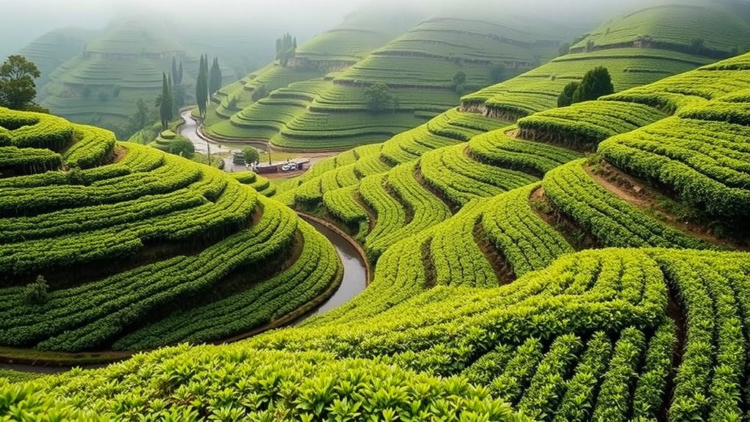
Beneath the rolling tea gardens of India’s Kangra Valley, an invisible ecosystem of bacteria, fungi and archaea is hard at work, sustaining one of the world’s most beloved beverages. A new metagenomic study has now catalogued this hidden biodiversity in unprecedented detail, sequencing millions of DNA fragments from the soil that clings to tea roots across four major tea-growing locations in the Himalayan foothills. The research offers the first comprehensive molecular portrait of the unculturable microbial life in the rhizosphere of Kangra’s tea plants, a community that had remained largely inaccessible to scientists who could only study the microbes willing to grow in a laboratory dish.
The rhizosphere, the narrow zone of soil influenced directly by plant roots, is one of the most dynamic habitats on Earth. It teems with microorganisms that govern nutrient uptake, promote growth, buffer plants against drought and disease, and maintain overall soil health. For tea, Camellia sinensis, this underground partnership is especially critical. Tea is grown almost exclusively in acidic soils that are naturally poor in available nutrients, which makes microbial nutrient cycling and root-zone activity decisive for productivity and leaf quality. Yet despite tea’s global economic importance, the structure and environmental drivers of its rhizosphere microbiome remain poorly characterised in many agroecological regions, and the Kangra Valley had never been examined at this scale.
To fill that gap, researchers collected rhizosphere soil from sixteen sites across four key locations in the valley: Baijnath, Dharamshala, Joginder Nagar and Palampur. Samples were taken from a depth of fifteen to twenty centimetres and pooled by location into composite samples representing each tea-growing region. From these soils, the team extracted total DNA and amplified two genetic barcodes: the V3-V4 hypervariable region of the 16S rRNA gene to profile bacteria and archaea, and the internal transcribed spacer regions of fungal ribosomal DNA to profile fungi. The libraries were sequenced on an Illumina MiSeq platform, generating a staggering 4,375,261 raw sequences. After stringent quality filtering and trimming, 2,614,107 reads remained, of which more than 1.7 million were assigned to bacteria, over 634,000 to archaea and nearly 217,000 to fungi.
The results reveal a microbial landscape that shifts dramatically from one valley location to the next. Proteobacteria emerged as the most abundant bacterial phylum everywhere, accounting for roughly 28 to 37 percent of bacterial reads depending on the site. Firmicutes, Actinobacteria, Bacteroidetes and Acidobacteria rounded out the dominant groups, though their relative proportions varied considerably. Dharamshala soils favoured Firmicutes and Bacteroidetes alongside Proteobacteria, while Baijnath showed a striking abundance of Actinobacteria at over 22 percent. Joginder Nagar stood out for a Firmicutes dominance approaching 35 percent, and Palampur hosted a more balanced mixture that included Verrucomicrobia. At finer taxonomic resolution, the classes Gammaproteobacteria, Betaproteobacteria and Bacilli dominated across the region, with orders such as Bacillales, Burkholderiales, Actinomycetales and Clostridiales varying in rank from site to site.
The fungal communities told a more uniform story. Eleven phyla were detected, and Ascomycota led in every location at around 45 to 46 percent of fungal reads, followed consistently by Basidiomycota at roughly 33 to 35 percent and Glomeromycota, the phylum containing the arbuscular mycorrhizal fungi that form celebrated symbioses with tea roots. Genera such as Penicillium and Trichoderma, both renowned for their ability to suppress soil-borne plant pathogens, were prominent members of the community. Palampur recorded the highest fungal generic richness with 196 genera, followed by Dharamshala with 189, Baijnath with 178 and Joginder Nagar with 159. The archaeal domain, often neglected in soil surveys, was surprisingly rich: Palampur yielded 1,022 archaeal operational taxonomic units, with unidentified archaea and the species Aeropyrum camini among the most common organisms found at all four sites.
Diversity statistics exposed intriguing contrasts between locations. Palampur’s bacterial community was the richest, with 211 observed species and a Chao1 estimated richness of 241.8, yet its low Shannon and Simpson indices of 1.75 and 0.52 revealed a strongly uneven distribution in which a few taxa dominated. Joginder Nagar presented the opposite pattern: its soils harboured only 79 bacterial species but supported them with striking evenness, producing the highest Shannon index of 2.46 and a Simpson index of 0.85. Beta diversity analysis reinforced the picture of a patchwork landscape. Bacterial communities differed markedly between sites, with Bray-Curtis dissimilarity values ranging from 0.4 to 0.8 and Jaccard distances reaching 0.82. Fungal communities were moderately differentiated, while archaeal assemblages proved remarkably consistent across the valley, with Bray-Curtis values as low as 0.12 to 0.25, suggesting that whatever forces shape bacterial turnover, the archaea persist in a more stable configuration.
The study also uncovered shared core microbiomes that bind the valley’s tea soils together. Seventy-five bacterial OTUs and 215 fungal elements were present at all four locations, indicating a common microbial backbone that likely underpins essential rhizosphere functions regardless of local conditions. Meanwhile, each site possessed its own unique residents: Baijnath alone contributed 104 bacterial elements found nowhere else in the survey, Dharamshala 50, Palampur 72 and Joginder Nagar 12. Principal component analysis, which combined diversity indices with soil physicochemical measurements, explained 85 percent of the total variation in the first two dimensions and pointed to specific soil properties as candidate drivers. Available nitrogen aligned positively with fungal diversity, while electrical conductivity and potassium tracked with archaeal diversity. Soil pH and organic matter showed moderate associations with bacterial diversity measures.
These ecological patterns carry real agricultural significance. Proteobacteria and Firmicutes include genera such as Pseudomonas and Bacillus, celebrated plant-growth-promoting rhizobacteria capable of solubilising nutrients, producing phytohormones and siderophores, and biocontrol of root pathogens. The prominence of Acidobacteria reflects long-term adaptation to the acidic, fertiliser-treated soils that decades of tea monoculture have produced. In China, researchers have documented that continuous tea cultivation depletes beneficial bacterial genera including Bradyrhizobium, Pseudomonas and Sphingomonas, and that long-term monoculture erodes microbial diversity overall. Comparable work in Darjeeling and Assam identified Proteobacteria, Actinobacteria and Acidobacteria as hallmark phyla of Himalayan tea soils, a pattern that the Kangra findings now confirm extends westward along the mountain range.
The authors are careful to note the limits of their survey. Each location was represented by a single composite sample, so within-site variability could not be assessed, and because only taxonomic information was gathered, the functional roles of the identified microbes remain hypotheses awaiting confirmation through shotgun metagenomics, metatranscriptomics or cultivation experiments. Correlations between soil properties and microbial diversity likewise do not establish causation, and factors such as tea cultivar, elevation, climate seasonality and management history may all contribute. Even so, the study delivers something Kangra previously lacked: a molecular baseline of its tea rhizosphere that complements an earlier culture-based inventory of the valley’s rhizobacteria. Together, these datasets sketch a foundation for microbiome-based strategies, from tailored biofertilisers to conservation of beneficial taxa, that could help one of India’s historic tea regions sustain its gardens, and its flavours, in a changing climate.
Subject of Research: Metagenomic analysis of bacterial, fungal and archaeal diversity in the tea plant rhizosphere of the Kangra Valley, Himalayan India
Article Title: Metagenomic Insights Into Microbial Diversity of Tea Rhizosphere of the Kangra Valley
Article References: Thakur, R., Dhar, H., Kiran, S., & Gulati, A. (2026). Metagenomic Insights Into Microbial Diversity of Tea Rhizosphere of the Kangra Valley. MicrobiologyOpen, 15(5), Article e70416. https://doi.org/10.1002/mbo3.70416
Image Credits: AI Generated
DOI: 10.1002/mbo3.70416
Keywords: metagenomics, tea rhizosphere, Kangra Valley, Camellia sinensis, microbiome, 16S rRNA, Proteobacteria, Ascomycota, soil health, plant growth-promoting rhizobacteria, archaea, acidic soils
Cite Scienmag News
APA
MLA
Chicago
Morgan Morrow. (September 26, 2026). Hidden Microbial World Beneath Himalayan Tea Gardens Revealed by DNA Sequencing. Scienmag. https://scienmag.com/hidden-microbial-world-beneath-himalayan-tea-gardens-revealed-by-dna-sequencing/
Morgan Morrow. “Hidden Microbial World Beneath Himalayan Tea Gardens Revealed by DNA Sequencing.” Scienmag, 26 September 2026, https://scienmag.com/hidden-microbial-world-beneath-himalayan-tea-gardens-revealed-by-dna-sequencing/. Accessed 26 September 2026.
Morgan Morrow. “Hidden Microbial World Beneath Himalayan Tea Gardens Revealed by DNA Sequencing.” Scienmag. September 26, 2026. https://scienmag.com/hidden-microbial-world-beneath-himalayan-tea-gardens-revealed-by-dna-sequencing/
Copy citation
Download RIS
Tags: 16S rRNAacidic soilsarchaeaAscomycotabiodiversity of archaea in tea garden soilsCamellia sinensisDNA sequencing of tea garden soil microbesHimalayan tea gardens microbial biodiversityimpact of soil microbes on tea plant growthKangra Valleymetagenomic analysis of tea plant rhizospheremetagenomicsmicrobial contribution to tea quality and yieldmicrobial nutrient cycling in acidic tea soilsmicrobial role in tea plant healthmicrobiomeplant growth-promoting rhizobacteriaProteobacteriasoil bacteria and fungi in Himalayan agriculturesoil healthsoil microbial communities in Himalayan foothillssoil microbiome in tea cultivationtea rhizosphereunderground ecosystem in Indian tea plantations