Cholesterol is one of the most famous molecules in medicine, blamed for heart attacks and clogged arteries, yet it is also an indispensable building block of every cell in the body. The intestine decides how much of it enters the bloodstream, and for two decades the protein NPC1L1 has been known as the gatekeeper of that process. It is the molecular target of ezetimibe, a widely prescribed cholesterol absorption inhibitor. Now, a team of Japanese researchers led by Yoshihide Yamanashi and Tappei Takada has revealed that NPC1L1 does far more than simply grab cholesterol from the gut. According to their study published in the journal iScience, the protein actively reshuffles cholesterol between the two halves of the cell membrane, a previously unrecognized function that could reshape how scientists think about cholesterol absorption and the drugs that block it.
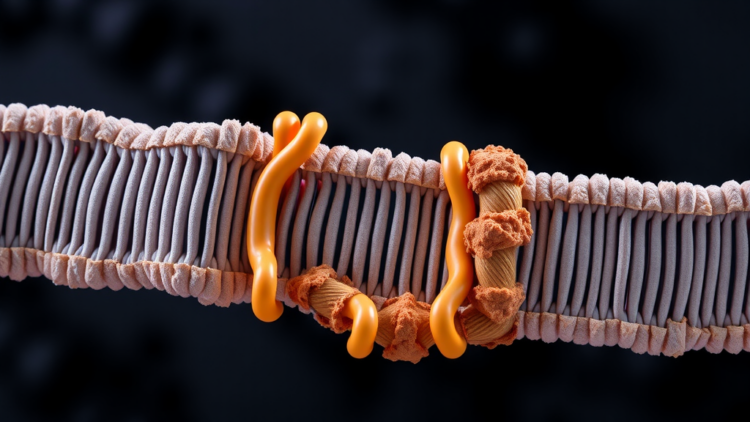
The cell membrane is a double layer of fatty molecules, and cholesterol within it is not evenly distributed. Biochemists now distinguish between accessible cholesterol, which floats freely and can interact with proteins, and inaccessible cholesterol, which is locked away by phospholipids such as sphingomyelin. Using sophisticated fluorescent probes derived from bacterial toxins, researchers have learned that the outer leaflet of the membrane generally holds far more accessible cholesterol than the inner leaflet, in some cases more than ten times as much. This asymmetry matters because intracellular lipid transfer proteins, including the GRAMD family, can only pick up cholesterol that is accessible on the inner side of the membrane. If dietary cholesterol is to travel from the cell surface to the endoplasmic reticulum without being packaged into vesicles, it must somehow cross from one leaflet to the other.
Yamanashi’s team hypothesized that NPC1L1 might be the factor that makes this crossing possible. Working with McA-RH7777 liver cells engineered to express the protein, they used two complementary probes: mCherry-tagged domain 4 of perfringolysin O, which labels accessible cholesterol in the outer leaflet, and a high-affinity variant called D4H that reports on the inner leaflet. The results were striking. Cells expressing NPC1L1 showed significantly reduced outer-leaflet cholesterol signal, while the inner-leaflet signal rose. In other words, the protein appeared to redistribute cholesterol from the outside of the membrane to the inside, making it available to the cell’s internal trafficking machinery.
Crucially, both effects vanished when the cells were treated with ezetimibe, and the inhibition was concentration-dependent, becoming evident at around two micromolar and reaching near-maximal levels at ten micromolar. Ezetimibe did not alter cholesterol distribution in control cells, and it had little effect on the total amount or membrane localization of NPC1L1 itself, ruling out nonspecific disruption of the membrane. Even a short one-hour exposure to the drug was enough to reverse the redistribution, suggesting the effect is direct rather than a downstream consequence of altered protein expression. The team confirmed the inner-leaflet findings with a second, independent biosensor called GFP-GRAM-W, which also showed increased inner-leaflet cholesterol in NPC1L1-expressing cells that was suppressed by ezetimibe.
One obvious alternative explanation was that NPC1L1 might simply be changing the amount of sphingomyelin in the outer leaflet, since sphingomyelin binds cholesterol and sequesters it. The researchers tested this using a fluorescent lysenin probe that specifically labels sphingomyelin, and found no difference between NPC1L1-expressing and control cells. This means NPC1L1 is a genuinely novel regulator of cholesterol asymmetry, working independently of the sphingomyelin shield. It also places NPC1L1 in a small and exclusive club. The cholesterol efflux transporters ABCA1 and ABCG1 are known to push accessible cholesterol from the inner to the outer leaflet, but no transporter had previously been shown to do the opposite.
To dissect the mechanism, the team turned to NPC1L1’s two specialized domains. The N-terminal domain, or NTD, is an extracellular region known to bind cholesterol directly. When the researchers introduced a mutation called L216A that cripples cholesterol binding in the NTD, the mutant protein still reduced outer-leaflet cholesterol and increased inner-leaflet cholesterol just like the wild-type protein, even though its ability to take up micellar cholesterol was severely impaired. However, when cells expressing either the wild-type or the mutant protein were fed cholesterol-containing micelles, only the wild-type cells showed an increase in outer-leaflet accessible cholesterol. This suggests the NTD’s job is to capture extracellular cholesterol and insert it into the outer leaflet, a process that ezetimibe only partially blocked.
The real star of the redistribution story turned out to be the sterol-sensing domain, or SSD, a conserved transmembrane region shared with other cholesterol regulators such as NPC1, HMG-CoA reductase, and the signaling receptor Patched 1. Mutations at two key cholesterol-binding residues within the SSD, L649R and a double mutation at G652 and S653, abolished the protein’s ability to lower outer-leaflet cholesterol and raise inner-leaflet cholesterol, while leaving protein expression and membrane localization intact. Both mutations also reduced cholesterol uptake, consistent with earlier work. Cryo-electron microscopy studies have shown that the SSD contains a tunnel structure that directly binds cholesterol, and the new functional data align neatly with that structural picture: cholesterol recognition by the SSD is required for NPC1L1 to control cholesterol accessibility across the membrane.
The findings also challenge the assumption that NPC1L1 works mainly through vesicular endocytosis, the pathway in which the protein is internalized along with its cholesterol cargo. A C-terminal mutation called Y1306A, known to impair cholesterol-dependent endocytosis, redistributed accessible cholesterol across the membrane just as effectively as the wild-type protein in the researchers’ experiments. This supports an emerging model in which non-vesicular transport plays a major role in cholesterol absorption. Recent work has shown that intestinal cholesterol absorption is reduced in mice lacking GRAMD1b and GRAMD1c, proteins that shuttle cholesterol from the inner leaflet of the plasma membrane to the endoplasmic reticulum. The new study fits this model perfectly: the NTD captures and inserts extracellular cholesterol into the outer leaflet, and the SSD then increases its accessibility on the inner leaflet, where GRAMD proteins can hand it off to the endoplasmic reticulum for esterification.
The implications extend beyond the gut. The researchers examined MDA-MB-231 breast cancer cells, which naturally express NPC1L1, and found that either ezetimibe treatment or genetic knockdown of the protein increased outer-leaflet cholesterol while decreasing inner-leaflet cholesterol, mirroring the overexpression experiments. This is intriguing because ezetimibe has been reported to suppress the migration and invasion of these very cells, and NPC1L1 expression has been linked to cancer malignancy. Since membrane cholesterol asymmetry influences cell proliferation and signal transduction, NPC1L1’s newly discovered role in cancer cells could open a fresh line of investigation into how membrane lipid organization shapes disease progression.
The authors are careful to note the limitations of their approach. The D4 and D4H probes measure cholesterol accessibility rather than absolute cholesterol amounts, and because cholesterol can spontaneously flip between leaflets, the study cannot yet prove that NPC1L1 directly mediates transbilayer movement rather than altering the membrane environment. Most mechanistic work was done in overexpressing cells, though the endogenous results in MDA-MB-231 cells argue against an artifact. Validation in intestinal models such as Caco-2 cells or organoids will be needed. Even so, the study delivers a compelling two-step model of a drug target that has been studied for twenty years, revealing that ezetimibe may work not only by blocking cholesterol capture but by scrambling the sterol-sensing domain’s control of membrane cholesterol, a mechanism that could inspire the next generation of cholesterol-lowering therapies.
Subject of Research: NPC1L1-mediated regulation of accessible cholesterol distribution between plasma membrane leaflets during non-vesicular cholesterol uptake
Article Title: Dual functions of NPC1L1 for cholesterol transport: Cholesterol capture and regulation of inner-leaflet cholesterol accessibility
Article References: Yamanashi, Y., Kitani, M., Kumamaru, M., Fukaya, T., Sugita, R., & Takada, T. (2026). Dual functions of NPC1L1 for cholesterol transport: Cholesterol capture and regulation of inner-leaflet cholesterol accessibility. iScience, 29(10), Article 117625. https://doi.org/10.1016/j.isci.2026.117625
Image Credits: AI Generated
DOI: 10.1016/j.isci.2026.117625
Keywords: NPC1L1, cholesterol, ezetimibe, plasma membrane, sterol-sensing domain, cholesterol absorption, accessible cholesterol, lipid asymmetry, GRAMD1 proteins, non-vesicular transport, cardiovascular disease, iScience
Cite Scienmag News
APA MLA Chicago
Denise Maddox. (September 25, 2026). Cholesterol Gatekeeper NPC1L1 Found to Reshuffle Membrane Cholesterol Between Leaflets. Scienmag. https://scienmag.com/cholesterol-gatekeeper-npc1l1-found-to-reshuffle-membrane-cholesterol-between-leaflets/
Denise Maddox. “Cholesterol Gatekeeper NPC1L1 Found to Reshuffle Membrane Cholesterol Between Leaflets.” Scienmag, 25 September 2026, https://scienmag.com/cholesterol-gatekeeper-npc1l1-found-to-reshuffle-membrane-cholesterol-between-leaflets/. Accessed 25 September 2026.
Denise Maddox. “Cholesterol Gatekeeper NPC1L1 Found to Reshuffle Membrane Cholesterol Between Leaflets.” Scienmag. September 25, 2026. https://scienmag.com/cholesterol-gatekeeper-npc1l1-found-to-reshuffle-membrane-cholesterol-between-leaflets/
Copy citation Download RIS
Tags: accessible cholesteroladvanced fluorescent probes in membrane studycardiovascular diseasecholesterolcholesterol absorptioncholesterol distribution between membrane leafletsCholesterol membrane dynamicscholesterol reshuffling mechanismezetimibeGRAMD1 proteinsimpact of ezetimibe on cholesterol regulationimplications for cardiovascular diseaseintestinal cholesterol absorptioniSciencelipid asymmetrymembrane lipid asymmetrynon-vesicular transportnovel functions of NPC1L1 proteinNPC1L1NPC1L1 cholesterol transportphospholipids and cholesterol interactionplasma membranerole of NPC1L1 in cell membranessterol-sensing domain